 Krishan Gopal Sharma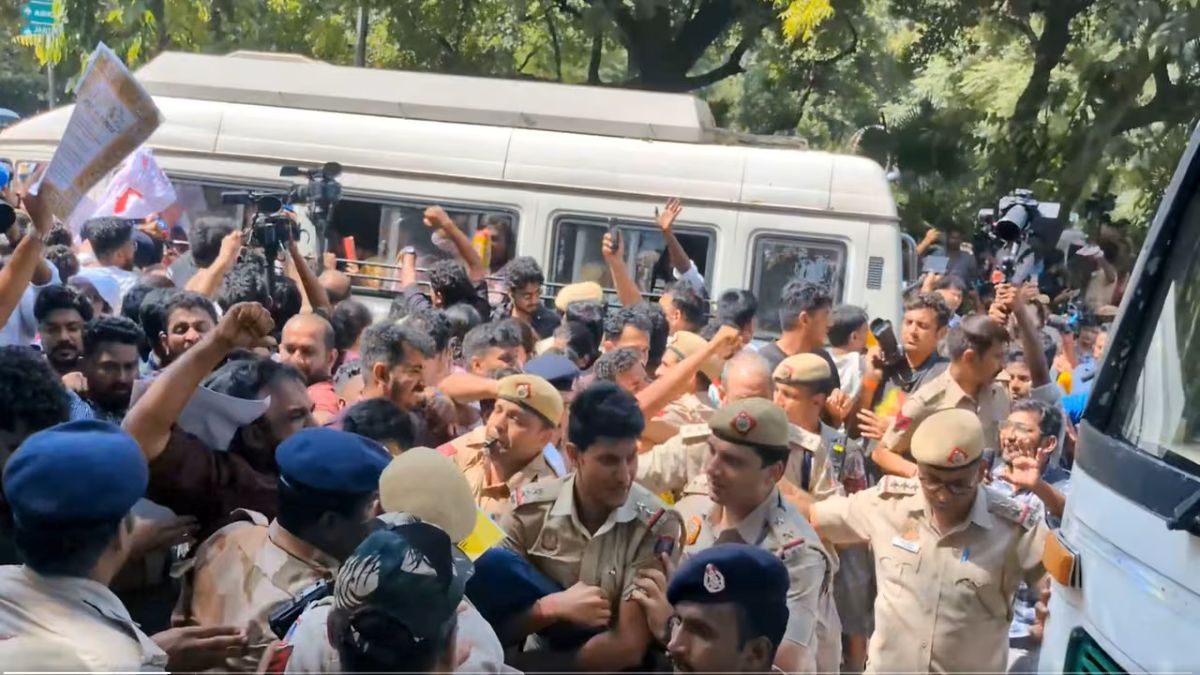
When a constitutional right becomes an administrative negotiation
A democracy is not tested only when people vote. It is tested when citizens disagree with those who govern them — and when that disagreement becomes inconvenient, noisy or politically uncomfortable. The Indian Constitution recognises the right of citizens to assemble peacefully, while also permitting reasonable restrictions in the interests of public order. The constitutional question, therefore, is not whether the State may regulate protest. It plainly can. The harder question is what happens when regulation becomes so discretionary that a right which exists in law becomes difficult to exercise in practice.
That is where the idea of the Permission State becomes worth examining. Democratic rights do not always disappear through dramatic acts of repression. They can be weakened more quietly — through permissions, prohibitory orders, route changes, restrictions on public spaces, administrative delays and decisions whose formal justification sounds reasonable but whose cumulative effect is to make dissent progressively harder. A right can remain perfectly visible in the Constitution while becoming increasingly negotiable at the administrative counter.
When dissent becomes an administrative problem
Governments have legitimate reasons to regulate public demonstrations. A large gathering can obstruct roads, affect hospitals and emergency services, create risks for residents and commuters, or become a flashpoint for violence. The State cannot simply stand aside and invoke constitutional freedom while public order collapses. Nor can protesters claim an unlimited right to occupy any public space indefinitely. The Supreme Court made precisely this point in its 2020 judgment concerning the Shaheen Bagh protests: public ways cannot be occupied indefinitely, but there is also a constitutional difference between reasonable regulation and arbitrary exclusion.
That distinction should be the starting point rather than an afterthought. The problem begins when the machinery created to regulate dissent acquires excessive discretion over whether dissent will be visible at all. A demonstration may be permitted but moved to an inaccessible location; a route may be altered until the protest loses its public character; permissions may become so cumbersome that only well-resourced organisations can navigate them; restrictions may be imposed selectively; or public infrastructure may be closed in ways that affect not only protesters but ordinary citizens. None of these measures, by itself, proves an authoritarian intent. Together, however, they raise a constitutional question: is the State regulating the exercise of a right, or gradually determining the practical conditions under which that right can exist?
The difference is not semantic. A constitutional right is supposed to constrain government power. An administrative permission is granted by government power. The more completely the latter determines the practical availability of the former, the more vulnerable the right becomes.
The quiet expansion of discretion
This is why the language of public order deserves careful scrutiny. Public order is a legitimate constitutional ground for restriction; it cannot become a universal administrative solvent into which every inconvenient exercise of freedom is dissolved. A restriction should have a lawful basis, pursue a legitimate purpose, be necessary for that purpose and remain proportionate to the harm it seeks to prevent. It should also be capable of independent review.
The principle is particularly important because the State does not always have to prohibit dissent outright. It can make dissent administratively exhausting. The citizen is still technically free to protest, but must negotiate a maze of permissions, conditions, locations, timings and police requirements. The right survives on paper while becoming increasingly conditional in practice.
There is another constituency that must not disappear from this discussion: people who are neither protesters nor officials. Residents have a legitimate interest in being able to reach their homes. Ambulances must move. Businesses cannot be expected to remain inaccessible indefinitely. Students, workers and commuters have rights too. A mature democracy therefore has to accommodate competing public interests rather than reducing every dispute to a battle between the State and the protester.
But accommodation requires judgment. If every inconvenience becomes sufficient reason to displace dissent, the easiest way to maintain public order will always be to remove the people causing the disturbance. Democracy would then reward silence simply because silence is administratively easier.
The police are not the government
This is where the question of policing becomes central. The police officer standing between a protest and the State is not supposed to be the political executive in uniform. The police are an instrument of constitutional government, not an extension of whichever government happens to be in office.
India has known this problem for a very long time. The Police Act of 1861 was designed in the aftermath of the 1857 uprising, and independent India never fully escaped the institutional inheritance of colonial policing. The Supreme Court's 2006 Prakash Singh judgment recognised the structural problem and issued directives intended to improve police accountability, security of tenure, separation of investigation from law-and-order functions and the functioning of police establishments and complaints authorities. Yet the fact that the Supreme Court has continued to deal with compliance decades later is itself revealing.
The issue is not that every police officer is politically compromised. Such a claim would be both unfair and impossible to sustain. The deeper concern is institutional: what happens to a police organisation when transfers, postings, promotions and professional prospects become vulnerable to political influence? An officer who believes that independence carries a career cost may not need to receive an explicit political instruction. Institutional incentives can do the work more quietly.
A striking contemporary example came in June 2026, when the Allahabad High Court, in Rajendra Tyagi and Others v State of U.P., criticised aspects of police functioning in Uttar Pradesh and spoke of a transfer-posting economy influencing official conduct. The court observed that the “vertical loyalty” of officers could run towards the ruling dispensation rather than the Constitution, and raised concerns about selective crackdowns, encounter killings and the use of the Gangsters Act against inconvenient individuals.
A judicial observation should not be turned into a sweeping indictment of an entire police force. It should, however, be taken seriously for what it reveals about the institutional vulnerability of policing to political incentives. The constitutional ideal is not a police force loyal to one political establishment or another. It is a police force loyal to law.
What obedience can — and cannot — explain
There is a useful psychological dimension to this discussion, although it needs to be handled with some caution. Stanley Milgram's famous obedience experiments demonstrated how readily ordinary people could continue an apparently harmful action when instructed by an authority figure. In the classic experiment, more than 60 per cent of participants proceeded to the maximum apparent shock level; later work replicated important elements of the obedience effect under carefully modified conditions.
The lesson is not that police officers, civil servants or soldiers are naturally inclined to brutality. That would be a crude misuse of the research. The more useful lesson is that institutions matter because authority can alter individual behaviour. People who would hesitate to exercise power on their own may behave differently when they believe the institution, hierarchy or superior has authorised the action.
The Stanford Prison Experiment has often been cited to make a related argument about institutional roles and power. But that study has also attracted substantial methodological criticism, making it unwise to treat it as settled proof that ordinary people inevitably become abusive when placed in positions of authority.
The broader point survives the controversy surrounding individual experiments: institutions can either restrain human impulses or amplify them. Rules, accountability, independent oversight and professional culture are not bureaucratic ornaments. They are safeguards against the concentration of discretionary power.
When neutrality becomes fragile
The danger becomes still greater when institutional discretion encounters social prejudice. The Status of Policing in India Report 2019, based on a survey of police personnel, found that about half of those surveyed considered Muslims “very much” or “somewhat” naturally prone to committing crimes. The report's own table recorded 14 per cent choosing “very much” and 36 per cent “somewhat”. It was an all-India survey, not a finding about Delhi police alone — an important distinction that should not be lost in argument.
A survey of attitudes cannot by itself establish discriminatory conduct in every police station or every case. But it does identify a serious institutional risk. Policing involves discretion: whom to stop, whom to question, whose complaint to prioritise, how much force to use, whether a situation is treated as dangerous or merely inconvenient. If social prejudice enters that discretionary space, the consequences can be far more serious than prejudice expressed in ordinary conversation.
India's history contains repeated reminders of what can happen when policing loses neutrality during communal conflict. The Justice B.N. Srikrishna Commission's inquiry into the 1992–93 Bombay riots, for example, documented failures of policing, political interference and communal bias within sections of the force. The existence of such commissions is itself a reminder that institutional safeguards become most important precisely when public passions are at their highest.
The answer is not to assume that every adverse police action against a member of a minority community is evidence of communal bias. That would replace one form of prejudice with another. The answer is to insist on evidence, transparency and procedures capable of exposing bias when it occurs.
When administration becomes punishment
The issue becomes more fundamental when administrative power crosses into punishment. An encounter killing justified as an administrative necessity, or the demolition of a person's property because a member of the household has been accused of a crime, raises a question that goes beyond policing: can the State impose consequences before the judicial process has established responsibility?
The Supreme Court has repeatedly emphasised the importance of due process in such matters. In 2024, while dealing with demolition practices, the Court made clear that alleged involvement in crime cannot by itself justify demolishing a legally constructed and occupied home. It subsequently laid down procedural safeguards governing demolitions, including notice and an opportunity to respond.
These safeguards are not technical obstacles placed in the path of an efficient State. They are precisely what separates constitutional government from government by administrative impulse. A house cannot become guilty because its occupant has been accused. A citizen cannot lose legal protection because the allegation against him is politically unpopular. Punishment is supposed to follow a lawful determination of responsibility, not replace it.
This is also why the language of an “executioner State”, while rhetorically powerful, can be misleading if used as a blanket description of contemporary India. The more useful question is whether particular institutions or practices create the possibility of executive punishment without adequate procedural protection. That possibility is serious enough without exaggeration.
The most dangerous consent
Perhaps the deepest danger lies not in the State's capacity to restrict dissent but in society's willingness to applaud it.
A citizen may tolerate restrictions on someone else's protest because the protest concerns an issue he dislikes. Another may approve when a disliked activist is arrested. A third may welcome a demolition because the occupant has been labelled a criminal. Each individual decision can be rationalised: They had it coming. Why should the authorities tolerate this? Why should taxpayers suffer inconvenience? Why worry about procedure when everyone knows what they have done?
That is how constitutional principles can erode without any formal amendment to the Constitution.
Rights are easiest to defend when they belong to people with whom we agree. Their real test comes when they belong to people we distrust, dislike or fear. The presumption of innocence, due process and freedom of peaceful assembly have little value if they are treated as privileges reserved for the respectable.
There is also a practical reason to resist this temptation. The State does not remain permanently under the control of the people who currently exercise it. Governments change. Political majorities change. Public enemies are redefined. A power created to silence one group can eventually be used against another. Constitutional restraints are therefore not concessions to today's dissenter. They are insurance for tomorrow's citizen.
A State strong enough to tolerate dissent
The strongest State is not necessarily the one that can disperse the largest crowd, shut the most roads or impose the fastest punishment. A stronger State may be one confident enough to tolerate disagreement without interpreting disagreement as disorder.
That does not mean allowing every protest to continue without limits. It means making the limits predictable, lawful and proportionate. It means providing alternative spaces rather than simply removing public visibility. It means ensuring that restrictions are based on demonstrable risks rather than political discomfort. It means subjecting administrative decisions to review. And it means ensuring that the police, whatever government is in power, understand their ultimate loyalty as being to the Constitution and the law.
The question, then, is not whether citizens should need permission to exercise every aspect of public life. Nor is it whether the State should be powerless in the face of disorder. The question is more uncomfortable: how much discretion should an administrative system possess before a constitutional freedom begins to depend on the goodwill of the administrator?
That is the point at which a democracy should become alert.
A democracy does not prove its strength by making dissent disappear. It proves its strength by remaining recognisably democratic when dissent becomes difficult to tolerate.
And perhaps the most important safeguard is a simple one: when the citizen stands before the State asking to exercise a constitutional freedom, the question should never become whether the State is generous enough to allow it. The question should be whether the State has sufficient constitutional reason to restrict it.
Author's Note
This essay is not an argument against the police, public-order regulation or the legitimate authority of the State. Democracies require all three. Its concern is narrower and more consequential: what happens when lawful regulation becomes excessive discretion, when administrative convenience begins to outweigh constitutional freedom, or when public approval encourages the State to bypass due process. The argument is therefore about institutional safeguards rather than political labels. A democracy remains secure not because those in authority are always benevolent, but because the Constitution places limits on what even well-intentioned authority may do.
<><><>
(Author: kgsharma1@gmail.com; The writer is a retired officer of the Indian Information Service and a freelance writer. Also worked as an international media consultant with UNICEF Nigeria and contributes regularly to various publications.)
Related Posts
FIR against RaGa,Priyanka over Akashvani Bhawan entry amid protest
CBI files FIR against OSD to Punjab CM, State moves to SC
Cong lies are biggest threat to democracy, wants to shield fake voters: BJP