 Uday Kumar Varma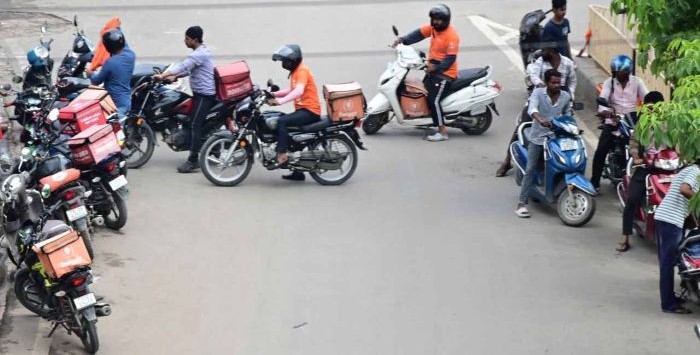
The doorbell rings. I look at my phone. Your order has arrived.
Outside stands a young man, helmet still on, perhaps sweating beneath it. He hands me the packet, waits for the OTP, gives me a faint smile and turns away. By the time I close the door, he is already back on his motorcycle, looking at his phone for the next assignment.
I rarely know his name. I do not know where he has come from, who is waiting for him at home, or how many hours he has already spent on the road that day. I know only that he has brought me what I ordered, and that he has done so quickly.
The little moving dot on my phone has acquired a human face.
The City Is His Workplace
There was a time when the delivery boy was the boy from the neighbourhood restaurant or bakery. Today, he is more likely to be a stranger summoned by an app and guided by an algorithm. He may bring us breakfast, medicines, groceries or dinner, sometimes from several kilometres away and often within minutes of our placing the order.
For millions of young Indians, the motorcycle has become more than a means of transport. It is their office, their shop and their livelihood. The gig economy has opened an avenue of work that requires relatively few formal qualifications and offers an immediacy that conventional employment often cannot. For someone who needs an income today rather than the promise of one tomorrow, that flexibility can be valuable.
But the freedom comes with a price. When the city becomes your workplace, every pothole, traffic signal, speeding vehicle and sudden shower becomes an occupational hazard.
Racing Against the Clock
We sometimes complain when a delivery is late. The rider knows better why it is late. The restaurant may have taken too long to prepare the order; traffic may have come to a standstill; a road may have been flooded; the customer may not have answered the phone. Meanwhile, somewhere on his screen, another clock is running.
The faster he completes one delivery, the sooner he can begin another.
A recent nationwide survey of platform workers by Janpahal and the Gig Workers Association of India puts some numbers to this daily reality. More than 57 per cent of the workers surveyed worked for over 49 hours a week, while nearly one in four worked for more than 70 hours. More than 62 per cent reported having experienced a near-miss with another vehicle, and 27.5 per cent had suffered a traffic accident while working.
These figures acquire a different meaning when one imagines the actual hours behind them: long stretches in traffic, under an unforgiving sun, through rain and pollution, with a motorcycle between the worker and the demands of earning a living.
More Than the Traffic
The hazards are not confined to accidents. There is the heat of an Indian summer, when the asphalt seems to radiate fire, and the sudden violence of the monsoon. There are winter mornings enveloped in fog and the polluted air of our larger cities. There is fatigue, accumulated over long hours of riding.
And then there are people.
Impatient motorists. Aggressive drivers. Customers who are abusive because an order is late or an address cannot be found. The rider is expected to remain courteous because the customer is king, even when the customer forgets that there is a human being on the other side of the transaction.
The survey found that 44 per cent of those questioned did not have accident insurance and 62 per cent had no health insurance. Sixty per cent had received no safety training from their platforms. For a worker whose livelihood depends upon being constantly on the move, such vulnerability is difficult to ignore.
Not All Heroes
Yet there is another side to the story, and it should not be ignored.
Not every delivery rider is a victim. Some ride recklessly, jump traffic signals, drive on pavements and endanger pedestrians. There are complaints of rude behaviour, fraudulent practices and, occasionally, theft and other criminal acts. Customers can sometimes have legitimate reasons to be aggrieved.
Economic vulnerability cannot become an excuse for wrongdoing. A humane society must protect its workers, but it must also expect responsibility from them. The uniform does not confer virtue, just as hardship does not confer immunity from the law.
The larger point, however, is that we should not allow the misconduct of some to make us indifferent to the vulnerability of many.
A Stranger at the Door
Perhaps what is most striking about this new relationship is how little we know about the person who serves us.
He may be twenty-two or thirty-two. He may have come from another town or another state. He may be supporting parents, a wife, children or siblings. He may be saving for a better motorcycle, a better job, or simply trying to get through the month. We do not know.
We see him for perhaps thirty seconds. Yet those thirty seconds are often enough to judge him: Why is he late? Why is he calling again? Why can’t he find the address?
Technology has made the transaction wonderfully seamless. It has not necessarily made the human connection any deeper.
The Journey Home
I sometimes wonder what happens after the last delivery.
The phone finally falls silent. The day’s earnings have been made. The motorcycle turns away from the bright apartment towers, restaurants and shopping complexes that have kept him moving all day. He is no longer a delivery partner or a moving dot on somebody’s screen. He is simply a young man going home.
Perhaps his family is waiting. Perhaps there is dinner. Perhaps a child wants to tell him something. Perhaps tomorrow morning he will put on the helmet again and return to the road.
And we will summon him again.
Perhaps, when the doorbell rings next time, we can pause for a moment before reaching for the packet. We can look at the person who has brought it to us, and say thank you. It costs nothing, but it acknowledges something that our remarkable digital economy sometimes makes us forget.
Behind every delivery is a human journey.
And for the man making that journey, the road is not merely a route between two addresses. It is his workplace, his livelihood and, for much of his waking life, his world.
(Uday Kumar Varma is an IAS officer. Retired as Secretary, Ministry of Information & Broadcasting)







Related Items
FIFA World Cup 2026: Portugal beat Croatia 2-1 after late VAR drama
Senegal suffer Cup exit after Belgium’s late comeback
Canada reach first World Cup last 16 with late win over South Africa