 Krishan Gopal Sharma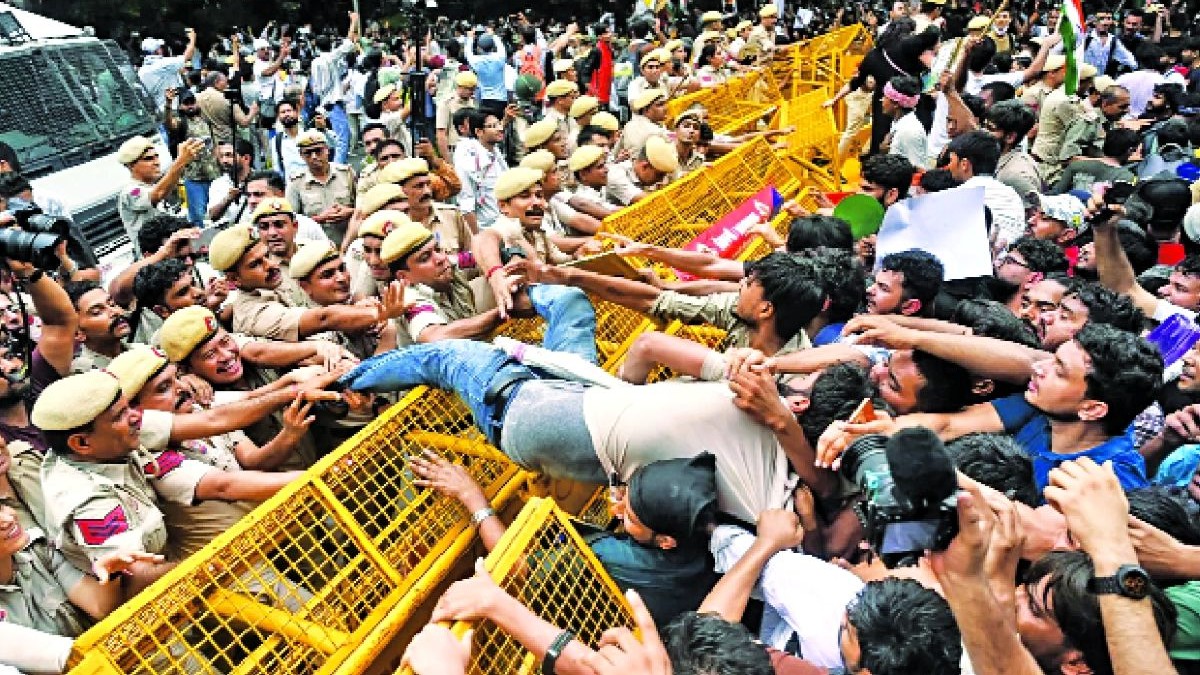
ADMINISTRATION MOBILISED AGAINST COCKROACH INSURGENCY
New Delhi | Special Correspondent
NEW DELHI: The National Capital Region woke up to barricades, emergency advisories and an unprecedented deployment of security personnel this morning after the Ministry of Home Affairs confirmed a “significant tactical movement” by Blattodea, known to ordinary citizens as the cockroach, or tilchatta.
Barricades appeared along major roads from Connaught Place to Noida. Residents were advised to remain indoors, secure their steel dabbas and avoid approaching any unidentified creature displaying more antennae than the authorities considered strictly necessary. The government assured the public that there was no reason to panic, an assurance that was immediately followed by a second advisory asking citizens not to panic even if they had already begun to do so.
“We are dealing with a highly organised and psychologically sophisticated adversary,” said a visibly shaken Delhi Police Joint Commissioner from inside an armoured vehicle parked at a reassuring distance from the alleged theatre of operations. “Last night, a patrol encountered a cockroach near Khan Market. Our personnel ordered it to disperse. It refused. It raised its antennae and continued in the direction of the drain. We cannot rule out a deliberate attempt to undermine police authority.”
Asked whether the insect had made any threatening movement, the officer said that the matter was under investigation. A special committee had been constituted to establish whether the antennae were being used for communication, surveillance or what officials described as “provocative non-verbal signalling”.
The present emergency follows an earlier infestation that, according to an internal note, caused significant disruption to senior administration. The note recorded two casualties: a junior official who sprained both ankles while attempting to climb onto a plastic chair, and a joint secretary who fainted into a bowl of butter chicken. The latter incident was subsequently classified as a food-safety matter, apparently because the department responsible for recording insect-related casualties had no appropriate category for gravy.
The Chief Minister addressed the capital from a secure location in Civil Lines, wearing what aides described as a pollution mask adapted for biological defence. “The government is committed to a peaceful and negotiated settlement,” the Chief Minister said. “We have offered the cockroaches administrative responsibility for the Municipal Corporation, subject to satisfactory performance against agreed sanitation targets. We await their response.”
There was no immediate confirmation that the cockroaches had received the offer. Officials said that a communication channel was being established, although the department responsible for receiving correspondence had temporarily suspended work after an unidentified insect was seen near its reception desk.
THE JANTAR MANTAR CONUNDRUM: INSURGENCY OR BLACK MAGIC?
The situation took a more disturbing turn when intelligence agencies traced what they believed to be the insects’ command centre to Jantar Mantar, the historic astronomical observatory that has also served as a familiar venue for public protests.
The discovery raised fresh questions in the corridors of power. Some officials wondered whether the cockroaches had merely selected the site for its location. Others suspected that its name, combining the ideas of instruments and calculation, concealed an altogether more sinister purpose. By lunchtime, the distinction between astronomy, mathematics and the occult had become a matter of national security.
“They are moving in geometrically precise formations,” disclosed a senior source familiar with the investigation. “They appear to understand angles, shadows and celestial alignments. We have not yet established whether this indicates advanced scientific knowledge or an unusually ambitious pest-control problem.”
A team of negotiators sent to the site reportedly found several cockroaches gathered near an astronomical instrument. Their movements were described as “rhythmic”, though a subsequent briefing admitted that the team had not been able to distinguish between chanting and the ordinary clicking associated with insects.
The Home Ministry is understood to be considering three options: deploying additional paramilitary personnel, commissioning a scientific study, or consulting specialist tantriks. The scientific option has encountered resistance on the grounds that a report might take several weeks, whereas the public expects visible action before the evening news. The proposal to engage occult specialists has progressed more rapidly, partly because their representatives have already submitted a detailed presentation, complete with a quotation for emergency services.
The government has denied that the investigation is being influenced by superstition. It has also declined to explain why the proposed committee on occult activity will have a chairperson, two vice-chairpersons and a subcommittee on interdepartmental coordination.
THE REAL FRONT LINE: THE INDIAN KITCHEN
While officials debated the metaphysical implications of antennae, a rather less dramatic operation was under way in kitchens across Delhi. There, the cockroach has long been a familiar adversary, requiring no intelligence assessment, diplomatic channel or press conference. It arrives without invitation, ignores the household's carefully maintained hierarchy and disappears just when the person holding the slipper is ready to act.
Mrs Sharma, president of the Greater Kailash United Kitchen Defence Front, was unimpressed by the government's response. When contacted by this newspaper, she was rolling out parathas and had apparently not received the emergency advisory.
“They have put barricades on the roads because one cockroach was seen near Khan Market?” she asked. “We see them in the kitchen every monsoon. Sometimes they run. Sometimes they climb the wall. And sometimes, just when you think the matter is settled, one of them opens its wings and flies straight at your face. That is when all your education, position and good manners leave the room together.”
She paused to turn a paratha.
“Of course, you scream. Everyone screams. But then you pick up the belan and finish the job. You don't call a committee.”
Mrs Sharma's daughter-in-law, who had joined the conversation, added that the household had developed a practical division of responsibilities. One person watched the insect, another secured the food, and a third stood ready with a slipper. There were no written protocols. Everyone knew what to do. The arrangement had survived several monsoons without a single interdepartmental meeting.
Asked whether the family might consider offering its services to the government, Mrs Sharma said she would first need to know the proposed remuneration. She was not prepared to undertake a national assignment at domestic rates.
The exchange has attracted considerable interest from advertising agencies, which have begun exploring the commercial possibilities of the crisis. One proposed campaign features a homemaker confronting a flying cockroach with the slogan: “Governments negotiate. Mothers get the job done.” Another suggests that the household slipper should be declared a strategic asset.
The Cockroach High Command, meanwhile, is reported to have issued an advisory instructing its troops to avoid residential kitchens. The document, if authentic, describes the Delhi Police as “unpredictable under pressure” but warns that a householder defending a spice box should be regarded as a high-risk operational environment.
The report could not be independently verified. However, sources close to the kitchen front say the warning is sensible.
A WORD FROM OUR SPONSORS
No modern crisis is complete until somebody discovers a product category.
Bharat's advertising industry has moved swiftly to reassure the public that, although the government may be uncertain about the nature of the enemy, the market is already prepared to defeat it.
Enter Bharat Squadron Pest Control and its new Laxman Rekha Ultra-Max range, advertised as offering “advanced protection against ordinary pests, extraordinary pests and pests with unexplained spiritual affiliations”. The campaign features a solemn gentleman in a crisp Nehru jacket holding a can of insect spray with the gravity of a soldier displaying a newly commissioned weapon.
The accompanying slogan reads: “Keep Calm. Aim Carefully. Spray Responsibly.”
A special festive package promises protection for the rasoi, the storeroom and, subject to additional charges, the immediate vicinity of the family deity. The company has declined to explain how its product distinguishes between a cockroach and an occult manifestation, but insists that the formulation has undergone rigorous testing.
Orders can be placed through quick-commerce platforms. Customers are advised, however, that delivery may be delayed in areas where the cockroaches have established what the company describes as “a temporary territorial advantage”.
A spokesperson assured us that the product was safe, effective and entirely unrelated to the present emergency. The company had begun developing it several months before the outbreak, which was fortunate, as it had not previously found a sufficiently compelling reason to advertise it.
MARKET WATCH: FEAR IS A GROWTH INDUSTRY
The corporate sector has also responded with characteristic speed. Where the administration sees an emergency, the market sees an unmet demand. Where the citizen sees a cockroach, an entrepreneur sees a customer who has not yet been properly monetised.
Real estate platforms have introduced a Chitin Probability Index to help buyers assess the likelihood of encountering insects in their prospective homes. Ground-floor properties in Greater Kailash have reportedly suffered a decline in enquiries, while high-rise apartments in Gurugram are being promoted as offering superior vertical security.
“Cockroaches have not yet demonstrated the ability to operate lifts,” a property consultant explained. “Our clients are paying for peace of mind.”
Asked whether insects might enter through drains, pipes or ventilation ducts, the consultant said the company was developing a premium advisory service to address such concerns.
A Gurugram start-up has announced iCrush Pro, an artificial-intelligence-enabled, blockchain-backed jutti designed to calculate the optimal angle, pressure and trajectory for crushing a cockroach. The basic subscription costs ₹79,999 a month. A spokesperson said the product would eliminate the need for “unstructured, emotionally driven pest intervention”. The company is currently seeking investors who have not yet asked why a slipper requires a blockchain.
Not to be outdone, a leading lifestyle retailer has reportedly explored a bio-defence collection made from organic khadi cotton. The proposed range includes tailored protective suits, insect-resistant travel accessories and a festive ensemble for those who prefer to face an emergency without compromising their personal aesthetic.
The collection's working slogan is “Fear, but make it fashion.”
Meanwhile, the government has announced that a task force will study the economic impact of the infestation. Its terms of reference include the effect on housing prices, consumer confidence, delivery services and the emerging market for insect-resistant luxury goods. No provision has yet been made to assess the cost of the task force itself.
THE LATEST FROM THE CAPITAL
10.15 am: The Delhi Metro has received a request from an unidentified organisation seeking permission to reroute part of the Yellow Line. The application was rejected because the applicant had failed to provide proof of identity. Officials declined to say whether the application bore a signature or a set of antenna marks.
11.30 am: A senior police officer was photographed wearing cardboard antennae near Janpath. The department described the exercise as an attempt to understand the adversary's perspective. The officer was later removed from the field after attempting to enter a restricted area by crawling beneath a barricade.
12.05 pm: Several residents were seen throwing lemons and chillies near an affected intersection. Police said they were investigating whether the objects were intended as protective charms, improvised weapons or refreshments for the assembled personnel.
1.20 pm: A quick-commerce platform announced that insect spray could be delivered in seven minutes, provided customers were located outside the restricted zone. Delivery partners have reportedly refused to cross the perimeter. The company is considering an additional incentive for riders willing to undertake what it calls “high-exposure assignments”.
2.00 pm: The Home Ministry confirmed that the situation was under control. Asked why barricades remained in place, a spokesperson explained that the operation had entered a “consolidation phase”. Asked when normal traffic would resume, the spokesperson said the matter required further consultation with the relevant stakeholders.
The cockroaches were unavailable for comment.
THE FINAL BRIEFING
By evening, the capital had acquired all the familiar features of a major emergency: a security perimeter, a control room, several competing explanations, a growing market for protective products and a committee empowered to recommend the formation of another committee.
The original cockroach had not been located.
Officials insisted that its disappearance did not indicate a failure of the operation. On the contrary, they said, it demonstrated the effectiveness of the containment strategy. The absence of visible insects was being treated as evidence of success, although the possibility that the cockroach had simply gone home remained under consideration.
Mrs Sharma, reached once more by telephone, said she had finished her household work and was preparing dinner.
“Has the government caught it?” she was asked.
“Which one?” she replied.
At the time of publication, the administration was seeking clarification.
The capital remained on alert.
Author's note: This is a work of fiction and satirical exaggeration. It uses an imaginary cockroach emergency to examine institutional panic, bureaucratic procedure and the commercial exploitation of public anxiety. The invented incidents, statements and commercial initiatives are not reports of actual events. Any resemblance to real administrative habits is unintended—or, as the case may be, a matter for the relevant committee.
<><><>
(Author: kgsharma1@gmail.com; The writer is a retired officer of the Indian Information Service and a freelance writer. Also worked as an international media consultant with UNICEF Nigeria and contributes regularly to various publications.)

Related Posts
FIR against RaGa,Priyanka over Akashvani Bhawan entry amid protest
INDIA bloc protest march against CEC, several leaders detained
AAP workers detained at Jantar Mantar amid SIR protest