 Newsinc24 Team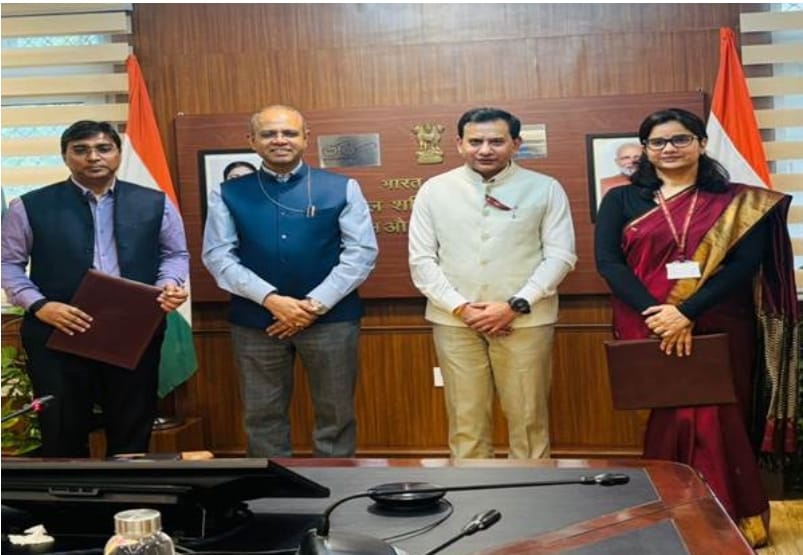
Reform-linked Memoranda of Understanding (MoUs) have been signed under Jal Jeevan Mission 2.0 with Gujarat, Haryana, Himachal Pradesh, Chhattisgarh and Goa, marking a significant step towards strengthening rural drinking water service delivery through a community-driven and accountable framework.The agreements were formalised during a series of virtual meetings convened by the Department of Drinking Water and Sanitation, with Union Jal Shakti Minister C. R. Patil participating in each session. Senior officials from the Centre and states outlined commitments on service delivery, institutional reforms and community participation, with state water departments completing the signing process to operationalise reform measures.
The MoU signings saw participation from key political and administrative leaders across states. In Gujarat, Chief Minister Bhupendra Patel and Minister of State for Water Supply and Water Resources Ishwarsinh Patel were present. Haryana’s meeting included Chief Minister Nayab Singh Saini and Public Health Engineering Department Minister Ranbir Gangwa. In Chhattisgarh, Chief Minister Vishnu Deo Sai and Deputy Chief Minister Arun Sao participated, while Himachal Pradesh was represented by Chief Minister Sukhvinder Singh Sukhu and Deputy Chief Minister Mukesh Agnihotri. Goa Chief Minister Pramod Sawant and Minister for Water Resources Subhash Phal Dessai also joined the proceedings, alongside senior bureaucrats from both Centre and states.
The revamped mission is being positioned as a shift towards assured water supply, long-term functionality and sustainability, with greater emphasis on Gram Panchayat-led governance and local ownership. The National Jal Jeevan Mission reiterated the importance of transparency, accountability and adherence to quality standards, while maintaining a zero-tolerance stance on corruption.State-specific approaches were highlighted during the discussions. Gujarat’s execution capacity, Haryana’s technology-driven coordination, Himachal Pradesh’s geographical and climatic challenges, and Chhattisgarh’s focus on improving coverage in lagging districts were noted. Goa was recognised for maintaining progress in ensuring reliable water supply despite saline coastal conditions.
The MoUs mandate a service-based, community-centred governance model, with a strong focus on operation and maintenance systems, source sustainability and last-mile connectivity. States have committed to ensuring financial sustainability through local participation and context-specific solutions, particularly in difficult terrains and extreme weather conditions.Officials from the department indicated that technical, institutional and capacity-building support will be extended to empower Gram Panchayats to manage operations and, where appropriate, levy user charges to sustain services.
Monitoring of water quality, system functionality and sustained service delivery will remain a key focus area under the agreements. The initiative also emphasises multi-village schemes, recharge measures and strengthened monitoring systems to ensure long-term asset sustainability and equitable coverage.The programme has been extended until December 2028 with an enhanced financial outlay, providing a framework for long-term reforms aimed at ensuring reliable rural drinking water services. Officials underlined that continued Centre-state collaboration will be crucial in achieving water security goals aligned with the broader vision for developed India by 2047.








Related Items
India confronting West Asia crisis with full strength: PM Modi
Hockey India Awards: Navneet, Hardik named Players of the Year
France plans G7 Summit with India, Brazil, Kenya- China not invited