 Ira Singh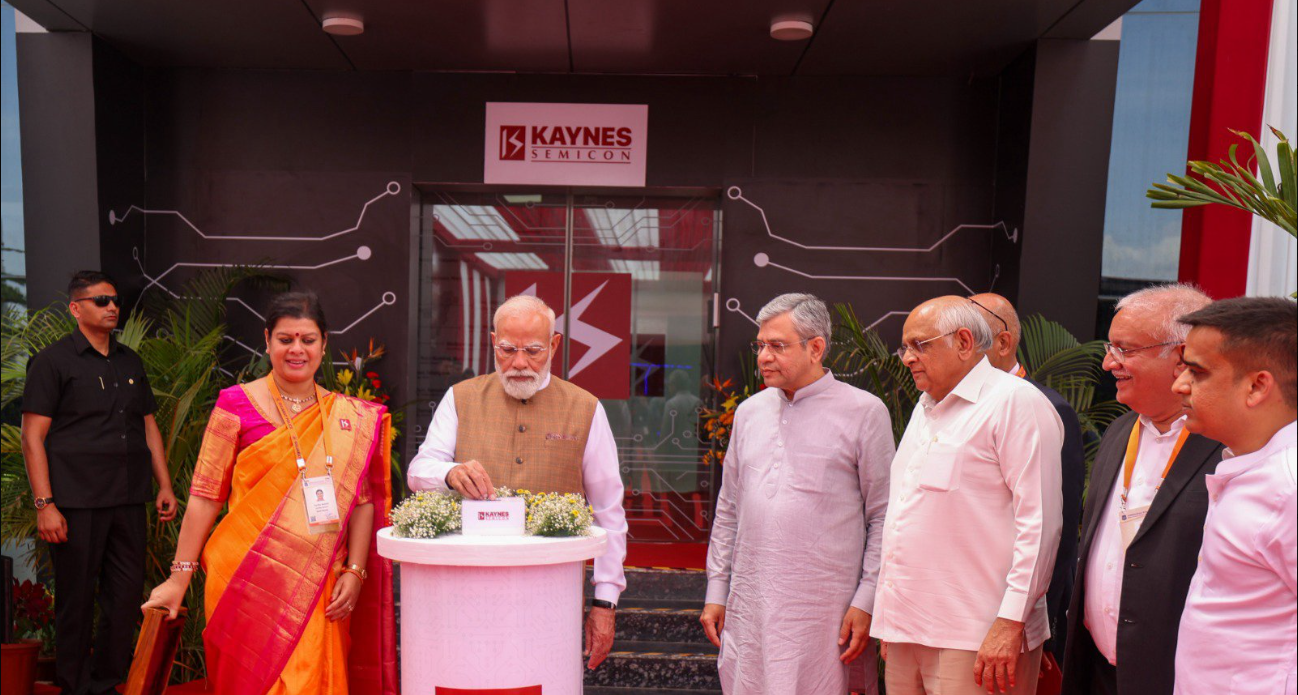
PM Narendra Modi on Tuesday inaugurated a semiconductor facility of Kaynes Technology India Limited in Sanand, Gujarat, marking the commencement of production and reinforcing India’s ambitions to build a robust domestic chip ecosystem.Highlighting the rapid progress in the sector, the Prime Minister referred to his recent visit to Sanand on February 28 for the inauguration of Micron Technology’s facility, noting that back-to-back milestones signal strong momentum in India’s semiconductor journey.
According to information,the Kaynes plant will manufacture Intelligent Power Modules used in electric vehicles and industrial applications, with a significant portion of output aimed at export markets. Officials said the facility is already integrated into global supply chains, linking domestic manufacturing with international demand.Emphasising policy support, Modi said the India Semiconductor Mission, launched in 2021, is driving investments across the value chain, with 10 projects worth over Rs1.6 lakh crore currently underway across six states. He added that India is positioning itself as a reliable semiconductor supplier amid global supply chain disruptions impacting electronics, energy, and advanced manufacturing sectors.
The inauguration of the Kaynes Semicon facility strengthens India’s push towards self-reliance. It marks an landmark step in building a robust semiconductor ecosystem. https://t.co/hJOo5srmOS
— Narendra Modi (@narendramodi) March 31, 2026
Citing industry projections, the Prime Minister noted that India’s semiconductor market, currently valued at around $50 billion, is expected to surpass $100 billion by the end of the decade. He also highlighted the next phase of the mission, which aims to strengthen domestic capabilities in semiconductor equipment, materials, and critical raw supply chains under initiatives such as the National Critical Minerals Mission.On the technology front, he pointed to the development of the indigenous ‘Dhruv 64’ microprocessor and ongoing efforts to strengthen chip design and manufacturing capabilities. He added that nearly 85,000 semiconductor design professionals are being trained, with programmes across close to 400 institutions already enabling the development of over 50 chips.
Four Semiconductor Plants by 2026: Vaishnaw
Union Minister Ashwini Vaishnaw said four semiconductor plants are expected to be ready in India by 2026, with two more slated for 2027 and the country’s first fabrication unit in Dholera targeted for completion by 2028.He noted that the Sanand unit is the second semiconductor plant inaugurated within a month, with a third facility scheduled for launch in July. Highlighting the pace of execution, Vaishnaw said the Kaynes plant moved from foundation to commercial production in just 14 months.The minister added that around 60,000 engineers have been trained in advanced chip design tools such as Synopsys and Cadence, with contributions from 315 universities. He also noted that global firms including Nvidia, AMD, and Intel are undertaking advanced chip design work in India, including cutting-edge 2-nanometre technologies.
#WATCH | Sanand, Gujarat: Union Minister Ashwini Vaishnaw says, "Today is a day of pride for India. Today the second semiconductor plant has been inaugurated here in Sanand. Last month on February 28, the first plant was inaugurated, and today the second plant has been… pic.twitter.com/1bXmRA2B2v
— ANI (@ANI) March 31, 2026
Chief Minister Bhupendra Patel said Gujarat is rapidly emerging as a hub for next-generation technologies, with Sanand and Dholera poised to develop into a “semiconductor valley.”He highlighted initiatives such as the establishment of an Advanced Material Centre, introduction of semiconductor-focused courses, and improvements in logistics infrastructure. Gujarat’s semiconductor policy, introduced in 2022, has further strengthened the state’s position as a preferred destination for high-tech investments.
Sanand, Gujarat: CM Bhupendra Patel says, "Under the visionary leadership of Prime Minister Narendra Modi, a strong semiconductor ecosystem is taking shape in Sanand and Dholera today..."
— IANS (@ians_india) March 31, 2026
(Source: CMO Gujarat) pic.twitter.com/JqaxEa6Fex
Later in the day, the Prime Minister laid the foundation stone and inaugurated multiple development projects worth over Rs20,000 crore in the Vav–Tharad region.A key highlight was the inauguration of the Ahmedabad–Dholera Expressway, an access-controlled corridor built at a cost exceeding Rs5,100 crore, expected to significantly enhance connectivity to the Dholera Special Investment Region and boost industrial growth.Additional projects included the foundation stone for the 4-lane Idar–Badoli bypass and the upgradation of the Dholavira–Mauvana–Vauva–Santalpur stretch of NH-754K, aimed at improving connectivity to key regions and tourist destinations such as Dholavira.
#WATCH | Vav-Tharad, Gujarat: Prime Minister Narendra Modi lays the foundation stone, inaugurates, and dedicates to the Nation multiple development projects worth more than Rs 20,000 crore.
— ANI (@ANI) March 31, 2026
These projects span key sectors including Power, Railways, Road Transport & Highways,… pic.twitter.com/5N9R264SPH
The broader set of initiatives spans power, transport, railways, healthcare, urban and tribal development, tourism, and water infrastructure, reflecting a comprehensive push to strengthen connectivity, drive economic growth, and improve quality of life across Gujarat.
(State Correspondent)


_(5).jpg)







Related Items
Agri GVA rises to Rs 52.08 lakh cr as India's farm economy expands
India's retail inflation rises to 4.45% in July on food prices
Nearly 25 children dead in Gujarat as Chandipura virus returns