 Ira Singh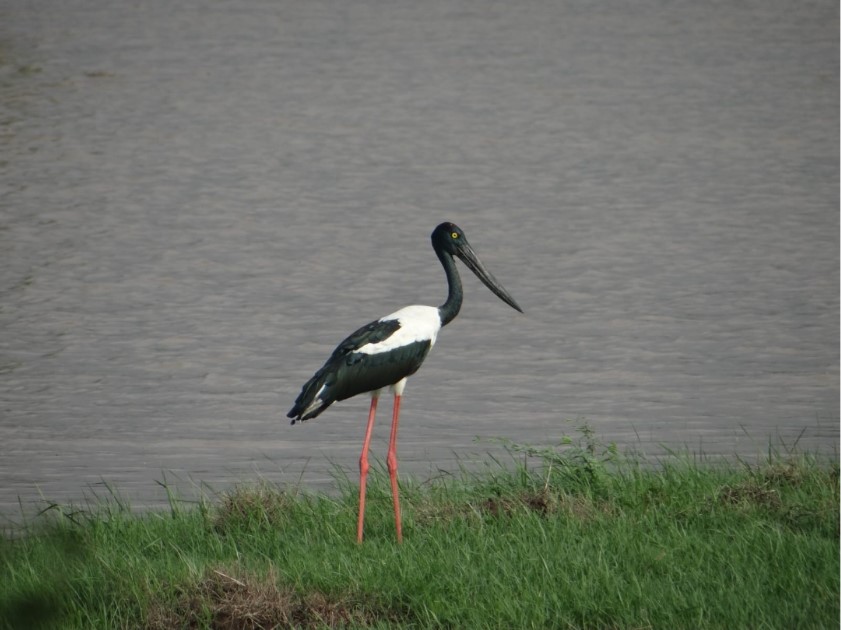
Khijadiya Bird Sanctuary in Jamnagar has emerged as an important breeding ground for the Black-necked Stork, with a new scientific study confirming four active nests and a 100 per cent fledging success during the 2024-25 breeding season.
The study by researchers from the Gujarat Ecological Education and Research (GEER) Foundation found that each of the four breeding pairs successfully raised two chicks, resulting in eight fledglings. Along with five regularly observed non-breeding adults, the sanctuary recorded a peak seasonal population of 21 Black-necked Storks.Published in the peer-reviewed Journal of Threatened Taxa, the study examined the species’ population status, breeding ecology, nest characteristics and reproductive performance between July 2024 and March 2025.
Researchers conducted field surveys across 48 georeferenced sampling points in eight management zones, combining nest monitoring, behavioural observations and habitat assessments. The exercise generated more than 320 hours of observation data.The findings show that Khijadiya offers several conditions crucial to the species’ breeding success, including shallow wetlands, aquatic prey, emergent vegetation, suitable nesting trees and relatively undisturbed areas. All four nests were built on Neltuma juliflora, commonly known as gando baval, at heights of three to 4.5 metres.While the Black-necked Stork is traditionally associated with large native trees such as acacias and figs, the study indicates that the species can adapt to structurally suitable invasive trees where native nesting sites are limited.
A breeding cycle marked by remarkable parental care
Breeding activity began with behavioural changes in August and September, followed by nest construction in early October. Eggs hatched between late October and early November, with chick-rearing continuing through December before the young fledged by the end of the year.The study also recorded striking parental coordination. During 89 nest-monitoring visits, adult storks remained at their nests for an average of 62 minutes per visit. In 94 per cent of observed foraging departures, one parent returned to replace the other at the nest, ensuring continued protection and care of the chicks.Researchers recorded no nest abandonment, predation or chick mortality during the monitoring period. All four nests produced fledglings, giving the sanctuary a 100 per cent fledging success rate.“The study also highlighted the strong parental commitment exhibited by the species,” said B.P. Pati, Director, GEER Foundation. He said the four active nests each produced two fledglings, resulting in eight juveniles.
The sanctuary’s stable hydrological conditions, abundant prey and relatively low human disturbance are believed to have contributed to the successful breeding. The nesting sites were located near shallow wetlands with water depths of 0.3 to 0.7 metres, surrounded by a mix of open water, emergent vegetation and elevated ground.These habitats provide fish, amphibians, crustaceans and aquatic invertebrates that are vital for breeding adults and growing chicks. Juveniles were also observed seeking food from their parents after fledging, highlighting the species’ prolonged parental care and gradual transition towards independent foraging.
Forest and Environment Minister Arjun Modhwadia congratulated the GEER Foundation research team, saying the findings would help develop more focused conservation measures. Minister of State for Forests and Environment Pravin Mali said the state government had taken several steps to protect Gujarat’s natural heritage, including the Ramsar-designated Khijadiya Bird Sanctuary.
Exciting news from Khijadiya Bird Sanctuary! ????
— Arjun Modhwadia (@arjunmodhwadia) August 25, 2026
A new study by the GEER Foundation confirms the Ramsar Site in Jamnagar has become a major stronghold for breeding Black-necked Storks. ????
Researchers documented 4 active nests within the sanctuary. Every pair successfully raised… pic.twitter.com/FEtHDdOrj7
Principal Chief Conservator of Forests (Wildlife) Jaipal Singh said the study underscored that successful breeding depends not merely on water but on a combination of feeding grounds, aquatic prey, nesting trees, shallow water, vegetation and undisturbed sites.Located along the Central Asian Flyway, Khijadiya Bird Sanctuary combines freshwater and saline habitats and supports a rich diversity of resident and migratory birds. The latest findings add another dimension to its ecological importance, confirming the sanctuary as a significant breeding stronghold for the Black-necked Stork in western India.The Black-necked Stork is listed under Schedule II of the Wild Life (Protection) Act, 1972, following the 2022 amendment.
(State Correspondent)

Related Posts
Yadav urges forest officers to balance development with conservation
Kuno welcomes 5 cheetah cubs, marking new Botswana lineage
Gujarat revamps Porbandar forest division for Barda lion rehabilitation