 Newsinc24 Team
In a breakthrough that could transform cancer diagnosis and treatment, Indian scientists have developed an artificial intelligence (AI)-based tool capable of identifying hidden cancer stem-like cells that often escape conventional therapies and trigger tumour recurrence.
According to official statemet,researchers from the S. N. Bose National Centre for Basic Sciences (SNBNCBS), an autonomous institute under the Department of Science and Technology (DST), in collaboration with Ashoka University, have developed an AI framework called ACSCeND (AI-based Cancer Stem-like Cell Profiler and Neoplasm Deconvoluter).The new system can identify three distinct developmental states of cancer stem-like cells—pluripotent-like, multipotent-like, and unipotent-like, providing researchers with a deeper understanding of tumour behaviour and bringing precision medicine a step closer, particularly in regions with limited healthcare facilities.
Cancer stem-like cells have long been considered one of the most challenging aspects of cancer research. Although modern therapies can eliminate millions of cancer cells, a small population often survives, enabling tumours to return, spread to other organs and develop resistance to treatment.Scientists have believed for years that these rare cells are responsible for tumour recurrence, metastasis and treatment failure. However, their ability to continuously change their identity and their extremely low numbers have made them difficult to detect accurately.
The research team, led by Dr. Shubhasis Haldar, built ACSCeND on the foundation of its earlier AI platform, OncoMark, which decoded the biological mechanisms driving cancer progression across millions of cells with more than 99 per cent predictive accuracy.Unlike conventional approaches that assign tumours a single "stemness" score, ACSCeND provides a more detailed analysis by identifying multiple developmental states of cancer stem-like cells. The framework combines insights gained from high-resolution single-cell sequencing with deep-learning algorithms to analyse conventional tumour RNA sequencing data.This approach allows researchers to study hidden cancer cell populations in thousands of patient samples, even when advanced single-cell sequencing data are unavailable.
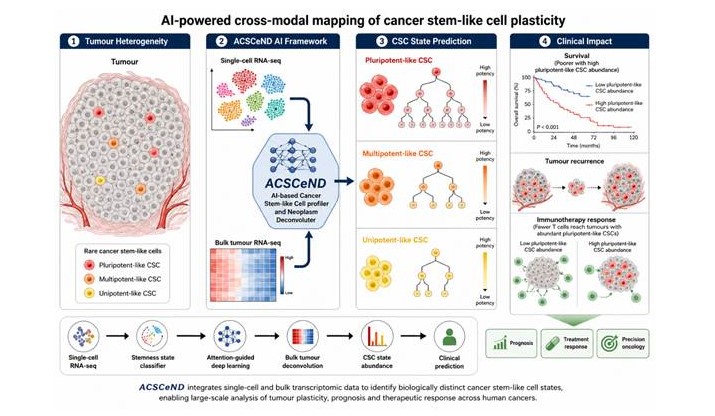
The researchers validated ACSCeND against existing computational techniques and found that it consistently outperformed current methods across independent datasets and sequencing platforms.The team subsequently analysed more than 25,000 tumour samples from leading international cancer databases, including The Cancer Genome Atlas (TCGA) and PRECOG.Their findings revealed that tumours containing a higher proportion of pluripotent-like cancer stem cells were associated with poorer survival rates, a greater risk of tumour recurrence and a weaker response to immunotherapy.
Beyond identifying these high-risk cells, ACSCeND also uncovered the molecular mechanisms that enable them to survive, adapt and evade the body's immune system.According to the researchers, these findings could help scientists identify new drug targets, predict which patients are more likely to experience disease relapse and develop more effective, personalised treatment strategies.Artificial intelligence is increasingly emerging as a powerful tool in biomedical research by enabling scientists to analyse massive genomic datasets and identify biological patterns that would be nearly impossible to detect manually.Researchers believe that studies such as OncoMark and ACSCeND demonstrate the growing role of AI in accelerating scientific discoveries and improving cancer diagnosis, treatment prediction and the development of next-generation therapies.The breakthrough highlights how AI-driven technologies could reshape cancer care by making advanced diagnostic tools more accessible and improving treatment outcomes for patients worldwide.



Related Posts
Atleast 14 infants killed in Islamabad hospital fire
Maharashtra: fire at Amravati hospital kills 3 newborns, CM orders probe
SC cuts 3-year legal practice to one year for entry-level judicial exam