 Ajay Chaturvedi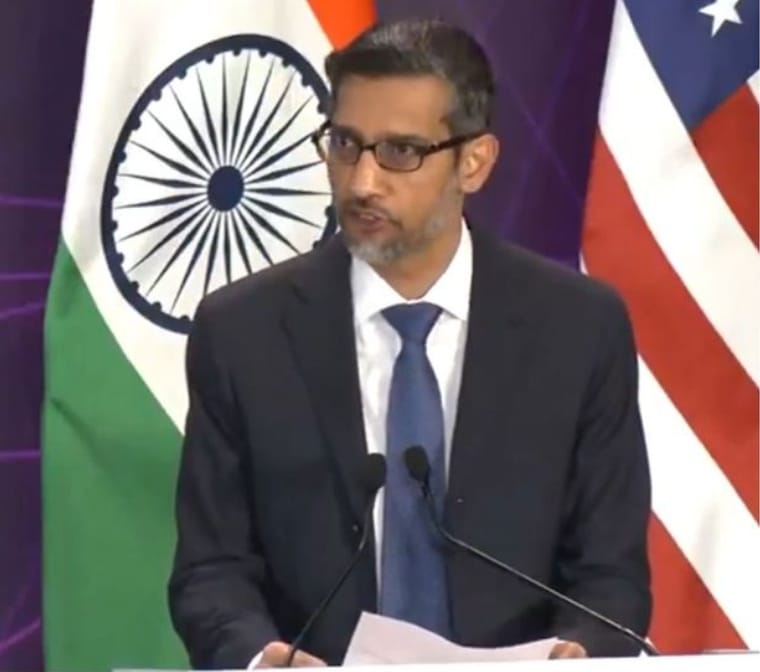
Day 5 of the AI Impact Summit 2026 at Bharat Mandapam unfolded with a marquee gathering of global CEOs, policymakers and technology pioneers, underscoring India’s rising influence in the global artificial intelligence landscape. The expo featured a powerhouse line-up led by Sundar Pichai, Kristalina Georgieva, Nandan Nilekani and Salil Parekh, alongside Union Minister Ashwini Vaishnaw.The day opened with high-level sessions focused on accelerating India’s AI ambitions and leveraging artificial intelligence for economic development and social good. The discussions reflected the government’s strategy to align regulatory frameworks with private-sector innovation, as India positions itself at the forefront of the global AI race.
US-India Partnership Key to Democratizing AI: Pichai
At the signing ceremony of the Pax Silica Declaration between India and the US, Pichai described the moment as pivotal for the future of technology cooperation between the two democracies.“I said we are on the cusp of an era of hyper-progress and new discoveries. We must work together to ensure the benefits of AI are available to everyone and everywhere. The US-India partnership has a critical role to play. Google is proud to serve as a connection point between them, both figuratively and literally,” he said.
Expressing strong confidence in India’s digital trajectory, Pichai added, “I believe India is going to have an extraordinary trajectory with AI, and we are supporting it with a full-stack commitment, including products, scaling, and infrastructure. We are working on building AI products and solutions for Indian consumers and businesses.”Speaking further on the Pax Silica Declaration, Pichai emphasized its strategic importance. “Pax Silica focuses on making sure that the supply chains are safe and secure and encourages greater commercial partnerships across key technologies. So let me congratulate the US and India on this historic moment. Alongside the recent trade agreement, this will lay a strong foundation for a robust US-India tech partnership for many years to come.”
#WATCH | Delhi: At the signing ceremony of the Pax Silica Declaration between India and the US, CEO of Google and Alphabet, Sundar Pichai, says, "I said we are on the cusp of an era of hyper-progress and new discoveries. We must work together to ensure the benefits of AI are… pic.twitter.com/CD4vCkMGZz
— ANI (@ANI) February 20, 2026
Global CEOs Chart the Future of AI
Joining the discussions were global business leaders including Cristiano Amon, who examined the evolution of next-generation connectivity and semiconductor ecosystems. As the head of Qualcomm, Amon highlighted the critical role of advanced chips and open digital networks in powering AI at scale.Panels through the day are exploring the transition from traditional automation to autonomous AI systems, with Indian and global executives debating how to move AI initiatives from pilot stages to nationwide deployment. Topics include regulatory guardrails for open data ecosystems, digital public infrastructure, and workforce preparedness in an AI-driven economy.
Policy, Infrastructure and Inclusive Growth
Nilekani and Parekh spoke about scaling India’s digital public infrastructure to enable AI-led transformation across sectors such as healthcare, agriculture, education and financial services. Their discussions emphasized interoperability, open networks and responsible data-sharing as cornerstones of India’s AI journey.Kristalina Georgieva, leading the International Monetary Fund, focused on AI’s macroeconomic implications, calling for global cooperation to ensure equitable access and balanced growth across emerging economies.Union Minister Ashwini Vaishnaw reiterated the government’s commitment to creating enabling policies in electronics, IT and railways to integrate AI solutions at scale, aligning infrastructure development with India’s broader digital transformation agenda.With sessions spanning geopolitics, semiconductor supply chains, open digital networks and AI governance, reinforcing India’s intent to shape the next era of technological advancement.

Related Posts
Rajnath Singh calls for stronger India-ASEAN defence cooperation
Vaishnaw says India eyes 25-year roadmap for tech resilience
INDIA bloc, civil society unite to restore democracy