 Newsinc24 Team
Iceland declared a state of emergency on Friday after a series of powerful earthquakes rocked the country's southwestern Reykjanes peninsula, in what could be a precursor to a volcanic eruption.According to the Icelandic Met Office, around 1,400 earthquakes were measured in the 24 hours leading up to around midday on Thursday November 9, with another 800 in the first 14 hours of Friday. Seven of Thursday’s were of a magnitude of four or above – and all of these were on the peninsula, between Eldvörp, near the airport, and Sýlingarfell, a mountain just to the east of the Blue Lagoon."The National police chief ... declares a state of emergency for civil defence due to the intense earthquake (activity) at Sundhnjukagigar, north of Grindavik," the Department of Civil Protection and Emergency Management said in a statement."Earthquakes can become larger than those that have occurred and this series of events could lead to an eruption," the administration warned.
The Icelandic Met Office (IMO) said an eruption could take place "in several days".The village of Grindavik, home to around 4,000 people, is located some three kilometres (1.86 miles) southwest of the area where Friday's earthquake swarm was registered. It has evacuation plans in place in case of an eruption.Around 1730 GMT, two strong earthquakes were felt as far away as the capital Reykjavik some 40 kilometres away, and along much of the country's southern coast, rattling windows and household objects. According to preliminary IMO figures, the biggest tremor had a magnitude of 5.2, north of Grindavik.
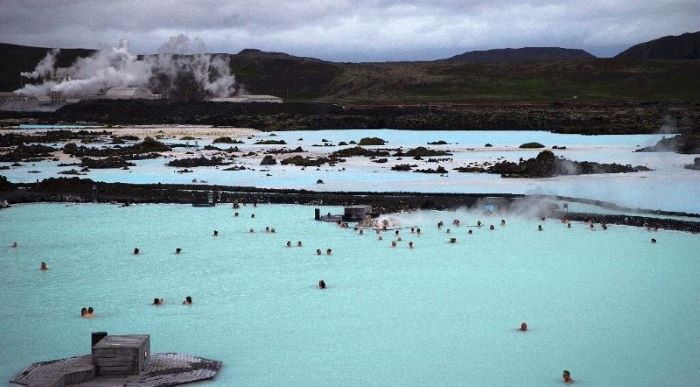
Iceland is one of the most active volcanic areas on the planet. Rather than having a central volcano, the Reykjanes Peninsula is dominated by a rift valley, with lava fields and cones. The world-famous Blue Lagoon geothermal pool has closed for a week because of the current seismic activity around the site.The site is part of southwest Iceland’s Reykjanes Peninsula – a thick finger of land pointing west into the North Atlantic Ocean from capital Reykjavik. As well as the Blue Lagoon, the peninsula is also home to Iceland’s main airport, Keflavik International.The Reykjanes Peninsula has now been coded yellow – one above the rest of the country’s green – for eruption risk.
The IMO noted an accumulation of magma underground at a depth of about five kilometres (3.1 miles). Should it start moving towards the surface it could lead to a volcanic eruption."The most likely scenario is that it will take several days rather than hours for magma to reach the surface," it said."If a fissure were to appear where the seismic activity is at its highest now, lava would flow to the southeast and to the west, but not towards Grindavik."



Related Posts
NASA's 22 yr old swift space telescope makes fiery return to earth
Imran Khan's party, allied group slam emergency, governor's rule in KP
ISRO launches advanced earth observation satellite for strategic data