 Newsinc24 Team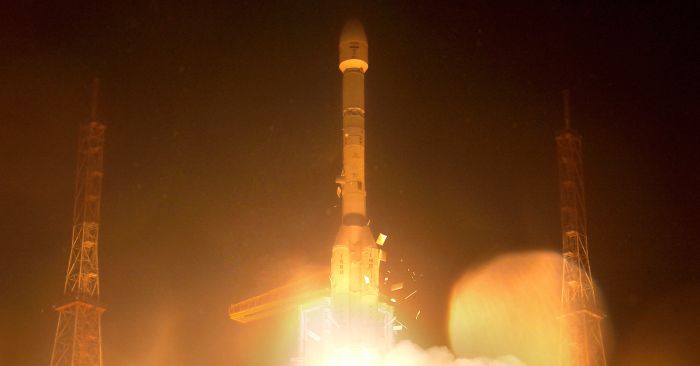
ISRO's advanced Earth observation spacecraft, India's first ever imaging satellite in geo-orbit was successfully launched from the spaceport on Friday early morning by a GSLV rocket. The EOS-05 satellite was successfully placed in the intended sub-geosynchronous transfer orbit, about 18 minutes after it lifted off from the spaceport in Sriharikota, ISRO announced. "The eye in the sky," as one of the senior scientists involved in the mission described the satellite, is set to provide real-time imagery and help the nation in areas including agriculture, and disaster management.
#WATCH | Sriharikota, Andhra Pradesh: ISRO's GSLV-F17/EOS-05 mission has been successfully accomplished. The satellite has been successfully placed into the intended orbit (Sub-Geosynchronous Transfer Orbit).
— ANI (@ANI) September 3, 2026
(Source: ISRO) pic.twitter.com/U9uS5i8ppM
ISRO Chief V Narayanan said that once the Earth Observation Satellite 05 is operationalized in orbit, it will become India's first dedicated imaging satellite from the geo orbit, providing important strategic data for our country. "This mission is a very important mission for our country because, for the first time, we are going to place an Earth observation satellite in the geosynchronous orbit, which is essentially required for continuously monitoring India and its nearby places for Earth observation."
#WATCH | Sriharikota, Andhra Pradesh: On the successful launch of GSLV-F17/EOS-05 mission, ISRO Chief V Narayanan says, "We have got a historical achievement for the country. The GSLV-F17 vehicle has successfully placed the advanced Earth observation satellite 05 in the required… pic.twitter.com/zJE4QGoPgv
— ANI (@ANI) September 3, 2026
While several earth observation satellites operate from low earth orbit (LEO), the EOS-5 satellite is set to hover at an altitude of roughly 36,000 km above earth, which is the geosynchronous orbit and at that level, the satellite will match Earth’s rotational speed. This is the 107th launch from Sriharikota and the 19th mission of GSLV. The 3-stage, 51.7 meter Geosynchronous Launch Vehicle (GSLV), with its third stage being cryogenic, has a lift off mass of 420.5 tonne and the heavy satellite is ensconced on the rocket nose cone. The GSLV-F17/EOS-05 mission is said to be a replacement for the unsuccessful GSLV-F-10/EOS-03 mission of 2021.















Related Items
ISRO's Talent Drain: Why scientists are leaving India's Space Agency
'ISRO at the Dawn of a New Space Era': Chairman Dr. V. Narayanan
Bharat Taxi launched in Maharashtra with cooperative mobility model