 Ira Singh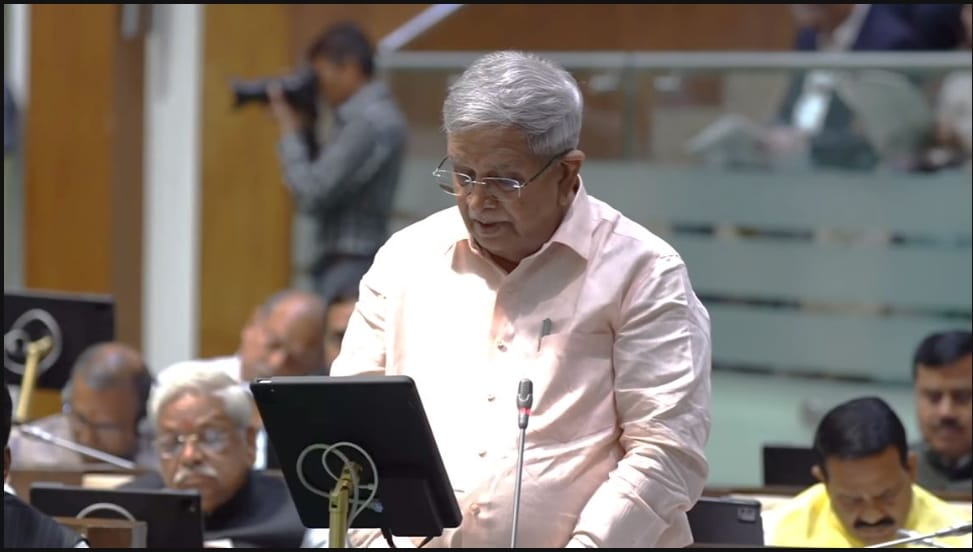
The Gujarat government on Wednesday presented a record Budget of ₹4,08,053 crore for the financial year 2026–27, outlining an ambitious roadmap anchored on social security, infrastructure expansion, industrial growth and environmental sustainability.Presenting the Budget for the fifth consecutive time, Finance Minister Kanu Desai said the outlay is structured around five key pillars — social security, human resource development, infrastructure facilities, economic activity expansion and green growth — adopting what he termed a holistic and inclusive development approach.The Budget size crosses the ₹4 lakh crore mark for the first time, setting a new fiscal benchmark for the state.
Infrastructure & Connectivity Push
A strong emphasis has been placed on transport and road connectivity:
•2,463 new buses to be added, including 500 AC electric buses
•500 mini buses for tribal areas and industrial labour mobility
•₹1,286 crore allocated for bus expansion
•₹5,600 crore for Chief Minister Gram Sadak Yojana
•₹800 crore for ‘Garvi Gujarat High-Speed Corridor’ (1,155 km)
•₹3,000 crore additional allocation for Namo Shakti and Somnath-Dwarka Expressways
•To promote clean energy, ₹150 crore has been earmarked for a floating solar project at Kadana Dam.
Housing & Urban Development
Under the “Home for All” vision:
•₹4,272 crore allocated for housing schemes including PM Awas Yojana
•Five new satellite towns to be developed near Kalol, Sanand, Savli, Bardoli and Hirasar
•₹500 crore under Gujarat Wire-Free City Mission
•₹16,116 crore under Swarnim Jayanti Mukhyamantri Urban Development Scheme
•Smart parking facilities will be created with ₹100 crore allocation.
Women & Social Welfare (GYAN Focus)
The Budget strengthens its focus on the GYAN framework — Poor, Youth, Farmers and Women.
Key announcements include:
•₹47 crore for Lakhpati Didi expansion
•₹45 crore for Self-Help Group interest subsidy
•₹972 crore for supplementary nutrition in Anganwadis
•₹1,250 crore for Namo Lakshmi Yojana
•₹2,848 crore for Ganga Swarupa Economic Assistance Scheme
•₹360 crore for construction of 2,000 new Anganwadi centres
•Monthly assistance for students in ashram schools and hostels has been increased from ₹2,160 to ₹2,500.
Agriculture & Rural Economy
•₹1,539 crore for interest subsidy under Kisan Credit Card
•₹1,565 crore for farm mechanisation support
•₹500 crore for cow breeding and Gau Mata Poshan Yojana
•₹1,500 crore under VB-G RAM G rural employment scheme
•₹2,000 crore for regional economic master plans
The Budget also proposes reforms easing land restrictions in rural areas by redefining “old condition” agricultural land.
Industry & Investment
Industrial development remains a core focus:
•Five new GIDCs to be established
•25 GIDCs to be upgraded as smart industrial estates
•₹1,775 crore for MSME support under Atmanirbhar Gujarat Scheme
•₹2,755 crore for textile sector promotion
•Gujarat State Export Promotion Council to be set up
•Major allocations include ₹610 crore for Dholera infrastructure and ₹613 crore for the Ambaji Copper Project.
The government declared 2026 as “Gujarat Tourism Year,” outlining a comprehensive push to position the state as a global travel destination. An allocation of ₹236 crore has been made to strengthen infrastructure at the Statue of Unity, while ₹300 crore has been earmarked under the Ambaji Corridor Master Plan. A provision of ₹95 crore has been made for the National Maritime Heritage Museum at Lothal, and ₹447 crore has been allocated for developing bus ports at Somnath and Ambaji to improve pilgrimage connectivity. The government also announced plans to develop Somnath Temple as a “Global Destination,” with “Somnath Swabhiman Parva” to be celebrated throughout the year.
In education and skill development, ₹5,967 crore has been allocated for scholarships benefiting nearly 97 lakh students, while ₹3,472 crore has been set aside for the PM-JAY Mukhyamantri Amrutam health scheme. Higher education loans will receive ₹869 crore, and ₹226 crore has been provided for the Namo Gujarat Skill and Employment Mission. The Budget also proposes ₹120 crore for integrated school campuses, ₹100 crore for establishing the Namo Central Library at Gandhinagar, and the launch of 926 new PM Shri schools. Strengthening governance and public safety, ₹60 crore has been allocated for an AI-powered Data Fusion Centre for Gujarat Police, ₹1,571 crore for police housing, ₹1,855 crore for a State Disaster Mitigation Fund, and ₹100 crore for the Gujarat Unified Digital Stack initiative.
Fiscal & Economic Snapshot
The Budget indicates:
•65.57% expenditure on developmental activities
•23.45% on non-developmental expenditure
•Gujarat contributes 8.2% to India’s GDP
•Per capita income stands at ₹3.01 lakh
Political Reactions
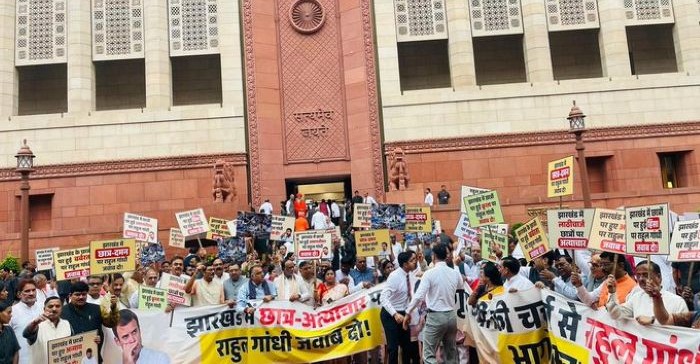
Congress leaders protested ahead of the Budget presentation, stating that announcements must translate into concrete implementation rather than remain policy declarations.
The Road Ahead
With a record ₹4.08 lakh crore outlay, Gujarat has outlined an expansive fiscal blueprint aimed at balancing welfare commitments with capital-intensive infrastructure, industrial competitiveness and green growth initiatives.
(State Correspondent)







Related Items
India's Ethanol Story: From Sugarcane to Energy Security
India well-placed to leverage AI, digital infrastructure: RBI Governor
'Paper agreement won't bring security', Iran MP warns Saudi Arabia