 Dr Mysi Patil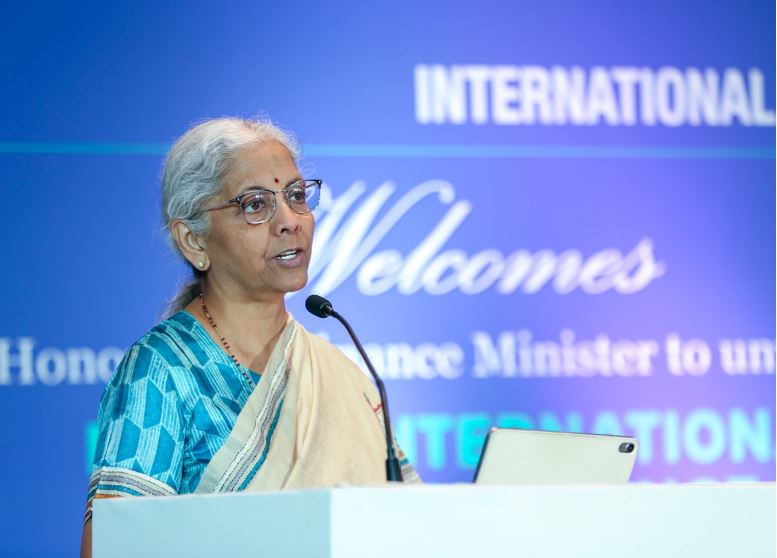
Union Finance Minister Nirmala Sitharaman said the government’s structural tax reforms have focused on fundamentally reducing tax litigation rather than merely managing dispute backlogs.Speaking at the International Tax Research and Analysis Foundation (ITRAF) 8th International Tax Conference in Bengaluru on Wednesday, Sitharaman said the government’s approach was to make voluntary compliance easier while reserving enforcement capacity for cases that genuinely require it.“The philosophy is simple: make voluntary compliance easier and reserve enforcement capacity for cases that genuinely require it. We have aimed at reducing tax litigation rather than merely managing it,” she said.
VIDEO | Bengaluru, Karnataka: "Continuous negative commentary about economy is worrying.. India is navigating these waters amid global challenges in such a way that our people do not suffer, and we are far better placed than others," says Union Finance Minister Nirmala Sitharaman… pic.twitter.com/NOKZI8snLO
— Press Trust of India (@PTI_News) September 16, 2026
Sitharaman highlighted the government’s tax reforms, including the reduction of corporate tax to 22 per cent in 2019 and the rationalisation of individual tax rates in 2025, under which an individual pays no income tax on an income of Rs 12 lakh.She also pointed to the replacement of the 1961 Income Tax Act with a concise, plain-language code drafted in six months without disturbing the overall tax burden.
Sitharaman said the consolidation of the Goods and Services Tax (GST) into essentially two primary rates in 2025 was another major reform that helped reduce classification-related disputes.On tax disputes, Sitharaman said the ‘Vivad se Vishwas’ schemes provided taxpayers and the government an opportunity to close old disputes rather than litigate them indefinitely.She also noted that in 2024, the monetary threshold for departmental appeals was raised to Rs 60 lakh before the appellate tribunal, Rs 2 crore before the high courts and Rs 5 crore before the Supreme Court.
Sitharaman urged industry representatives and policy researchers to move beyond conventional demands for rate cuts, exemptions and concessions in their pre-budget submissions.She called for qualified, impact-assessed proposals that could contribute to the journey towards Viksit Bharat 2047.“So, I wish to hear a submission that says, ‘here is a provision that no longer serves the tax system and ought to be removed even though we presently benefit from it’,” Sitharaman said.She asked professionals to quantify the impact of proposed changes, including the number of taxpayers affected, compliance costs and implications for government revenue.She also urged them to assess how proposed changes could affect the tax base, administration and other taxpayers, while identifying potential unintended consequences.
Focus on International Tax Architecture
Sitharaman also highlighted changes in India’s international tax architecture, including treaty renegotiations with Mauritius, Singapore and Cyprus to restore India's source-based capital gains taxation rights.She cited the implementation of General Anti-Avoidance Rules (GAAR), the Multilateral Instrument and the expansion of the Advance Pricing Agreement (APA) programme, along with new safe harbour provisions.Calling for stronger independent tax research, Sitharaman urged ITRAF to move from quiet commentary to visible research similar to international institutions such as the UK's Institute for Fiscal Studies and the Netherlands' IBFD.She said rigorous independent research could help present policymakers with examined policy choices and contribute to strengthening India's economic framework.
(State Correspondent)












Related Items
India has potential to power next wave of global growth: IMF
Keralam Govt in talks with states, Discoms to purchase power: CM
India’s trade deficit narrows to $26.86 bn as exports rise 26% in Aug