 Newsinc24 Team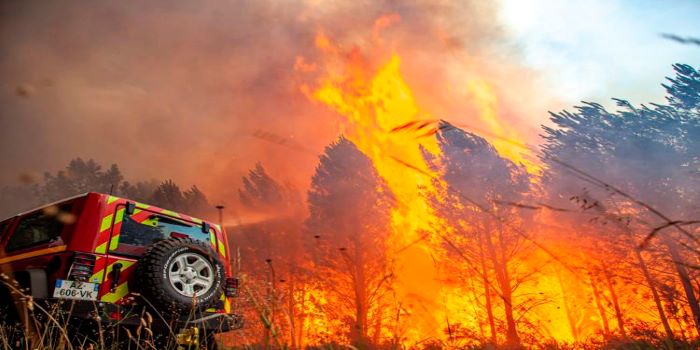
Firefighters struggled on Sunday to contain wildfires raging out of control in France and Spain as Europe wilts under an unusually extreme heat wave that authorities link to a rise in excess mortality. Two huge blazes that have been consuming pine forests for six days just south of the city of Bordeaux in southwest France have forced the evacuation of some 14,000 people, including many who were set to spend their vacation at campsites. So far, there have been no fire-related deaths in France or Spain. In Portugal, a pilot of a firefighting plane died when his aircraft crashed on Friday.In Spain, firefighters supported by the armed forces' emergency brigades are trying to stamp out over 30 fires consuming forests spread across the country. Spain’s National Defense Department said that “the majority” of its fire-fighting aircraft have been deployed. Many areas are rugged, hilly terrain that makes it difficult for ground crews to access. Drought conditions in the Iberian Peninsula have made it particularly susceptible to wildfires, some caused by lightning, others by accident, and even some intentionally set, after a mass of hot air was blown up from Africa last week.
But as temperatures remain unusually high, heat-related deaths have soared amid a heat wave that the European Union considers the work of climate change.In Spain the second heat wave of the summer has kept highs above 40 degrees Celsius (104 degrees Fahrenheit) in many areas, hitting peaks of 43 degrees Celsius (109 degrees Fahrenheit) regularly. According to Spain’s Carlos III Institute, which records temperature-related fatalities daily, 360 deaths were attributed to high temperatures from July 10-15. That was compared with 27 temperature-related deaths the previous six days. The death of a street cleaner after he suffered heat stroke while working has led to the town hall of Spain's capital giving the option for its street cleaners to work in the evenings to avoid the worst spells of the day.
In France, the fire in La Teste-de-Buch near the Atlantic coast has forced 10,000 people to flee. The Gironde regional government said on Sunday that "the situation remains unfavorable" due to gusting winds that, combined with hot and dry conditions, have fanned more flare-ups overnight. Hungary, Croatia and the Greek island of Crete have also fought wildfires this week, as have Morocco and California. The scorching temperatures have reached as far north as Britain, where its weather agency has issued its first-ever “red warning” of extreme heat for Monday and Tuesday, when temperatures in southern England may reach 40 C (104 F) for the first time. That will still be relatively bearable compared with the 47 C (117 F) recorded in Portugal’s northern town of Pinhao on Wednesday, establishing a new national record.














Related Items
Spain to grant legal status to half a million unauthorized immigrants
India-France review progress under Global Strategic Partnership
France foils bomb plot outside US bank in Paris