 Ira Singh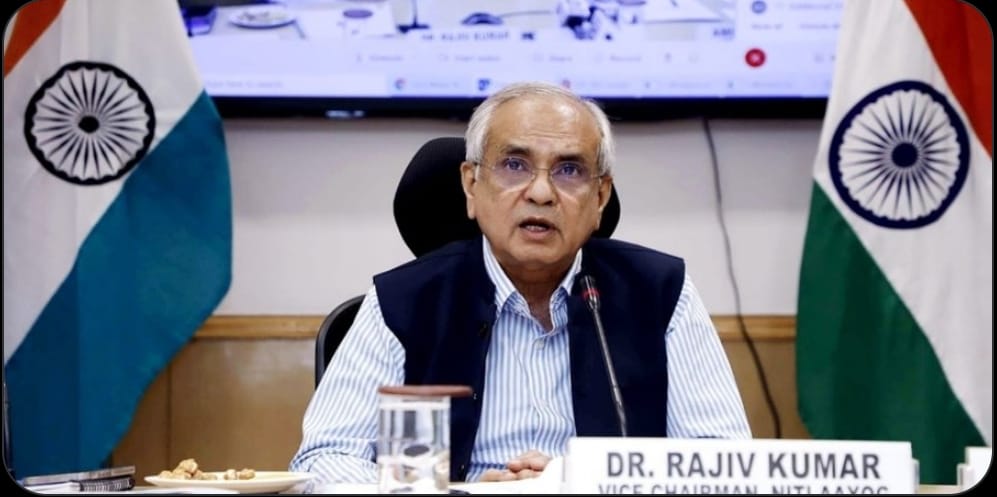
A strong economy is the bedrock of an effective foreign policy, and countries that lack economic strength are rarely taken seriously on the global stage, economist and former NITI Aayog vice-chairman Rajiv Kumar said on Wednesday.Speaking at the Rashtriya Raksha University (RRU) in Gandhinagar, Kumar underlined that economic power ultimately determines a nation’s standing in global politics. “Economics is the foundation of geopolitics. If you don’t grow your economy, you don’t have the leverage to talk about anything,” he said, echoing External Affairs Minister S Jaishankar’s view that strengthening the economy is India’s best foreign policy.
Kumar, who currently chairs the not-for-profit policy think tank Pahle India Foundation, told students that countries with weak economic fundamentals struggle to command respect internationally. “You may sit at the table and play the games of diplomacy, but nobody takes you seriously. They will take you seriously only when you are economically strong,” he said.Citing China as an example, Kumar pointed to the link between sustained economic growth and global influence. He noted that China, now the world’s second-largest economy, leads in 47 of 53 frontier technologies. “That is what gives China the ability to stand up to the United States,” he said, adding that economic dominance translates directly into strategic leverage.Turning to India’s global ambitions, Kumar said the country must significantly raise its share in global trade to play a larger international role. India’s share in global merchandise trade has remained below 2 per cent for the past three decades, a level he described as inadequate. “If you can make it 10 per cent, then we will have a role on the global stage. Just 2 per cent doesn’t matter,” he said, calling it one of India’s biggest economic challenges.
He added that India’s share in global services trade stands at around 4 per cent, stressing that aspirations for global leadership must be backed by a much stronger economic base. “Let’s not attempt to have a big global role unless we make our economy much stronger,” he said.
On India-US relations amid shifting global policies under the Donald Trump administration, Kumar advised a mix of patience and firmness in protecting national interests. “This time will also pass. The second thing is to stick to your guns for your national interest. India is not a country that can be taken lightly,” he said.
Recalling the international backlash after India’s 1998 nuclear tests under then Prime Minister Atal Bihari Vajpayee, Kumar said the country had shown resilience in the face of sanctions and pressure. “There was a massive uproar and sanctions were imposed, but we rode through that,” he said.Emphasising the need for “real strategic autonomy”, Kumar cautioned against excessive dependence on any single country and said it was time to reassess India’s relationship with China. To achieve this autonomy, he argued, India must empower its private sector, which he described as the engine of economic growth. “We have to strengthen our private sector and give it all the support it needs, because India can build its economy through the private sector,” he added.
(State Correspondent)

_(5).jpg)







Related Items
'Many forces don't want India to become Vishwaguru':Bhagwat on I Day
India celebrates 80 years of freedom, renewing shared 'National Spirit'
Amreli hosts Gujarat’s Grand 80th I-Day state level celebration