 Ira Singh
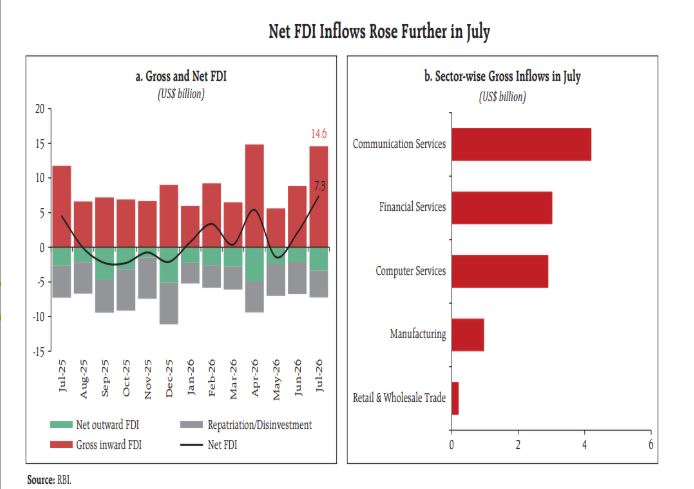
India’s net Foreign Direct Investment (FDI) inflows surged to $7.35 billion in July, marking their highest monthly level in more than five years, even as global investors continue to navigate higher interest rates, changing investment patterns and opportunities in other markets.Data released by the Reserve Bank of India (RBI) late Friday showed that net FDI in July was the highest since May 2021, when India recorded an inflow of $8.80 billion.
The latest figure also represents a sharp improvement from a year earlier. Net FDI rose 64% year-on-year, while gross FDI increased 24% to $14.58 billion, making July the third-highest month for gross FDI inflows in the past six years.
Services Lead Foreign Investment
The RBI said communication, financial and computer services accounted for more than four-fifths of equity FDI inflows during the month, underlining the continued importance of India’s services sector in attracting overseas capital.Among source countries, Mauritius, the UAE and the US emerged as the biggest contributors, together accounting for around 70% of equity inflows.For the first four months of 2026-27, net FDI stood at $13.43 billion, up 38% from the corresponding period last year. Gross FDI during the same period increased 13% to $43.85 billion.
Why Net FDI Matters
The headline improvement becomes more significant when net FDI is separated from gross inflows.Net FDI is calculated after adjusting gross FDI for money repatriated by foreign companies and investments made overseas by Indian companies. While India attracted a record $97 billion in gross FDI in 2025-26, net inflows had weakened considerably in recent years.
The combined net FDI inflow during 2024-25 and 2025-26 was only $7.7 billion, as foreign investors repatriated earnings and Indian companies increased their overseas investments.July, however, brought some relief. Foreign companies repatriated $3.84 billion, down 16% from a year earlier, while outward FDI by Indian companies rose 26% to $3.39 billion.
Global Headwinds Remain
The stronger FDI numbers come against a challenging global backdrop.Chief Economic Adviser V Anantha Nageswaran noted on Friday that even if India gets its domestic policies right, foreign capital may not immediately follow because the global investment environment has changed.He pointed to higher global interest rates and changing international investment conditions as important factors influencing capital flows.The government and the RBI have also taken steps to attract foreign funds. Over the past four months, the concessional swap window for Foreign Currency Non-Resident (Bank) deposits has attracted strong interest.
FDI Rises, But Portfolio Money Keeps Leaving
The latest numbers also highlight a striking divergence in foreign investment flows.While long-term FDI inflows have improved, foreign investors have continued selling Indian stocks and bonds. So far in 2026-27, foreign investors have sold $6.54 billion worth of Indian equities and debt, following sales of $16.59 billion in 2025-26.This suggests that India is seeing stronger flows into longer-term investments even as portfolio investors remain cautious about domestic financial markets, noted experts.The rupee also remains under pressure. It closed at 95.82 against the US dollar on Friday, close to its all-time low of 96.96.
Indian Companies Step Up Overseas Investments
At the same time, Indian companies are expanding their presence overseas.In July, outward FDI by Indian firms rose 26% to $3.39 billion. More than two-thirds of these investments went to Singapore, the UK and the UAE.Meanwhile,the RBI noted financial, insurance and business services, along with manufacturing, accounted for around two-thirds of outward FDI during the month.The July figures therefore present a mixed but important picture of India’s external sector: stable foreign capital is showing renewed strength, even as more mobile portfolio money continues to flow out of domestic markets.For India, the key question will be whether the improvement in net FDI can continue in the months ahead, particularly as global interest rates, currency pressures and international investment preferences continue to evolve.
(Business Correspondent)



Related Posts
Higher advance tax drives 13% rise in net direct tax collection
CBI files FIR in LIC Investment Fraud against Reliance Capital
US judge blocks Trump rule limiting stay for foreign students, journalists