Vijay Singh
One of the holiest city in India,Varansi is, in general, famous for the grand and one of the oldest temples-Kashi Vishwanath temple. This is one of the twelve Jyotirlingas among the holiest of Shiva Temples.
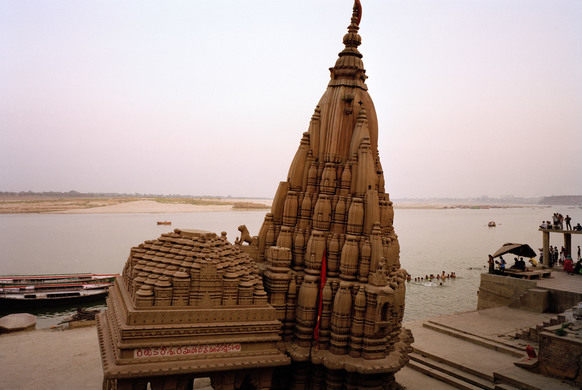
The remarkable thing of this holy city is that although thousands of ancient temples stand on the bank of river Ganga ... but Ratneshwar Mahadev Mandir famously known as Leaning temple finds a special mention. The temple dedicated to Lord Shiva, constructed at the Scindia Ghat, is a major attraction because of its resemblance with Pisa Tower of Italy. Pisa Tower is leaning by 4 degree and the height is around 57 meter while Ratneshwar Temple leans by 9 degree and nearly 74 meter tall.... means taller than the world fame leaning tower. The design of the temple is in the nagara shikhara style with a phamsana mandapa adorned with pillars. The bottom portion of the temple houses the Garbha Griha and remains underwater most of the time during the year. In the monsoon season,even its gumbaj gets submerged with rising water level of the river Ganga.
According to some reports, in the 19th century, the priest used to dive in the water to conduct worship when the temple entrance was submerged.
The temple is believed to have stood straight before the 1860s. This can be verified from the early photographs of the 1860s, but certainly by the early 20th century subsidence at the back end of the temple had started.
The exact reason for such a severe lean in the structure has not been figure out till date. Legend and history do not match up to Ratneshwar Mahadev Temple. The lean could be the result of a structural problem, or because it was built on silt, or because of a curse.Thus the origins of the temple are uncertain.
In this context various legends are associated with the leaning temple of Shiva. According to one of the beliefs, the temple ghat collapsed and leaned backwards after not being able to withstand its weight. Some people believe that Rajput King Raja Maan Singh's servant built a temple in honor of his mother, Ratnabai, with the belief of paying back her debt. But she was pained by his gesture because a mother's love can never be equated to debt. As a result of his mother's agony and the curse, the temple started leaning backwards.
Another legend says that the temple was built by Ratna Bai, a female servant of Ahilya Bai of Indore. And since she named it after herself... it invited the curse of Ahilya Bai.
Scholars however place the construction of this temple to be a little later than the legends suggest. Some believe it was built by Queen Baija Bai of Gwalior in the 19th century, others have placed it’s construction to the mid 1850s by the Amethi royal family. According to Revenue records, it was built sometime between 1825 and 1830, and this fact is backed up by a drawing of the temple made by James Prinsep. He was master of Banaras Mint from 1820 to 1830.
Because of its stunningly mysterious lean...Ratneshwar Mahadev Temple draws a lot of attention from pilgrims and tourists. During the Winter and Spring month, the water levels of the Ganga come down to low enough allowing the visitors to access the temple without getting their feet wet. Some nice carvings are also worth to see. These have been found in remarkably good condition considering the length of time this temple is submerged each year.
Pisa Tower of Italy is a World Heritage site but no one across the world is aware of this leaning Ratneshwar Temple.This is one of the most photographed temples in India. Let's make it known all over the world. So is the time for the govt. authorities specially Culture and Tourism officials to take notice and promote this leaning Temple as a popular tourist spot on the globe.
**************************