 Newsinc24 Team
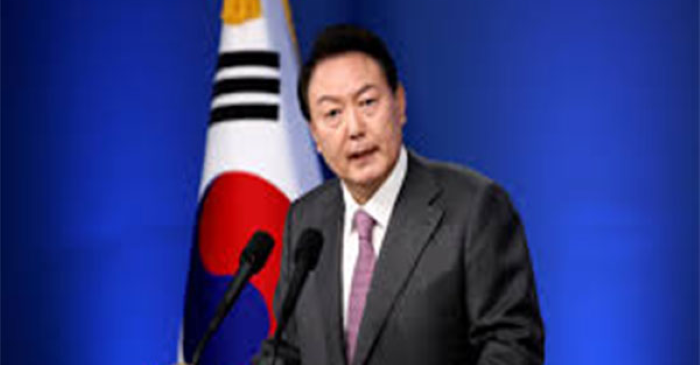
South Korea’s opposition lawmakers have filed a motion to impeach President Yoon Suk Yeol after he declared martial law, causing a major political crisis Tuesday. Yoon announced on TV, leading to widespread criticism and comparisons to South Korea’s past dictatorships. After facing a strong backlash, Yoon reversed his decision within six hours. Kim Yong-min, a member of the opposition Democratic Party, said the impeachment vote could happen as soon as Friday. Six political parties support the motion, but Yoon’s party, the People Power Party, does not.
For the impeachment to pass, at least two-thirds of South Korea’s National Assembly must vote in favour. Yoon’s party holds 108 of the 300 seats, so some members of his party would need to support the motion. If impeached, Yoon would be suspended from office. The Constitutional Court would then decide whether to permanently remove him.In the late 1980s, South Korea had a series of strongmen who repeatedly invoked North Korea when struggling to control domestic dissidents and political opponents.Meanwhile, several small protests have been taking place around the Seoul on Wednesday, demanding the resignation of President Yoon Suk Yeol.
South Korea became a democracy only in the late 1980s, and military intervention in civilian affairs is still a touchy subject. During the dictatorships that emerged as the country rebuilt from the 1950-53 Korean War, leaders occasionally proclaimed martial law that allowed them to station combat soldiers, tanks and armored vehicles on streets or in public places to prevent anti-government demonstrations.Dictator Park Chung-hee, who ruled South Korea for nearly 20 years before he was assassinated by his spy chief in 1979, led several thousand troops into Seoul in the early hours of May 16, 1961, in the country’s first coup. He proclaimed martial law several times to stop protests and jail critics.
Less than two months after Park’s death, Maj. Gen. Chun Doo-hwan led tanks and troops into Seoul in December 1979 in the country’s second coup. The next year, he orchestrated a brutal military crackdown on a pro-democracy uprising in the southern city of Gwangju, killing at least 200 people. In the summer of 1987, massive street protests forced Chun’s government to accept direct presidential elections. His army buddy Roh Tae-woo, who had joined Chun’s 1979 coup, won the election held later in 1987 thanks largely to divided votes among liberal opposition candidates.


Related Posts
BCCI announces India Women’s squads for South Africa tour
SC issues notice to NPCI, RBI on UPI MDR; refuses interim stay
Karnataka: Prominent names figure in SIR notice list