 Newsinc24 Team
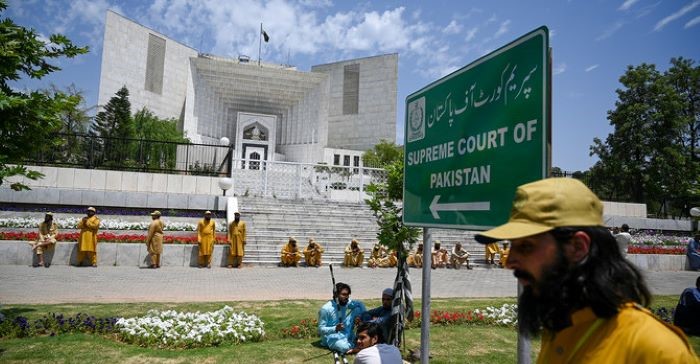
In a landmark ruling, Pakistan's Supreme Court on Friday scrapped the recent amendments to the country's anti-graft laws and restored corruption cases against public office holders, including former prime minister Nawaz Sharif, who was one of the major beneficiaries of the changes.In a 2-1 verdict, the Supreme Court ordered to restore the corruption cases against public office holders that were withdrawn after amendments were made to the country’s accountability laws.The apex court was announcing its reserved decision on jailed former prime minister Imran Khan's plea filed last year, challenging the amendments made to the accountability laws by the then government led by former prime minister Shehbaz Sharif, the younger brother of Nawaz Sharif.
The reserved verdict was announced by a three-member bench comprising Chief Justice of Pakistan (CJP) Umar Ata Bandial, Justice Ijazul Ahsan and Justice Syed Mansoor Ali Shah on PTI Chairman Imran Khan’s 2022 petition challenging amendments made to the accountability laws.CJP Bandial and Justice Ahsan declared Imran’s plea to be maintainable while Justice Shah disagreed with the majority verdict, according to which not just the corruption cases but also the inquiries and investigations were directed to be restored.The court also declared some amendments to the accountability laws to be contrary to the Constitution and struck them down.These included one which limited the National Accountability Bureau’s (NAB) jurisdiction to cases involving over Rs500 million and one which allowed the accused to claim the amount of plea bargain deposited after being acquitted.
The court also declared null and void the verdicts issued by the accountability courts in light of the amendments made to the laws.It directed that the cases withdrawn as a result of the amendments be fixed for hearing in accountability courts within a week. The court further directed the NAB to send the records to the relevant courts within seven days.The amendments made several changes to the National Accountability Ordinance (NAO) 1999, including reducing the term of the NAB chairman and prosecutor general to three years, limiting NAB’s jurisdiction to cases involving over Rs500 million, and transferring all pending inquiries, investigations, and trials to the relevant authorities.
In his petition, the PTI chief had claimed that the amendments to the NAB law had been made to benefit influential accused persons and legitimise corruption.In June 2022, the PTI chief had moved the apex court against amendments made to the National Accountability Bureau (NAB) ordinance under the National Accountability (Second Amendment) Act 2022.


Related Posts
India defeat Pakistan by 1 wicket to clinch U-19 Asia Cup title
Pakistan: Defence Minister flags exodus of top officials in country
Pakistan: 33 killed, over 40 injured in school roof collapse in Peshawar