 Nausheen Khan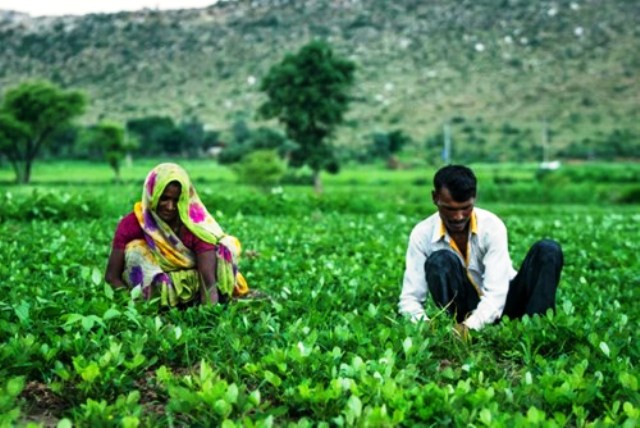
Organic farming is very popular in India . Farmers of Bundelkhand region in UP and MP also adopting the Organic farming in a big way. Farmers are now growing crops with indigenous manure and doing organic farming of wheat, gram iand moong and due to this, the income of the farmers has increased. Their soil is now more fertile. In Bundelkhand about 2300 hundred farmers are doing organic farming from the year 2018-19. After three years, farmers will get the logo of organic farming. With this, farmers will be able to sell organic farming produce in markets, malls and mandis. The price of organic crops is one and a half times more than other crops.
There was a time,agriculture was done in accordance with the natural environment conducive to human health, due to which organic and inorganic substances were used simultaneously. As a result of which, water, land, air and environment were not polluted. But later as time changes,various types of chemical fertilizers and pesticides are being used in agriculture, due to which the balance of the cycle of organic and inorganic substances started deteriorating, and the environment got polluted, affecting the health of mankind as well as degrading environment.Increasing costs of Chemical fertilizers and pesticides badily affected the marginal and small faermers because they were unable to bear the exorbitant cost of fertilizers.
To help the marginal and small farmers, goverment motivated them to adopt organic farming. In 2001, organic farming was started in one village of each development block in every district of Madhya Pradesh and these villages were named as "organic villages". In this way, organic farming started in 313 villages in the first year. After this, in 2002-03. two villages of each development block of each district were added. In the year 2003-04, 2-2 villages i.e. 1565 villages, were doing organic farming. Again in the year 2006-07, 5-5 villages were selected in each development block. In this way, the program of organic farming is being carried in 3130 villages of the state. Due to this, the income of the farmers has increased, the fertility power of the land is also increasing. The important thing is that the demand for organic manure has increased significantly. Awareness campaign and capacity building of farmers about Organic Farming is still going on.
Organic Agriculture refers to a farming system that enhances Soil fertility by maximizing the efficient use of local resources. Organic agriculture relies on a number of farming practices based on ecological cycles and aims at minimizing the enviromental impact of the food production, preserving live long term sustainability of soil and maximum use of renewable resources. The Principal methods of Organic farming includes encourages crop diversity, polyculture, encourage beneficial organism in soil, crop rotation, companion crops, agricultural input production on own farms, animal husbandry, pest repelling plants, biological pesticides & herbicides, insect trap, physical barriers, water harvesting etc
UP govt has also decided to develop as a role model for organic farming. The state govt is exploring the possibility of organic agriculture and promotion of zero-budget agriculture in the drought- hit areas.
The method of organic farming in rainfed areas is even more beneficial. The land is also saved from becoming barren by turning off chemical fertilizers. According to agriculture department preparing the organic fertilizer is not costly .It is cheap and easy to use also.
Organic Fertilizers: -
Nadep, biogas slurry, vermi compost, green manure, bio fertilizer (culture), cow dung manure, Nadep phospho compost, pit compost (Indore method), poultry manure, bhubat ampatpani, amrit sanjeevani, matka manure, cow-urine, neem - leaf solution (niboli , cake)whey,chilli,garlic, wood ash, neem and karanj khali.
Advantages of organic farming: -
1. Increase the fertility of the soil.
2. Beneficial in increasing good insects.
3. The crop produced from organic manure is nutritious and beneficial for health.
4. The environment is safe because chemical fertilizers along with rainwater go into the water of ponds, destroying the living organisms in the water.
5. A crop grown with organic manure gives better production at a lower cost, whereas chemical fertilizers are taught to buy at expensive prices.














Related Items
Maharashtra assembly passes bill to recognise women farmers
JD(S) steps up opposition to Bidadi township, farmers join march
PM joins 'Paschimbanga Divas', boosts farmers with PM-Kisan funds