 Newsinc24 Team
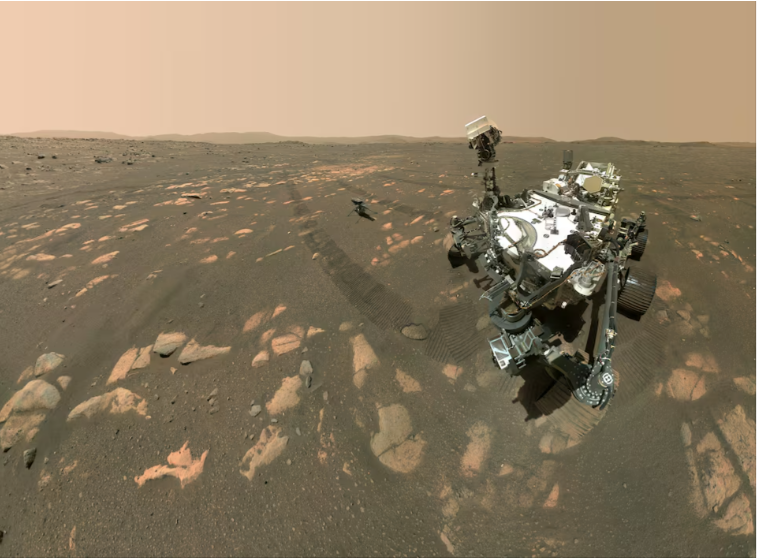
 NASA’s Perseverance Rover is on the verge of completing a marathon-length journey on the Martian surface, marking another milestone in its mission to uncover clues about ancient life on the Red Planet.
According to agency reports, the six-wheeled robotic explorer has travelled 26.09 miles (41.99 km) across Mars since landing in February 2021, just short of the official marathon distance of 26.22 miles (42.2 km). According to Perseverance mission manager Robert Hogg, the rover is expected to surpass the mark within the next month.Originally designed for a mission lasting one Martian year — roughly 687 Earth days — Perseverance has continued operating well beyond expectations while exploring the ancient terrain of Jezero Crater.“The rover continues in good health with at least a decade left in its power source. The duration of the mission will depend on choices NASA makes,” Ken Farley said in comments provided by NASA.
Perseverance has been studying the geology and climate of Jezero Crater, a region in Mars’ northern hemisphere believed to have once contained a large lake and river delta more than three billion years ago. Scientists consider the site one of the best places on Mars to search for signs of ancient microbial life because liquid water is regarded as a key ingredient for life.Among the rover’s most significant discoveries was a reddish rock sample collected from the crater floor that contained minerals and chemical signatures potentially linked to ancient microbial activity. However, researchers cautioned that the features could also have formed through non-biological processes.
“Further work evaluating whether these are truly evidence of Martian life requires analysis in terrestrial laboratories,” Farley said, adding that Perseverance will continue collecting rock samples for possible return to Earth through a future robotic or crewed mission.The rover has also detected organic molecules, documented electrical activity in the Martian atmosphere linked to dust devils, and observed an aurora in visible light on Mars for the first time, with the sky glowing faintly green.
According to scientists Perseverance’s findings have helped reconstruct the life cycle of the ancient lake that once filled Jezero Crater about 3.7 billion years ago. The lake is believed to have started shallow before deepening significantly, creating a delta formed by sandy sediments carried by flowing water.
Currently operating outside the crater, Perseverance is examining rocks estimated to be more than four billion years old — dating back to the early history of Mars and possibly resembling conditions on early Earth when life first emerged.“Because rocks of this era were completely destroyed on Earth, Mars offers a key analog environment in which to investigate pre-biotic chemistry and possibly the origin of life,” Farley said.NASA’s Perseverance mission has also made history through the success of Ingenuity, the small helicopter that accompanied the rover and became the first aircraft to achieve powered flight on another planet. Ingenuity completed 72 flights in the thin Martian atmosphere before concluding its mission.Perseverance is now closing in on the distance record set by NASA’s Opportunity rover, which travelled 28.06 miles (45.16 km) during its 15-year mission between 2004 and 2019. NASA’s Curiosity rover, operating since 2012, has covered 22.93 miles (36.91 km) on Mars,according to sources.



Related Posts
NIA Court awards life term to 8 Bangladeshi in human trafficking case
Prez Murmu urges Teachers to embrace technology for better learning
E20: A Debate That Needs Science And Economics More Than Rhetoric