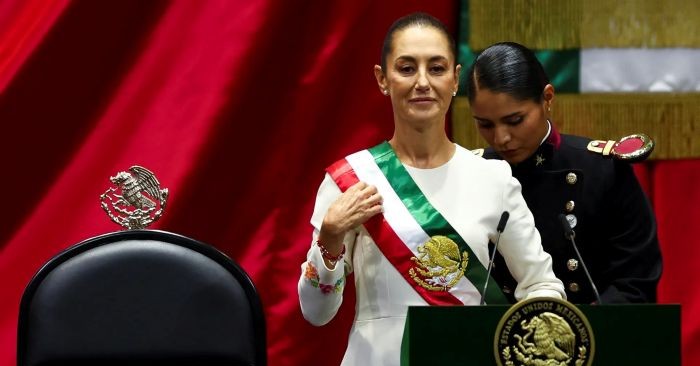
Mexican President Claudia Sheinbaum struck back at Trump, detailing what her country has done to fight drug trafficking and slow migration and criticizing the U.S. for its high levels of drug consumption. She said Mexico would retaliate with its own tariffs on American imports, adding: “Problems are not resolved by imposing tariffs, but by talking and engaging in dialogue.” The two nations and China are America’s top trading partners, supplying the U.S. with food, medicine, oil, cars, timber and electronics. The leftist leader, who has repeatedly sought to calm tensions with U.S. President Donald Trump, touted her government's record since she took office in October, seizing 20 million doses of deadly synthetic opioid fentanyl, in addition to detaining more than 10,0000 individuals tied to drug trafficking. "We categorically reject the White House's slander that the Mexican government has alliances with criminal organizations, as well as any intention of meddling in our territory," Sheinbaum wrote. Sheinbaum's comments came after Trump signed an order to impose stiff tariffs on imports from Mexico, Canada and China.
Meanwhile, Governor Gretchen Whitmer of Michigan in US, has condemned the tariffs and the effect they would have on the auto industry in her state, which voted for Trump in 2024: “A 25% tariff will hurt American autoworkers and consumers, raise prices on cars, groceries and energy for working families and put countless jobs at risk. Trump’s middle-class tax hike will cripple our economy and hit working-class, blue-collar families especially hard.”
The tariffs against Canada and Mexico upend a trade pact that dates back three decades and is the linchpin of many tightly integrated industries across North America. Trump himself signed the newest version of the trade accord during his first term, praising the 2020 U.S.-Mexico-Canada Agreement as “the fairest, most balanced and beneficial trade agreement we have ever signed into law.” Under the U.S.-Mexico-Canada trade agreement, any country has the right to pull out at any time. And a U.S. president can impose new tariffs without approval from Congress by invoking the International Emergency Economic Powers Act, which authorizes executive action to counter threats to national security, foreign policy or the economy.


Related Posts
Trump proposes fresh tariffs on India, China and other trade partners
Trump plans fresh tariffs, India, China, 14 economies on radar
Amish Shah vows to tackle Anti-India hate, roll back tariffs in US Cong