 Newsinc24 Team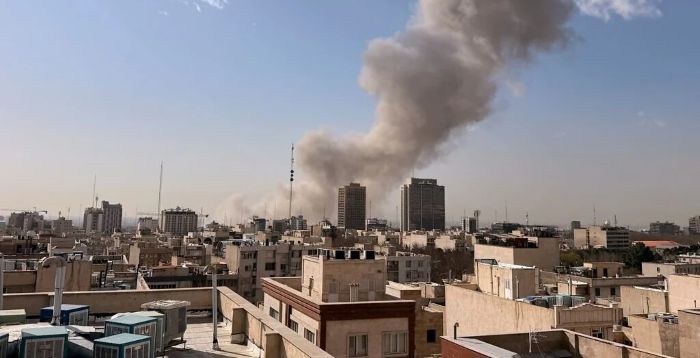
West Asia is witnessing its most serious escalation in weeks after a fragile ceasefire between Israel and Iran collapsed, triggering successive rounds of missile and air strikes across the region. The latest cycle of hostilities began late Sunday when Iran’s Islamic Revolutionary Guard Corps launched ballistic missiles toward Israel, saying the attack targeted the Ramat David airbase in northern Israel. Tehran described the strike as retaliation for Israeli air operations against Beirut’s southern Dahieh district. Israel confirmed the missile launches and said its air defence systems were activated to intercept the incoming projectiles.
The confrontation intensified early Monday when the Israeli military announced that its Air Force had carried out strikes against military targets in western and central Iran. According to the IDF, the attacks targeted military infrastructure and radar installations. The military said the Israeli Air Force struck three sites at a petrochemical complex in the Mahshahr area in southwest Iran, aiming to destroy infrastructure used by Iran to produce raw materials for the manufacture of missiles.
0450Z
— Shin (@hey_itsmyturn) June 8, 2026
Salman Farsi Petrochemical Complex
Mahshahr, Khuzestan Province, #Iran
(Via @IliaHashemicom's TG) pic.twitter.com/TJMrjbDaFN
Iranian media reported explosions in several locations, although the extent of the damage could not be independently verified. Hours later, the Revolutionary Guards said they launched a second wave of missiles aimed at the Nevatim and Tel Nof airbases in Israel, further widening the exchange and raising fears of a prolonged military confrontation.
The renewed fighting has also disrupted civilian air traffic across the region. Iraq and Syria announced temporary closures of their airspace as a precaution, while airlines rerouted flights to avoid potential conflict zones. The crisis has drawn in other regional actors. Yemen’s Houthi movement announced a ban on Israeli-linked shipping in the Red Sea and claimed responsibility for a separate missile launch toward Israel. The Israeli military said the projectile was intercepted before reaching its target.
Meanwhile, aq Palau-flagged cargo ship carrying 24 Indian crew members was attacked near the Strait of Hormuz on Monday, Arab and Indian media reported. According to the reports, the vessel's engine room was hit in the attack. No immediate information was available on casualties or the extent of the damage. The IRGC Navy said on Monday that any warship from "hostile countries" entering the Strait of Hormuz would be targeted immediately.
Iran's Khatam al-Anbiya joint military command said on Monday that the armed forces had halted operations against Israel after what it called a “painful response." The command said the strikes were carried out in support of the people of Lebanon after Israeli attacks in southern Lebanon and Dahiyeh, which it said were backed by the United States. It warned that any continued attacks, including in southern Lebanon, would bring a much harsher response.
US President Donald Trump says both Israel and Iran want “an immediate ceasefire” but warns that “stupidity” could thwart a peaceful resolution. “Both sides, Israel and Iran, are looking to do an immediate CEASEFIRE!” he writes on Truth Social. “Final negotiations on ‘Peace’ are proceeding, subject to ignorance or stupidity getting in its way. The Blockade will remain in place, and in full force and effect, until a ‘Final Deal’ is reached. Things should move quickly.”

















Related Items
India beat Pakistan by seven wickets in women's T20 Asia Cup
US sanctions Turkish bank to cut Iran's financial lifelines
Trump calls Iran conflict ‘small potatoes’ for US