 Newsinc24 Team
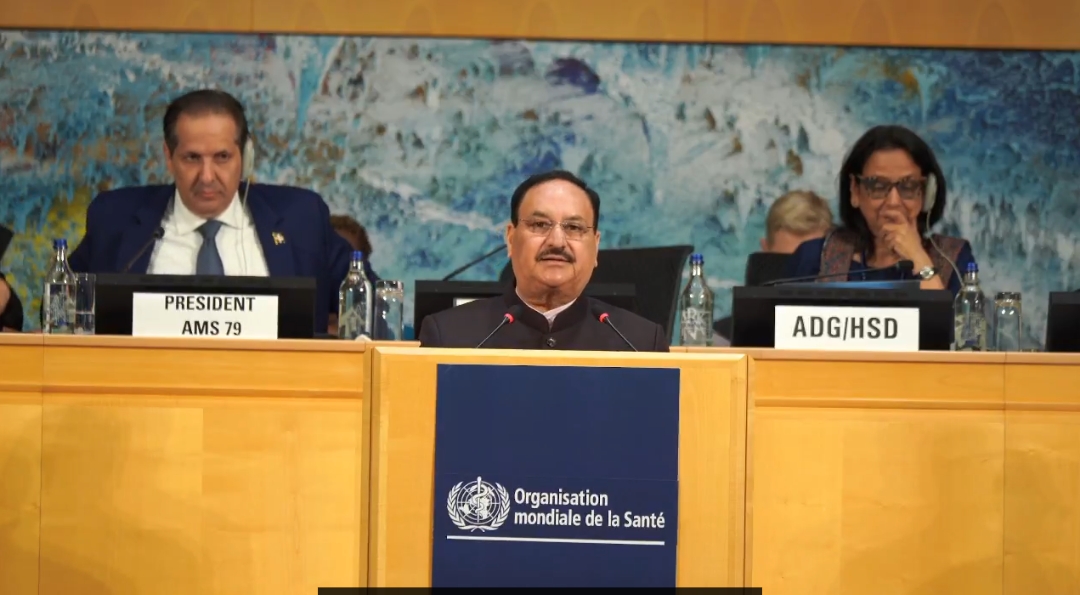
India showcased its expanding digital healthcare capabilities and commitment to equitable global health systems at the 79th World Health Assembly in Geneva, with Union Health Minister J. P. Nadda highlighting the country’s progress in universal healthcare, digital innovation and pandemic preparedness.Addressing the plenary session themed “Reshaping Global Health: A Shared Responsibility”, Nadda said India’s healthcare reforms are being driven through a “whole-of-government” and “whole-of-society” approach aimed at ensuring affordable and quality healthcare access for all citizens.Speaking on behalf of India, the Minister said the country is accelerating its efforts towards Universal Health Coverage through people-centric healthcare policies designed to leave no one behind.
Addressed the 79th World Health Assembly in Geneva and reaffirmed India’s steadfast commitment to Universal Health Coverage, digital health innovation and global health solidarity.
— Jagat Prakash Nadda (@JPNadda) May 20, 2026
Driven by a ‘whole-of-government’ and ‘whole-of-society’ approach, India is rapidly expanding… pic.twitter.com/XPiQkmQ27J
Nadda informed the Assembly that more than 1,85,000 Ayushman Arogya Mandirs have been operationalised across India to provide comprehensive primary healthcare services at the community level. He noted that these centres are playing a key role in preventive healthcare, early disease detection and treatment of common illnesses, helping reduce pressure on tertiary healthcare institutions.Highlighting India’s digital health transformation, the Minister said the Ayushman Bharat Digital Mission has significantly strengthened the country’s healthcare ecosystem by enabling the creation of over 880 million unique digital health identities.“These digital health IDs facilitate longitudinal health records and ensure a seamless continuum of care,” Nadda said, adding that the digital infrastructure is improving coordination among healthcare providers, enhancing patient outcomes and enabling data-driven policymaking.
On financial protection, he said the Ayushman Bharat Pradhan Mantri Jan Arogya Yojana, described as the world’s largest public health assurance scheme, is providing coverage to nearly 600 million vulnerable beneficiaries against catastrophic healthcare expenditure.The Minister also highlighted India’s efforts to strengthen pandemic preparedness and build resilient public health infrastructure capable of responding effectively to future global health emergencies.Addressing the role of emerging technologies in healthcare, Nadda referred to India’s recently launched Strategy for Artificial Intelligence in Healthcare and stressed the importance of ethical and human-centric AI systems.“The future of Artificial Intelligence depends on our collective ability to build ethical and human-centric systems,” he said, calling for responsible innovation that prioritises patient safety, inclusivity and equity.
Reaffirming India’s role as the “Pharmacy of the World”, the Minister recalled the country’s contribution during the COVID-19 pandemic under the Vaccine Maitri initiative, through which India supplied nearly 300 million vaccine doses to around 100 countries.Nadda urged the global community to translate shared responsibility into meaningful action for strengthening global healthcare systems.“In the spirit of solidarity, let this Assembly move forward to transform policy into action for a healthier future for all,” he said.



Related Posts
Maharashtra woos UK investors with industry, technology opportunities
Technology must reach all, not remain privilege of few: PM Modi
Modi, Trump discuss bilateral ties in trade, defence, energy over phone