 Newsinc24 Team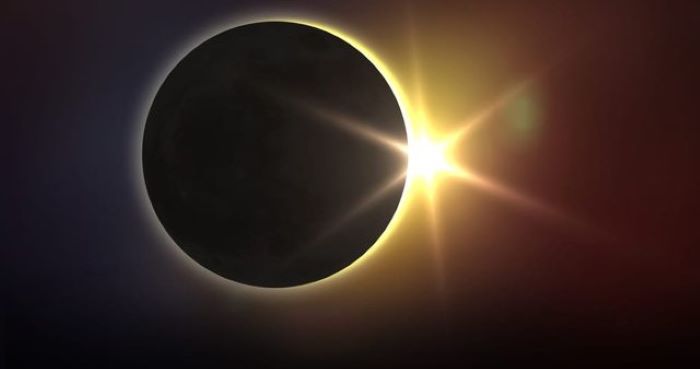
A rare celestial event is underway in several parts of the world as the Sun, Moon, and Earth are aligned together. The phenomenon known as a solar eclipse began at 7 am and is expected to last for five hours.The solar eclipse on Thursday is a hybrid event, as it is neither a total solar eclipse nor a partial one, instead it's a mix of the two phenomenons based on where you are seeing it from. A hybrid solar eclipse occurs when the moon is positioned at a distance from the Earth, causing it to appear smaller in the sky compared to the sun. When the moon passes in front of the sun during a hybrid solar eclipse, its size is just right to cover the entire solar disk, creating a perfect annular or ring-like shape around the moon's dark silhouette. This is what makes it an annular eclipse.
While the Hybrid Solar Eclipse on April 20 will last for over five hours, the totality, when the Sun is fully covered, will last for less than a minute. A hybrid solar eclipse is a rare type of eclipse that occurs only a few times per century. As per NASA, hybrid eclipses shift from annular to total due to our planet's curve.
LIVE: Watch a total solar eclipse in Australia with us! We're sharing live telescope views and answering your #AskNASA questions on NASA Science Live. https://t.co/a9z0plAikM
— NASA (@NASA) April 20, 2023
In Western Australia the eclipse will be visible from 10:29 pm to 10:35 pm EDT on April 19 (2:29 to 2:35 GMT, April 20), in East Timor from 11:19 pm to 11:22 pm EDT on April 19 (3:19 to 3:22 GMT, April 20) and in Indonesia from 11:23 pm to 11:58 pm EDT on April 19 (3:23 to 3:58 GMT, April 20).
The next Eclipse (Partial) will be visible in India on August 2, 2027 , will not be visible in Odisha and the next annular solar eclipse will occur in 2031.



Related Posts
Asian Games: Kamaljeet-Suruchi shoot India to gold in 10m Air Pistol
India win 4 x400m relay silver after Seema's bronze in 10,000m final
India cuts edible oil import duty to lower prices ahead of festivals