 Newsinc24 Team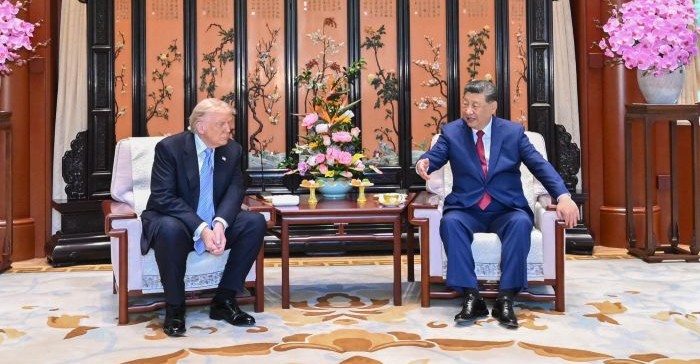
Asia Society Policy Institute (ASPI) experts comment on readouts from day one of the Trump-Xi Summit in Beijing.
Wendy Cutler - Senior Vice President, ASPI, and former Acting Deputy U.S. Trade Representative opined that Xi’s warning on Taiwan to President Trump was in stark contrast to the pageantry and nice words about reshaping the bilateral economic relationship to “constructive strategic stability.” The underlying message is clear. From Beijing's perspective, the U.S. and China can enjoy smoother economic relations provided Washington gives China more breathing room on Taiwan.
While this message may appeal to Trump, who has always prioritized the economic ledger of our relationship with China, his advisers will try to convince him to stay on message on Taiwan and not show flexibility.
Not surprisingly, Trump’s tweet on today’s meeting did not mention Taiwan. Trump instead focused on market access, investment and US-China shared interest in reopening the Strait of Hormuz.
So far, only one tangible outcome on the trade side has been announced. Specifically, Beijing finally agreed to re-issue import permits to U.S. beef producers paving the way for U.S. beef exports to China to resume. This limited market opening has been long overdue but nevertheless
welcome.
However, for the meeting to be deemed a success by Trump’s rural constituents, the hope remains that China this week will announce further multi-year mega U.S. agriculture purchases, including corn and meat, while confirming soybean purchasing commitments made last October.
We are likely to see more tangible outcomes before Trump leaves Beijing, Including the establishment of a Board of Trade and a Board of Investment announcements of Chinese mega dollar purchases of U.S. energy, agriculture and aircraft, and progress addressing regulatory concerns of the CEO delegation accompanying Trump.
Jing Qian - Vice President, Co-Founder, and Managing Director, Center for China Analysis has said that the Trump–Xi meeting does not look like a full reset. It looks more like an attempt to build a new operating system for competitive coexistence.
The striking point is that the Chinese and American readouts use very different political languages, but they are not moving in entirely different directions. Washington talks about market access, energy security, fentanyl, and deterrence. Beijing talks about stability, cooperation, and opposition to disruption. These are not identical worldviews, but they are not necessarily incompatible.
One of the most interesting details is that the Chinese readout lists health cooperation right after economy and trade. That ordering is likely not accidental. Health may now be one of the few remaining areas where Beijing still sees real space for constructive engagement with Washington.
The references to Iran, energy security, and the Strait of Hormuz show that the agenda is no longer only bilateral. The two sides are beginning to talk about shared systemic risks. Washington emphasizes freedom of navigation and deterrence. Beijing emphasizes opposition to militarization and disruption. Different language, but both point toward the same strategic necessity: avoiding uncontrolled escalation.
This summit felt less ideological and more leader-centric. The emphasis was on chemistry, symbolism, and personal rapport as instruments of statecraft. What struck me most was how personalized the diplomacy became. Even something like Beijing playing ‘YMCA’ at the state dinner signaled a very deliberate effort to connect with Trump not just politically, but symbolically and personally.
According to Lyle Morris - Senior Fellow on Chinese Foreign Policy and National Security- Beijing rolled out a full state-visit reception — red carpets, military honor guards, cannon salutes, schoolchildren waving flags, and elaborate Great Hall ceremonies. Chinese state media clearly wanted to project stability, respect, and the image of two superpowers managing competition responsibly. There were unusually long handshakes, back-patting, smiling, and synchronized walking during public appearances. The interaction was warmer and more relaxed than some previous Trump-Xi encounters.
Xi’s language on Taiwan was unusually direct. Chinese accounts of the meeting emphasized that Xi personally warned Trump against supporting Taiwanese independence or expanding U.S. military backing for Taiwan. Beijing unquestionably framed Taiwan as the core strategic issue in the bilateral relationship.
The four notable quotes from Xi Jinping on Taiwan were:
“The Taiwan question is the most important issue in China-U.S. relations.”
If Taiwan is “handled improperly,” the two countries could face “clashes and even conflicts.”
“Taiwan independence” and peace in the Taiwan Strait are “as irreconcilable as fire and water.”
Maintaining stability in the Taiwan Strait is a key shared interest between the U.S. and China.
Trump was much more restrained on Taiwan. He did not publicly elaborate on Taiwan in detail. When reporters asked whether Taiwan had come up in talks, he largely avoided the question and instead praised the summit and China broadly.
So far, there has been:
no U.S. readout announcing a Taiwan policy change;
no indication Trump agreed to reduce arms sales;
and no announcement altering longstanding U.S. policy.
In sum, the summit produced strong Chinese messaging on Taiwan, but no confirmed U.S. concession or formal policy change. We will have to see if any new developments emerge on Taiwan over the next day or so.
Lizzi C. Lee - Fellow on Chinese Economy, Center for China Analysis, opined that the most important signal in the Chinese readout is the introduction of a new phrase: constructive strategic stability. Beijing is effectively proposing a new operating system for the relationship.
The readout includes a four-part explanation of constructive strategic stability by Xi himself, i.e., cooperation-centered stability, bounded competition, controllable differences, and durable peace. The language suggests China is trying to move the relationship away from perpetual crisis management toward something more predictable and bounded, buying time for its own long-term economic and technological interests.
The banquet optics were very warm. Trumps remarks leaned heavily into people-to-people affinity, shared values, and historical ties, from Chinese restaurants in America to World War II cooperation and Tsinghua’s (Xi alma mater) connection to Theodore Roosevelt. This is likely well received by Beijing as it affirms the narrative that the two societies are not destined for hostility and that the relationship has deeper reservoirs of goodwill than the recent episodes of confrontation and tension suggest.
The White House invitation to Xi and Peng Liyuan gives the multiple summits (3 or 4) this year a forward-looking frame. Beijing wants this visit to be the start of a sequence of leader-level engagements. This is important to Beijing because the U.S.-China relationship has lacked durable stabilizers in recent years. A more structured, regularized summit track could help Beijing create more political space and breathing room.
Looking forward, an agreement on a AI best-practices protocol would be symbolically important. It is unlikely to become a deep trust-building mechanism, because both Washington and Beijing see AI as central to national power. But even a thin protocol could matter if it creates basic rules of the road around model safety, misuse, cyber risks, autonomous systems, or crisis communication.








Related Items
14th India-Nepal Joint Working Group meeting held in Dehradun
India & Brazil sign MoU in ICTs on sidelines of BRICS track meeting
Amit Shah chairs 31st Southern Zonal Council meeting in Kovalam