 Newsinc24 Team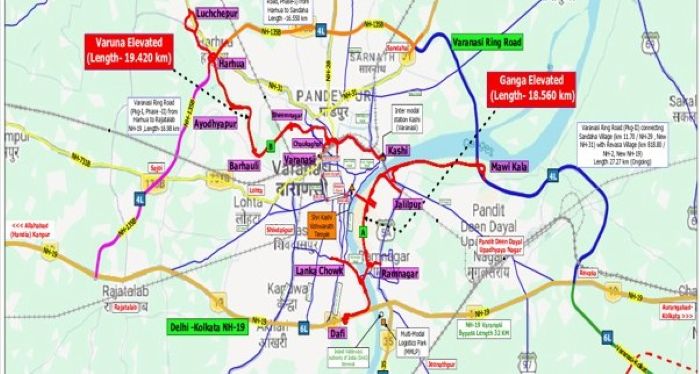
The Union Cabinet has approved 6-lane Greenfield Elevated Corridor covering over 46 kilometers between National Highway-19 and Varanasi Ring Road in Uttar Pradesh on Hybrid Annuity Model, improving urban mobility. Briefing media in New Delhi on Wednesday, Information and Broadcasting Minister Ashwini Vaishnaw said that the total capital cost of the project stands over Rs14,400 crore and will provide seamless connectivity between NH-19 and the Varanasi Ring Road, significantly decongesting the city’s road network and improving urban mobility. It is expected to reduce the average travel time across the project influence area from approximately 60 minutes to 20 minutes. He added that the project will significantly improve connectivity to major religious, educational and cultural landmarks. The cabinet has also approved the development of a over 43 km, 6/4-lane Elevated Corridor connecting NH-31 and the Varanasi Ring Road along the River Varuna for decongestion of Varanasi city. The Project entails a total capital cost of over Rs10,998 crore. The project will reduce travel time between NH-31 and Kashi Railway Station from approximately 40 minutes to 20 minutes, a reduction of nearly 50 percent.
Delhi: Union Minister Ashwini Vaishnaw says, "Along with the Ganga, a new elevated corridor will be built parallel to the river. It will connect Ramnagar, Lanka Chowk and the area near Banaras Hindu University (BHU). A cable-stayed signature bridge will also be constructed as… pic.twitter.com/IMpQDvMdvv
— IANS (@ians_india) July 15, 2026
Vaishnaw said that the cabinet has approved Semicon 2.0 with a budgetary outlay of Rs1.27,500 crore to strengthen India’s semiconductor design and manufacturing ecosystem. He said that building on the momentum of Semicon 1.0, the scheme aims to further the government’s commitment to putting India on the global semiconductor map. He said that the scheme will support economic growth, strengthen supply chain resilience, and establish technological leadership in critical sectors. The Minister said that Semicon 2.0 seeks to holistically build the semiconductor ecosystem through six pillars- Design, Machines and materials, Setting up more fabs, Further strengthening the ATMP-OSAT industry and Research and Development.
The Cabinet approves National Investment Policy for Urea-2026 for Atmanirbhar Bharat (NIPU-2026). The policy will encourage new investments in the Urea sector for setting up the gas based Urea manufacturing units in the country. This will help in the achieving the goal of self-sufficiency. At present, there are 33 operational Urea manufacturing units with total Reassessed/installed capacity of 269.42 LMT. There is a need to increase the indigenous production of Urea. There is a gap in the indigenous production and demand of urea in the country which is filled by the import of urea.











Related Items
Cabinet clears 4 railway multitracking projects worth Rs 9,450 crore
Karnataka cabinet portfolios out: DKS keeps finance, check full list
Delhi govt to introduce e-Cabinet system for paperless proceedings