 Uday Kumar Varma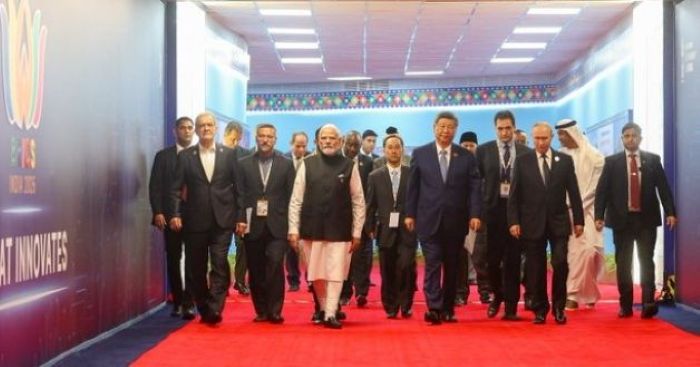
The New Delhi BRICS Summit could hardly have come at a more difficult moment. The world is fractured by wars, trade tensions, sanctions and strategic rivalries. Even multilateral forums that were once accustomed to producing carefully negotiated statements are increasingly finding consensus difficult.
Against this backdrop, the adoption of the New Delhi Declaration by all the BRICS members is more than a procedural achievement. It is a reminder that countries with sharply divergent interests can still find enough common ground to speak together. For India, which hosted the summit, it was a moment of considerable diplomatic accomplishment.
More importantly, the summit has given substance to some of the possibilities we had explored in the earlier article. What seemed like a desirable direction for BRICS has now acquired a measure of concrete expression.
From Possibility to Proof
The most striking feature of the summit was not that BRICS agreed on everything. It plainly did not. The achievement was that it agreed on quite a lot despite having every reason not to.
The negotiations reportedly continued for more than four days, including through the night, before consensus was secured. This was no small feat for an eleven-member grouping that includes countries with very different political systems, strategic interests and relationships with the major powers.
The 140-point New Delhi Declaration is consequently best read not as a statement of ideological unity but as a map of areas where cooperation remains possible. That distinction may be the most important lesson of the Delhi Summit.
Development as the Common Ground
Much of that common ground lies in economics and development—the terrain on which BRICS has the greatest chance of becoming consequential.
The Declaration pushes for easier and more efficient cross-border payments, greater use of local currencies, expansion of local-currency financing by the New Development Bank and the exploration of a new investment platform. It also advances cooperation in digital public infrastructure, artificial intelligence, industrial capabilities, health, logistics, MSMEs and resilient supply chains.
These may sound like disparate initiatives. They are not. Together they point towards a BRICS that is less interested in creating an alternative political camp and more interested in creating additional instruments for development.
That is a far more useful ambition.
The developing world, more than another ideological bloc, needs more choices—more sources of finance, more resilient supply chains, better technology, easier trade and institutions that give developing economies a larger voice in shaping the rules by which they themselves must live.
Climate Without Dogma
The same pragmatism was visible in the treatment of energy and climate change.
The Declaration calls for a “just, orderly, equitable and inclusive” energy transition while acknowledging that fossil fuels will continue to play an important role, particularly in emerging and developing economies. It also invokes technological neutrality and the principle of common but differentiated responsibilities.
This is significant because the energy transition cannot mean the same thing for countries at very different stages of development. For a developing economy, energy security, affordability and access remain inseparable from the climate question. BRICS appears to have recognised this reality without abandoning the larger objective of sustainability.
A Significant Stand on Terrorism
For India, however, another part of the Declaration carries particular significance.
The BRICS leaders explicitly condemned the terrorist attack in Pahalgam on April 22, 2025, in which 26 people were killed. More importantly, the Declaration went beyond the particular incident to reaffirm a commitment to combating terrorism “in all its forms and manifestations”, including the cross-border movement of terrorists, terrorism financing and safe havens. It called for zero tolerance and rejected double standards in combating terrorism.
The language matters. Countries with very different strategic interests—including China—accepted an explicit reference to Pahalgam and a broader formulation addressing cross-border terrorism, financing and safe havens.
India therefore succeeded in making terrorism, and specifically Pahalgam, a matter of collective BRICS concern. In a grouping as diverse as this, that is not a minor achievement.
Where Consensus Had Its Limits
The limits of the consensus are equally instructive.
On West Asia, Ukraine, sanctions and the larger contest over the international order, the Declaration necessarily reflects multiple national positions rather than a single BRICS position. It calls for restraint, dialogue and diplomacy while accommodating the very different perspectives of its members. On unilateral sanctions and trade restrictions too, there was considerable convergence, but not necessarily a common geopolitical interpretation.
And significantly, BRICS did not turn itself into an explicitly anti-Western or anti-American alliance. India had consistently resisted such a direction, and the Delhi Summit reinforced the idea of BRICS as a platform for cooperation rather than confrontation. Even the more ambitious rhetoric around reducing dependence on Western financial systems did not translate into the creation of a common BRICS currency or an institutional rupture with the existing global order.
This restraint may ultimately strengthen BRICS rather than weaken it.
India’s Diplomatic Moment
There is, therefore, good reason to give India substantial credit for the outcome. Diplomacy is ultimately conducted by people, and leadership matters. And in this case, the leadership was not merely about presiding over a summit; it was about holding together a consensus among countries whose differences were, in some respects, profound.
India managed to keep the agenda anchored in development and practical cooperation, while allowing space for contentious geopolitical issues without letting them overwhelm the forum. That required considerable diplomatic skill, patience and political judgement. The fact that consensus survived four days of difficult negotiations is itself testimony to the quality of the diplomatic effort.
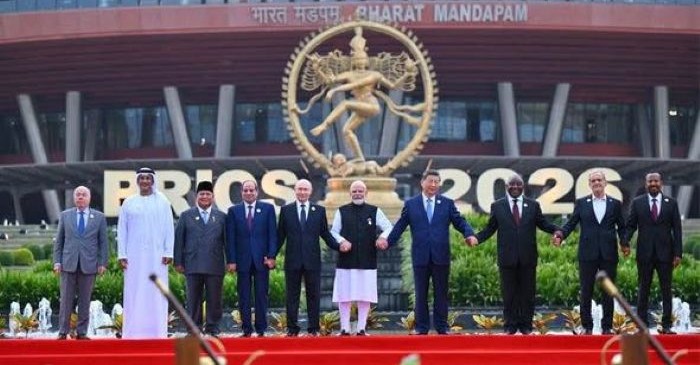
Prime Minister Narendra Modi's personal engagement with the participating leaders, including Xi Jinping, Vladimir Putin and others, was an important part of that effort. His ability to engage different interlocutors, to identify areas of convergence and to keep the larger purpose of the summit in view contributed significantly to the eventual outcome.
One is, on this count, tempted to become eulogical. Yet perhaps the most appropriate response is also the simplest: a tricky and intractable diplomatic mission was accomplished with tact, finesse and grace. India did not seek to make BRICS speak with one voice on everything. It helped the grouping discover what it could speak about with one voice.
That is no mean achievement.
The Delhi Moment
The real significance of the Delhi Summit will, however, be determined by what happens after the declarations are signed and the leaders have gone home.
BRICS has now demonstrated that it can produce consensus without pretending that its members are political allies. It has shown that development, trade, technology, energy, climate, health and terrorism can provide a wider and more durable basis for cooperation than geopolitics alone.
That was the possibility we had glimpsed before the summit. Delhi has now provided some evidence that it is possible.
The challenge is to convert that evidence into institutions, projects and outcomes that ordinary citizens can eventually see and feel. The payment systems must become cheaper. Development finance must become easier. Technology cooperation must become real. The promises on energy, health and digital infrastructure must move beyond declarations.
BRICS has not solved the world's divisions. Nor was it ever likely to.
But in New Delhi it demonstrated something perhaps more valuable: the world's divisions need not make cooperation impossible.
That, ultimately, may be the real Delhi Moment.
(Uday Kumar Varma is an IAS officer. Retired as Secretary, Ministry of Information & Broadcasting)









Related Items
Diplomatic achievement: Mayawati lauds adoption of BRICS Declaration
3-day Dryland Congress 2026 concludes in New Delhi
BRICS declaration flags nuclear risks, tariffs, condemns J-K terror attack