 Newsinc24 Team
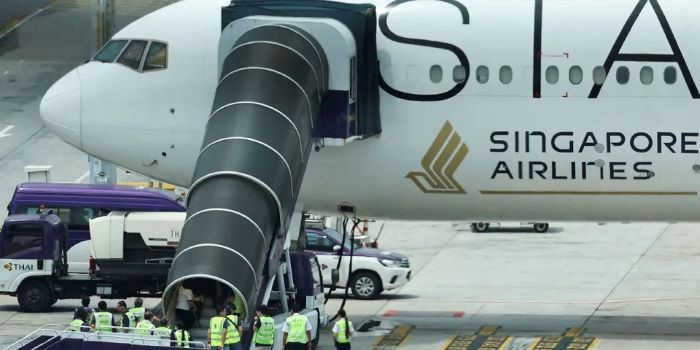
Passengers on Singapore Airlines flight SQ321 endured 19 seconds of extreme turbulence that included a drop of 178 feet in just 4.6 seconds – representing a vertical speed of 26mph. They also suffered violent changes in vertical acceleration.“This sequence of events likely caused the injuries to the crew and passengers,” say investigators.The Boeing 777 had departed from London Heathrow on a routine flight to Singapore. As it was flying south of Myanmar at 37,000 feet on 21 May, it hit violent turbulence. A 73-year-old British man, Geoff Kitchen, died of a heart attack during the incident. Other passengers and crew were injured, some of them seriously.Singapore’s Transport Safety Investigation Bureau (TSIB) has now issued its Preliminary Investigation Findings of Incident Involving SQ321 on Wednesday.
Singapore's Transport Ministry said investigators, including those from the U.S. National Transportation Safety Board, Federal Aviation Administration and Boeing, had compiled a chronology of events based on the preliminary analysis of the flight's data and cockpit voice recorders.The inflight drama began at 7.49am GMT as the plane flew through “an area of developing convective activity”. The aircraft was on autopilot.The report says: “An uncommanded increase in aircraft altitude, reaching a peak of 37,362 feet, was recorded. In response to this uncommanded altitude increase, the autopilot pitched the aircraft downwards to descend back to the selected altitude of 37,000 feet.“In addition, the pilots observed an uncommanded increase in airspeed which they arrested by extending the speed brakes. While managing the airspeed, at 07:49:32 hr, it was heard that a pilot called out that the fasten seat belt sign had been switched on.”
It took 11 seconds for the seatbelt sign to be switched on after the turbulence began. The pilots took over control from the autopilot.The ordeal for passengers and crew continued.“At 07:49:40 hr, the aircraft experienced a rapid change in G as recorded vertical acceleration decreased from positive 1.35G to negative 1.5G, within 0.6 sec. “This likely resulted in the occupants who were not belted up to become airborne,” report said.“In the midst of the sequence of rapid changes in gravitational force (G), recorded data indicated that the pilots initiated control inputs to stabilise the aircraft, disengaging the autopilot in this process.” The pilots manually controlled the aircraft for 21 seconds before reengaging the autopilot. When cabin crew told pilots of the injuries, they decided to divert to Bangkok. The “normal, controlled descent” began 17 minutes after the plane first hit turbulence.
It was unclear what caused the turbulence. Most people associate turbulence with heavy storms, but the most dangerous type is so-called clear air turbulence. Wind shear can occur in wispy cirrus clouds or even in clear air near thunderstorms, as differences in temperature and pressure create powerful currents of fast-moving air.



Related Posts
Cabinet approves India-Singapore MoU to boost aviation MRO Sector
Sensex fall 500 pts, Nifty below 25,250 amid selling pressure
Auto retail sales fall 23.8% to 31.72 lakh units in Oct: FADA