 Krishan Gopal Sharma
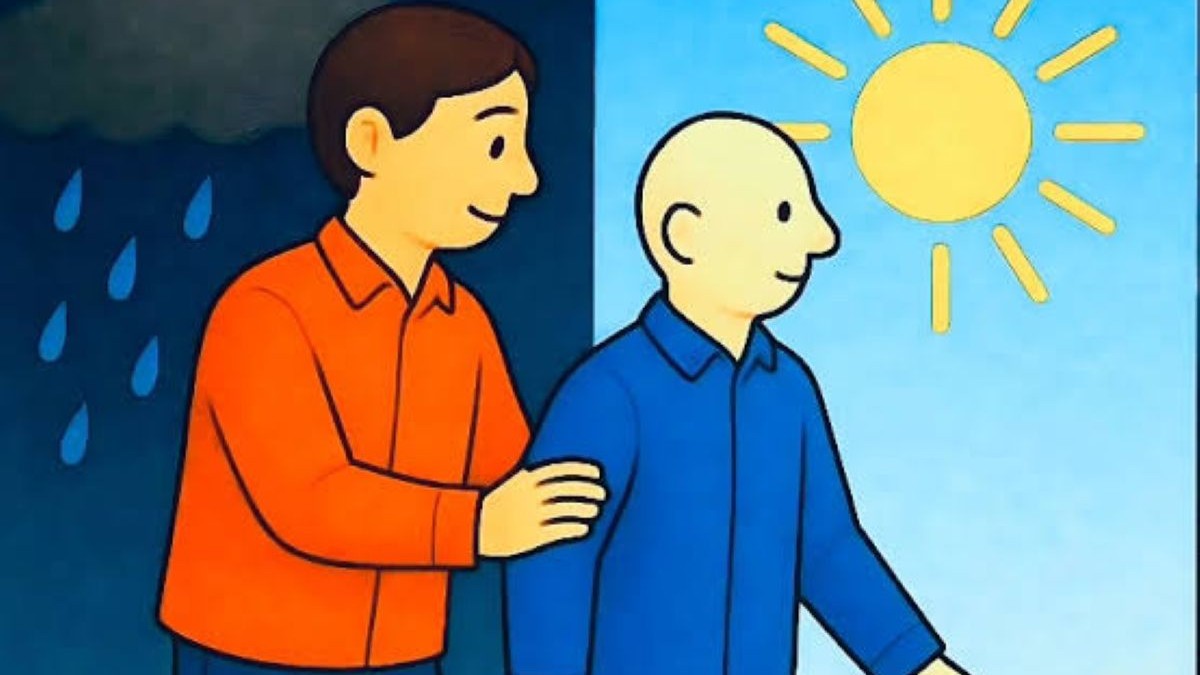
When life begins to unravel, human beings instinctively look for something to hold on to.
For a person crushed by poverty, confronted by sudden grief or caught in a disaster, the search for God is rarely an intellectual exercise. It is not a theological seminar or a philosophical debate. It is something much more primitive: a desperate search for an anchor when everything familiar seems to be slipping away.
At such moments, the human mind reaches beyond what it can see and control. Millions turn towards a supreme power, asking for protection, meaning, strength or simply the courage to endure another day. Sometimes the crisis passes. Sometimes a prayer appears to have been answered. Sometimes nothing changes at all. Yet faith may survive both outcomes.
Perhaps that is because faith, at its deepest level, is not merely a bargain with the supernatural. It is also a way of refusing to surrender to despair.
And that raises an uncomfortable but fascinating question: what if the companion we have spent centuries searching for outside ourselves has always been present within us?
The God we were taught to seek
Human civilisation has built magnificent places in which to encounter the divine. Temples, mosques, churches, monasteries and shrines have become repositories of faith, memory and community. There is nothing inherently wrong with that. For countless people, these places provide comfort, belonging and a language through which suffering can be understood.
The difficulty begins when the institution starts presenting itself as the exclusive gateway to God.
Then faith can become transactional. Offer this. Perform that ritual. Visit this shrine. Make this donation. Follow this prescribed path. Obey this authority.
The infinite begins to acquire an address.
The irony is that many of the world's great spiritual traditions have said almost the opposite: that the divine cannot be confined to a building, a ritual or a human intermediary.
Rabindranath Tagore captured the thought beautifully:
“Leave this chanting and singing and telling of beads! Whom dost thou worship in this lonely dark corner of a temple with doors all shut? Open thine eyes and see thy God is not before thee!”
Perhaps the real question, therefore, is not whether God exists somewhere above us.
Perhaps it is: have we been looking in the wrong direction?
The intelligence already inside us
Consider a newborn child.
Within moments of entering a world it has never seen, the infant begins breathing. It can suck, swallow, grasp and respond to certain stimuli through innate reflexes. No parent sits beside the newborn giving instructions on how to perform these basic acts. They are part of the extraordinary biological machinery with which life arrives.
That does not scientifically prove God.
But it does confront us with something equally astonishing: life contains an extraordinary capacity for self-organisation.
Look at a seed beneath the soil. It has no map of the world above it. Yet, given the right conditions, it begins to germinate. A plant responds to light through mechanisms involving photoreceptors and growth-regulating hormones. Its biological clock responds to cycles of light and darkness. It does not need a conscious hand to tell every cell what to do.
Modern biology explains much of this through evolution, genetics, cellular signalling and adaptation. These explanations do not make the phenomenon less wondrous. If anything, they make it more so.
And perhaps this is where science and spirituality need not become adversaries.
One person may look at this astonishing self-organising complexity and call it evolution.
Another may call it the intelligence of creation.
A third may call it God.
The scientific description does not necessarily settle the philosophical question.
The library inside the mind
Something similar happens within the human brain.
A lifetime of experience is stored, modified and recombined in ways of which we remain only partly conscious. Memory, imagination, emotion and association interact continuously. During periods of rest or mind-wandering, the brain's default mode network is involved in internally directed thought, autobiographical memory and imagination. Research has also found links between this network and creative thinking.
This may help explain why a solution sometimes appears when we have stopped consciously searching for it.
A scientist struggles with a problem for weeks. A writer cannot find the right sentence. An inventor keeps returning to the same dead end. Then, while walking, bathing, travelling or simply sitting quietly, something suddenly connects.
The experience can feel almost supernatural.
But the brain has been working with the material all along.
That does not make inspiration ordinary. It makes the human mind extraordinary.
There is still much we do not understand about consciousness, intuition, creativity and insight. Neuroscience has not discovered a single "creativity centre" in the brain, nor can it reduce every flash of insight to one simple mechanism.
That uncertainty matters.
Perhaps the honest position is not to replace one dogma with another, but to admit that the more we discover about ourselves, the less simple the mystery becomes.
When survival takes over
The same hidden intelligence becomes visible during crisis.
A person caught in an accident may suddenly perform an act of strength that seems beyond ordinary capacity. Someone facing an immediate threat can become intensely alert, focused and decisive. The body's stress-response systems can mobilise energy and attention with remarkable speed.
We often describe such moments in spiritual language.
"He was protected."
"She was given extraordinary strength."
"God saved him."
Perhaps those statements express something psychologically real even when science describes the mechanism differently.
The human being possesses reserves that ordinary life rarely demands.
Crisis sometimes opens the door to them.
The Sundarbans offers an even more fascinating example of how human beings have negotiated this relationship between fear, nature and faith. The region is home to the Royal Bengal tiger, estuarine crocodiles and a remarkable diversity of life, while its communities have developed rich traditions around living with such dangers. The legend of Bonbibi, regarded as a protector of people entering the forest, remains an important part of the cultural landscape.
This is not simply primitive superstition.
It is also a cultural way of teaching human beings humility before an environment they cannot dominate.
Perhaps faith, at its best, does something similar. It tells us that we are not the centre of everything.
The God who watches
There is another dimension to the question.
Many religious traditions teach that God watches what we do. The image of an all-seeing divine observer has helped societies construct moral boundaries: do good, avoid evil, because someone is watching.
But what happens when nobody is watching?
There is still the self.
We can deceive other people. We can sometimes escape the law. We can manufacture explanations for almost anything.
But we carry ourselves everywhere.
The mind can become its own courtroom.
Guilt, remorse, shame and moral conflict are not simply theological concepts. They are also deeply human psychological experiences. Our moral life is shaped by conscience, social learning, empathy, reflection and the consequences of our actions.
Immanuel Kant expressed the mystery with extraordinary economy:
“Two things fill the mind with ever new and increasing admiration and awe... the starry skies above me and the moral law within me.”
The phrase contains an intriguing possibility.
Perhaps the God we imagine looking down upon us is, at least partly, the moral presence we experience looking inward.
When faith becomes a weapon
The trouble begins when a private spiritual experience is converted into an institutional claim of ownership.
History is filled with examples of religion being intertwined with political power, territorial ambition and social control. Different traditions have, at different times, claimed exclusive possession of truth. Once that happens, the question changes from How should I live? to How must everyone else live?
That is where faith can become dangerous.
The problem is not belief itself.
The problem is the human desire to possess the truth.
A person may say, "This is what gives my life meaning." That is faith.
The moment the same person insists, "Therefore you must believe exactly what I believe," faith begins moving towards authority.
And authority, when mixed with fear and political power, has historically proved capable of doing terrible things.
Perhaps God is not where we were told to look
None of this requires declaring that God does not exist.
That would merely replace one certainty with another.
Science can describe the biological mechanisms through which a seed grows, a child breathes and a brain generates ideas. It can investigate the chemistry of emotion, the circuitry of memory and the physiology of survival. But science cannot, by itself, answer every metaphysical question about why there is something rather than nothing, why consciousness exists or whether existence possesses a purpose.
Those questions remain open.
And perhaps they should.
The more mature spiritual position may therefore be one of humility: God need not be imagined as a celestial administrator intervening in every event to make faith meaningful.
God may be understood differently — as creator, consciousness, moral presence, mystery, nature, love or something for which human language has no adequate name.
Or perhaps there is no God at all.
The important discovery may lie elsewhere.
When a frightened mother holds her child through a night of uncertainty, when a stranger helps another stranger after a disaster, when someone finds the courage to begin again after losing almost everything, something remarkable has happened.
Whether we call that strength biology, evolution, love, human resilience, grace or God may depend upon the language of our faith.
But the strength itself is real.
The companion within
Perhaps that is where the search should finally lead.
Not away from the world, but deeper into it.
Not towards a God imprisoned behind the walls of a shrine, but towards the mystery present in a human conscience, a child's first breath, a seed pushing through darkness, a mind suddenly discovering an idea, or a wounded human being finding the courage to stand again.
Faith does not have to disappear when science enters the room.
Nor does science have to bow before faith.
There may be room for both — provided neither pretends to possess every answer.
Perhaps the oldest human question — Where is God? — deserves a surprisingly simple response.
Look within.
Look around.
Look at the extraordinary fact that, despite everything that has happened to us, life keeps trying to live.
Maybe God is not always the hand that rescues us from the storm.
Maybe, sometimes, God is the quiet strength that helps us stand in the storm.
And perhaps the companion we have been travelling so far to find has been walking beside us all along.
Author's Note
This is not an argument against religion, nor an attempt to prove or disprove God through science. It is an invitation to reconsider where we place the divine in our imagination.
Perhaps faith becomes more beautiful when it does not need to exclude reason, and reason becomes more humane when it accepts that not every mystery has yet been solved.
The question may therefore remain open.
Where is God?
Maybe the answer is not there.
Maybe, at least sometimes, it is here — in the courage to endure, the conscience to choose, the capacity to love, and the astonishing resilience to begin again.
<><><>
(Author: kgsharma1@gmail.com; The writer is a retired officer of the Indian Information Service and a freelance writer. Also worked as an international media consultant with UNICEF Nigeria and contributes regularly to various publications.)


Related Posts
Punjab: Two AAP MLAs quit party
22 Indians, including 14 seafarers killed in West Asia conflict: MEA
UN delegates walk out, Netanyahu calls them moral cowards