 Krishan Gopal Sharma
“The most potent weapon in the hands of the oppressor is the mind of the oppressed.” — Steve Biko
The Trigger
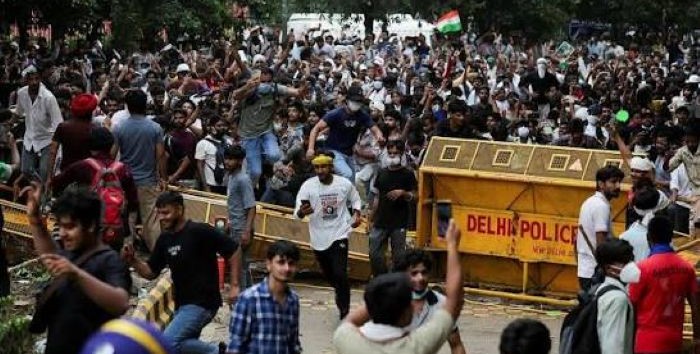
A crowded public square at Jantar Mantar, New Delhi. Amid the familiar choreography of barricades, heavy-handed policing, and television reporters hunting for the loudest soundbite, a young university student steps forward.
There is no megaphone. No slogan. No placard packed with furious text or the rehearsed vocabulary of professional protest.
Instead, the student raises a completely blank sheet of white paper.
In that single, unadorned gesture, the entire theatre of modern political communication falters. The authorities hesitate, uncertain how to criminalise what has not been written. The cameras, dependent on quotable outrage, confront a silence they cannot easily package for prime-time debate.
By refusing both the etiquette of deference and the script of predictable anger, Gen Z introduced India to a striking new form of dissent: the eloquence of deliberate silence.
When Language Becomes a Tool of Control
For centuries, power has rarely relied on force alone. It has also relied on language.
Under the respectable banners of decorum, civility, and diplomatic restraint, societies created elaborate linguistic hierarchies that protected authority from direct challenge. To confront a feudal landlord, a patriarchal elder, a colonial administrator, or an institutional elite, the marginalised were often expected to speak in the vocabulary designed by those very structures.
The ritual mattered.
The moment a grievance began with “My Lord”, “Your Excellency”, or “Sir”, the hierarchy had already been acknowledged before the argument had even started.
This is how structural violence often acquires a polite face. Exploitation is translated into procedure; inequality becomes etiquette; exclusion is wrapped in formal respectability.
And when the aggrieved abandon that controlled vocabulary and speak in raw, unfiltered language, they are frequently dismissed as uncivilised, vulgar, or unreasonable.
In such systems, language does not merely communicate reality; it manages reality. It softens injustice, protects prestige, and trains citizens to perform obedience even while protesting.
The Press and the Quiet Flattening of Hierarchy
Long before internet culture began mocking institutions, a quieter revolution had already taken place inside newspaper style guides.
Editors, partly for reasons of space and partly for reasons of consistency, gradually stripped away many honorifics and ceremonial titles. Mr, Mrs, Ms, His Honour, and similar linguistic decorations began disappearing from serious news writing.
The effect was larger than it appeared.
Archaic hierarchies
Preserved through honorifics and ceremonial decorum
Press style removes titles
Surnames on second reference become the common standard
Democratic equivalence
Tycoon, politician, and activist share the same linguistic baseline
A billionaire, a cabinet minister, and a grassroots organiser were increasingly reduced to the same linguistic baseline: their surname on second reference.
This editorial minimalism did not abolish inequality, but it did erode one of its daily rituals. It suggested that public discourse need not constantly rehearse social rank.
Hierarchies begin to weaken the moment people stop performing them verbally.
Jantar Mantar and the Weaponisation of Absurdity
The recent wave of youth-led demonstrations in India, especially around Jantar Mantar, represents a further evolution of that linguistic flattening.
This generation has grown up in an environment saturated with political rhetoric, corporate public relations, algorithmic outrage, and televised shouting matches that often generate more heat than meaning.
Many young people have reached a disquieting conclusion: conventional political language has become exhausted.
As George Orwell warned:
“When language is corrupted, people lose their ability to see reality.”
In response, Gen Z has not merely changed its slogans; it has changed the very grammar of protest.
Instead of lengthy ideological declarations, it deploys compressed visual metaphors, irony, memes, dark humour, and local slang. A serious structural crisis may appear on a poster as a joke sharp enough to travel faster than any manifesto.
What appears frivolous is often strategically economical.
Humour bypasses gatekeepers. Ridicule punctures fear. Absurdity exposes the absurd.
By refusing to sound solemn in the approved manner, these young protesters deny institutions the comfort of predictable opposition.
The Blank Poster and the Politics of Silence
The blank poster is the most radical expression of this new communicative landscape.
It also carries a powerful historical echo. During the Emergency of 1975–77, some newspapers used blank editorial spaces to signal censorship without printing the censored words.
The contemporary blank placard revives that logic for the age of surveillance and viral media.
When words can be banned, distorted, clipped, or selectively circulated, an empty sheet becomes unexpectedly difficult to control.
It cannot be misquoted.
It cannot be edited.
It cannot be fact-checked into submission.
Most importantly, it transfers the burden of meaning to the viewer.
The state sees suspicion. The supporter sees courage. The critic sees provocation. The undecided citizen sees a question.
Silence becomes a mirror.
And mirrors are unsettling because they force institutions to confront not what is written, but what is already known.
In a culture drowning in noise, the blank canvas achieves something rare: it creates a pause. And sometimes a pause is more disruptive than a shout.
Beyond Protest: A New Democratic Language
What is emerging is not simply a new protest tactic; it is a new democratic sensibility.
The old order relied on participation through prescribed forms: respectful petitions, approved vocabulary, recognised leaders, and controlled channels of dissent.
Gen Z is experimenting with participation that is decentralised, visual, ironic, and often leaderless.
This shift has dangers. Irony can become cynicism; memes can oversimplify complex realities; silence can be misunderstood.
Yet it also contains a profound democratic insight: citizens are not obliged to express themselves only in the language that power finds comfortable.
Every generation eventually redesigns the tools through which it experiences authority. For some, it was the pamphlet; for others, the newspaper editorial, the street slogan, the protest song, or the hashtag.
For this generation, it may sometimes be the meme, the visual fragment, the refusal to explain, or the blank sheet held aloft in a crowded square.
Conclusion
Language is never neutral. It is one of the principal instruments through which societies distribute dignity, authority, and fear.
The significance of India’s Gen Z protests lies not merely in what the young are opposing, but in how they are choosing to communicate.
By discarding feudal honorifics, ignoring elite codes of decorum, embracing satire, and at times weaponising complete silence, they are challenging the assumption that legitimacy belongs automatically to those who control official language.
The blank poster does not announce a finished ideology.
It announces a refusal.
A refusal to decorate power with unnecessary reverence.
A refusal to translate anger into approved bureaucratic grammar.
A refusal to allow meaning to be monopolised by institutions.
When the inherited vocabulary of a society begins to protect privilege more effectively than it protects truth, democracy does not merely need louder voices.
It needs new languages.
And sometimes, the most unsettling language of all is the one that says nothing — and forces everyone else to confront what they already know.
Author’s Note
This essay is not an endorsement of any political group or protest movement. It is an attempt to examine a deeper transformation in the way human beings communicate dissent in the twenty-first century.
Words are tools. When old tools become ceremonial, exhausted, or incapable of expressing lived reality, societies inevitably search for new ones. The blank placard, the meme, the ironic slogan, and the strategic silence are all part of that search.
Whether these forms ultimately deepen democracy or merely reshape its aesthetics remains an open question. But they have already revealed something important: power is challenged not only by louder speech, but also by the refusal to speak in the language that power expects.
(Author: kgsharma1@gmail.com; The writer is a retired officer of the Indian Information Service and a former Editor-in-Charge of India’s national broadcasters. Also worked as an international media consultant with UNICEF Nigeria and contributes regularly to various publications.)

Related Posts
Manipur: 3 killed by militants, protest erupt, combing Ops launched
Bangladesh: Charge sheet filed against Salma Wazed
Delhi Police de-notify Jantar Mantar as protest venue, name three sites