 Uday Kumar Varma
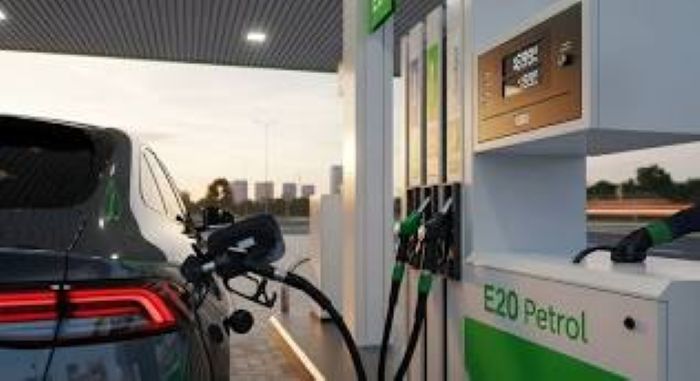
When a fuel blend becomes the subject of political campaigns and even gives birth to a political outfit, it is evident that the debate has travelled well beyond chemistry. India's transition to E20 petrol—20 per cent ethanol blended with 80 per cent petrol—has generated sharply divided opinions. Supporters see it as a milestone in energy security and environmental responsibility. Critics point to lower mileage, possible problems for older vehicles, and the environmental and economic costs of producing ethanol. The recently formed E20 Janta Party, demanding the option of buying unblended petrol, is a striking illustration of how quickly a technical policy can become a political issue. At least two major national opposition parties have also declared their opposition to the use of the blended fuel.
The fundamental question, however, is: whether even if E20 is technically feasible, is it the best way for India to pursue its energy future?
The answer requires separating three questions.
First, is E20 scientifically sound?
Broadly, yes—with qualifications. Modern vehicles designed for E20 are engineered to operate on it. Older vehicles may not be equally compatible with higher ethanol concentrations, and manufacturers should provide clear guidance to owners. Ethanol also contains less energy per litre than petrol. A modest reduction in fuel economy is therefore inherent in the fuel itself, not evidence of faulty engineering.
These are legitimate consumer concerns. But claims that E20 will universally damage engines are equally difficult to sustain. India's experience suggests that E20 is technically viable when used in vehicles and fuel systems designed or certified for it.
Second, is E20 economically justified?
Here the national perspective matters. India imports about 88 per cent of the crude oil it consumes, leaving its economy vulnerable to international prices and geopolitical disruptions. Ethanol blending has risen from 1.53 per cent in 2014-15 to 20 per cent in 2025-26. According to the Ministry of Petroleum and Natural Gas, the programme has, since 2014-15, substituted more than 310 lakh metric tonnes of crude oil and saved over ₹1.9 lakh crore in foreign exchange, besides generating substantial additional income for farmers.
These are significant gains. But they should not be treated as the final word. The real economic benefit of ethanol must be assessed on a net basis. Ethanol itself requires land, water, fertiliser, energy, transport and processing. The foreign exchange saved by reducing crude imports is therefore not necessarily equivalent to the net energy or economic gain to the country. This is a legitimate area for independent scrutiny.
This is also where the argument for giving greater priority to solar power and electric vehicles deserves serious consideration. Converting sunlight directly into electricity and using that electricity to power an EV is, in principle, a more efficient way of converting solar energy into mobility than growing a crop, processing it into ethanol and then burning it in an internal-combustion engine.
But this does not make ethanol redundant.
India has hundreds of millions of vehicles already on its roads. Replacing the existing fleet with EVs will take years, perhaps decades. Charging infrastructure, grid capacity, battery costs and the economics of different categories of transport also vary considerably. E20, by contrast, can reduce petroleum consumption within the existing vehicle fleet. It is therefore better understood as a bridge, not a competitor to the electric future.
Nor is every transport application equally amenable to electrification. While electric mobility is likely to dominate much of tomorrow's passenger-vehicle market, liquid fuels will continue to have a role in several heavy-duty, agricultural and other applications. Sustainable biofuels may therefore remain part of a diversified energy portfolio.
Third, can E20 itself become greener and more efficient?
This is perhaps the most important question for the future.
India should be cautious about expanding ethanol production through ever-greater dependence on food crops or water-intensive sugarcane. The food-versus-fuel question is real, as is the ecological cost of water and agricultural inputs. The next generation of ethanol policy should therefore increasingly favour second-generation ethanol, produced from crop residues, agricultural waste and other non-food biomass.
That would allow India to extract value from material that is otherwise often burnt or wasted, while reducing pressure on food production and water resources.
The experience of other countries is instructive. Brazil has demonstrated that ethanol can become a major component of a national transport system, supported by flex-fuel vehicles. The United States has demonstrated both the scale that biofuels can achieve and the controversies surrounding their agricultural and environmental costs. India need not copy either model. It can develop its own combination of solar power, electric mobility, biofuels, public transport, storage and other emerging technologies.
The objective, therefore, should not be to choose E20 or EVs, ethanol or solar. It should be to determine where each technology makes the greatest economic and environmental sense.
E20 may not be the most efficient long-term solution to India's energy challenge. Solar electricity, batteries and electric mobility are likely to play a much larger role in the India of tomorrow. But abandoning ethanol today would ignore the reality of the enormous internal-combustion fleet already on the road and the energy-security gains that domestic ethanol can provide.
The wiser course is to treat E20 as a transition technology: use it where it makes sense, disclose its costs honestly, protect consumers, continuously test its environmental and economic performance, and progressively shift its feedstock towards waste and non-food biomass. At the same time, accelerate investment in solar power, electricity storage, charging infrastructure and EVs.
The E20 debate should therefore not be about defending a government policy or defeating an opposition campaign. It should be about asking what combination of technologies will give India the greatest energy security with the least environmental and economic cost.
Nations are built not only by the technologies they invent or adopt, but also by the maturity with which they debate them. A nation that hesitates before every technological transition risks being overtaken by those willing to innovate responsibly. India's challenge is not to choose between science and political expedience; it is to ensure that the nation chooses the best options available to it.
(Uday Kumar Varma is an IAS officer. Retired as Secretary, Ministry of Information & Broadcasting)


Related Posts
India pushes for BIOFIN, tech transfer & global cooperation
India-EU investment protection agreement under discussion: Goyal
Mirabai Chanu to lead India at world weightlifting c'ships in China