 Nisha Singh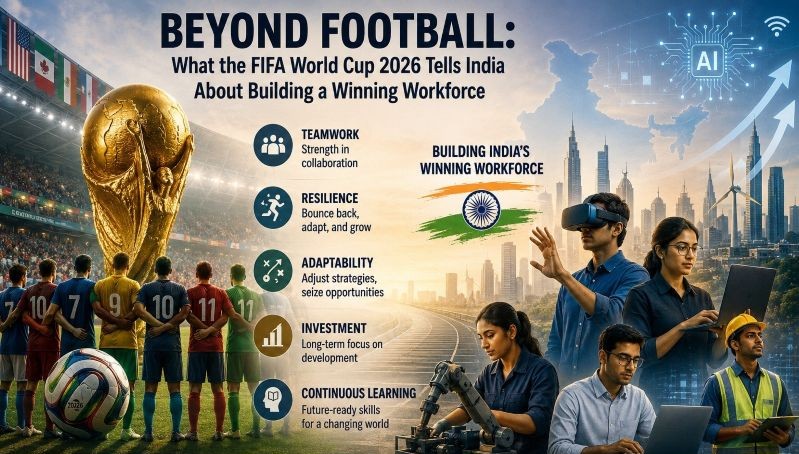
The FIFA World Cup 2026 will be remembered for its unprecedented scale. With 48 teams competing across three host nations, the tournament showcased not only football at its finest but also a powerful lesson about succeeding in an increasingly competitive world. The biggest lesson of the tournament was that sustained success is rarely built on individual brilliance. It comes from systems that continuously develop talent, adapt to change and perform under pressure.
That lesson extends far beyond the football pitch. It offers an important perspective for India's workforce and skilling ecosystem at a time when technological disruption is reshaping the nature of work.
The strongest teams were not always those with the biggest stars. They were the ones that combined technical excellence with squad depth, disciplined execution, tactical flexibility and a culture of continuous improvement. Their success reflected years of investment in coaching, youth development, performance analytics and long-term planning rather than dependence on individual brilliance.
India faces a comparable challenge as it prepares its workforce for an economy increasingly shaped by changing technologies and evolving skill requirements.
As artificial intelligence, automation and digital technologies transform industries, employers increasingly seek workers who can adapt, collaborate and learn continuously. According to the World Economic Forum, technological change is expected to reshape millions of jobs globally over the coming years, making continuous reskilling and upskilling essential rather than optional.
This shift requires India to move beyond viewing skilling as a one-time intervention. Training programmes must prepare individuals not only for their first job but for careers that will evolve repeatedly over the next three or four decades. Technical competencies remain important, but they must be complemented by problem-solving, communication, digital literacy and the ability to learn throughout life.
The World Cup also highlighted the importance of resilience. Teams that encountered setbacks responded by adjusting strategies instead of abandoning them. The same mindset is increasingly valuable in today's labour market, where economic uncertainty, technological disruption and changing business models demand agility from both workers and organisations.
Equally significant was the value of teamwork. Even the world's finest players relied on coordinated systems that enabled collective success. Organisations today operate in much the same way. Innovation rarely emerges from isolated expertise; it flourishes when diverse teams collaborate, share knowledge and solve problems together. Investing in people and organisational culture is therefore as important as investing in technology itself.
India possesses one of the world's youngest populations, providing a significant demographic advantage. Yet a demographic dividend is not guaranteed. It becomes an economic advantage only when education, industry and skilling systems work together to equip people with relevant, future-ready capabilities. As global competition for talent intensifies, countries that invest consistently in human capital will be better positioned to drive productivity, innovation and sustainable economic growth.
The FIFA World Cup demonstrated that championships are not won by talent alone. They are built through preparation, adaptability and sustained investment in developing people. The same principle applies to nations.
For India, the real competition is not on the football field. It is in creating a workforce capable of thriving in an economy defined by rapid technological change and global competition.
The countries that succeed in the coming decade will not simply be those with the largest populations or the fastest-growing markets. They will be those that build resilient, skilled and adaptable talent at scale.
With nearly 65% of its population below the age of 35, India has one of the world's largest young populations. Whether this demographic advantage becomes an economic dividend will depend on the quality of skills, the ability to adapt to technological change and a sustained commitment to lifelong learning.
The final whistle may have ended the tournament, but India's most important match is only beginning. Winning that contest will depend not on the size of our workforce, but on how effectively we prepare it for the future.
(Nisha Singh is a policy analyst under MSDE, working at the intersection of skilling, employability, and workforce development. Views expressed are her own).












Related Items
Mideast war doesn’t serve world’s interests: Xi Jinping
BRICS calls for IMF, World Bank Reforms at Mumbai meet
India's electoral process among most transparent in world: CEC