 Nisha Singh
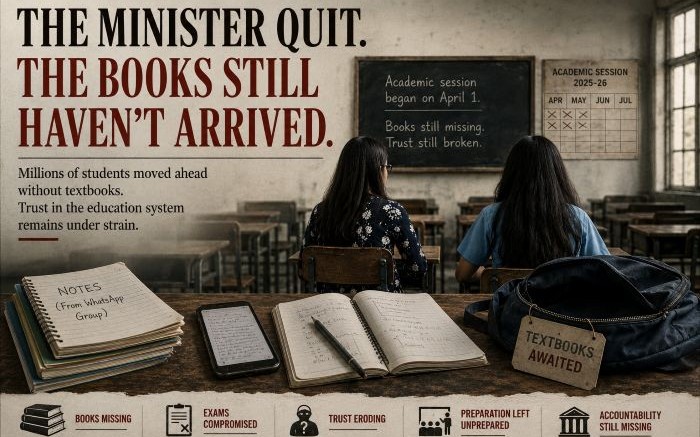
On Saturday, driving with my friend Renu, we got talking, not complaining; she is past that stage about a question she could not answer for her daughter Ahana, a Class 11 student: “Why don’t we have books yet?”
The academic session began on April 1. Teenagers like Ahana and Aaradhya have spent the term copying notes off a WhatsApp group where a parent photographs the blackboard every evening.
Then the girls asked something harder: “I don’t want to study further in this country where nothing is planned.”
A Textbook Was Too Much to Ask. A Fair Exam Wasn't Either.
Renu did not have an answer either. Neither do I, fully. But I know this much: it is not just missing textbooks anymore. It’s teenagers like Ahana and Aaradhya watching the NEET-UG exam cancelled this May over a paper leak, roughly 22 lakh candidates left waiting, the CBI called in and a re-test ordered while young people who had spent years preparing sat wondering whether the system they trusted for their future could still be trusted at all. Add to that CBSE’s on-screen marking mess this year, with thousands of students still waiting for clarity on results months after they should have had them.
These are not rumours. They are the reasons activist Sonam Wangchuk sat on hunger strike at Jantar Mantar for 26 days this June and the reason why what’s now being called India’s Gen Z protest students, first-time voters, young people who had simply had enough, gathered in the streets demanding Education Minister Dharmendra Pradhan resign, led by Cockroach Janta Party’s (CJP) Abhijeet Dipke. Pradhan did resign on 25 July.
Ahana and Aaradhya called that evening, happy that “Mom, Gen Z won.” The demand was met. The deeper failures were not.
Gen Z Won This Round. The Textbooks Are Still Missing.
As a parent, how do you keep a child motivated after that? Nobody tells you. You just do it, quietly, while the system that is supposed to be earning that trust keeps giving reasons to lose it. And then we act surprised when families who can afford it send their children abroad the moment they can.
This is not one family’s bad luck. It is the fourth year running that the basics have failed, and this year, the basics and the big exams failed together.
NCERT had planned to print close to 15 crore textbooks for this session. By early May, barely half 7 to 8 crore had reached a press, let alone a shelf. Officials said the gap would close “by month-end.” The Education Minister reviewed textbook development with NCERT the same week the shortage made news. A review happened. A statement was issued. The books still were not in any child’s bag. The ministers change. The apology-and-review cycle does not.
Now layer the next big idea on top. From this academic year, AI and computational thinking become mandatory from Class 3, tied publicly to the government’s Viksit Bharat 2047 vision. India has roughly one crore school teachers. Independent surveys show many already use AI tools for lesson planning, yet the vast majority have received no systematic preparation to teach the subject properly. Nobody has said, on record, where that training will happen at scale or who will fund it.
This is the pattern and it deserves to be said without softening it: our policymakers keep legislating outcomes and skipping delivery. A framework is signed off in Delhi with real intent. Somewhere between that signature and a classroom in Ghaziabad, the plan stops and stops without consequence. No official is fired over a missed printing deadline. No lasting accountability follows an exam that shook a generation’s trust in one news cycle. The Prime Minister speaks of a developed India by 2047. In 2026, children are still waiting for textbooks.
Gen Z did not take to the streets this year because they are impatient. They took to the streets because they watched the one thing they were told would reward hard work- a fair exam gets compromised, and accountability arrived too slowly. That is not youthful overreaction. That is a patience that had every right to run out.
So, ask the question this system would rather nobody asked aloud: if the government cannot print a textbook on time or run an exam without a leak, four years running, why should any parent believe it is on time for teaching her child artificial intelligence?
Policy is not governance. Governance is what happens after the press release. Right now, it mostly is not happening at all.
(Nisha Singh is a policy analyst under MSDE, working at the intersection of skilling, employability, and workforce development. Views expressed are her own).


Related Posts
Tamil Nadu: Former DMK minister arrested in Rs100-crore scam
Pakistan: Defence Minister flags exodus of top officials in country
Macron rejects Interior Minister’s resignation amid protests in France