 Uday Kumar Varma
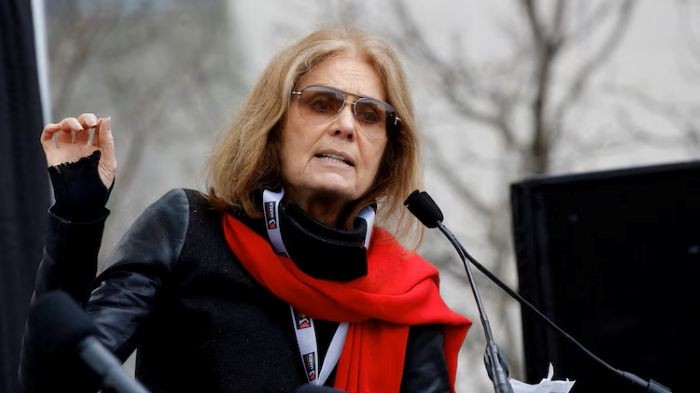
Gloria Steinem, who died yesterday(Thursday) at 92, was much more than an American feminist. For more than five decades, she was one of the most recognisable voices of the women's movement in the United States—a journalist, writer, organiser and campaigner who helped turn women's equality from a private grievance into a public and political question. She was among the defining figures of what came to be known as the Second Wave of American feminism.
But there is an intriguing Indian chapter to the story of this formidable American woman.
In 1956, at the age of 22, Gloria Steinem came to India on a Chester Bowles Asian Fellowship. She was young, curious and, by her own later account, still trying to understand what she wanted to do with her life. She spent time at Miranda House in Delhi, travelled through the country and, remarkably, joined followers of Acharya Vinoba Bhave as they moved from village to village with the Bhoodan movement.
It was not the India of monuments and tourist brochures that she encountered. It was an India of villages, poverty, caste, inequality and extraordinary experiments in social change. She listened to people whose lives were far removed from her own. She encountered Gandhian ideas of non-violence, persuasion and change from below.
Years later, Steinem would acknowledge how deeply this experience had shaped her. She once said that going from village to village with Vinoba Bhave's followers and learning about Gandhian activism had probably helped her become what she became. Perhaps even more revealing was another lesson she carried home: if you want to know how people live, go where they live; if you want people to listen to you, listen to them.
She returned to America and gradually became the Gloria Steinem the world came to know.
Through her journalism, she exposed the casual and institutionalised sexism of American society. Through Ms. magazine, which she helped launch in 1971, she created a powerful new platform for women's voices. Through political organisation and relentless campaigning, she fought for reproductive rights, equality and women's participation in public life. She helped build institutions that outlived individual campaigns and inspired generations of women.
Yet perhaps her most enduring contribution was conceptual. She helped persuade millions that discrimination against women was not merely a collection of individual injustices. It was embedded in social structures, institutions and assumptions that had long gone unquestioned.
And she kept evolving. Her feminism increasingly embraced the connections between gender, race, class and other forms of inequality. She remained an activist well into old age, refusing to become merely a monument to a movement she had helped create.
For India, however, there is another reason to remember her.
The young American who arrived in Delhi in 1956 was not yet a feminist icon. She came as a seeker. India gave her experiences, questions and perhaps, above all, a different way of looking at power and change.
She returned to America and helped change it.
That is why the story of Gloria Steinem in India is more than an interesting footnote to the life of a famous American.
She came to India before she knew what she was looking for.
India helped her discover it.
(Uday Kumar Varma is an IAS officer. Retired as Secretary, Ministry of Information & Broadcasting)


Related Posts
HC acquits Dera Sacha Sauda chief in 2002 journalist murder case
Thanksgiving Feast: Living Story of Native American Cuisine
Mamdani becomes first Indian-American Muslim Mayor of New York City