 Krishan Gopal Sharma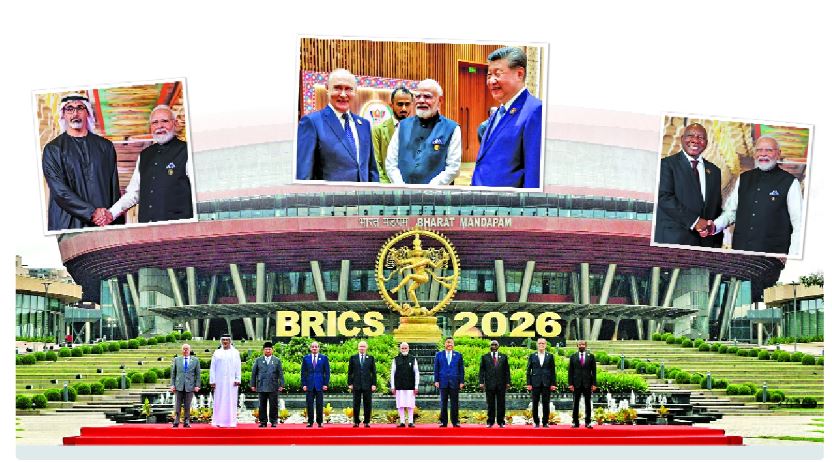
How India Kept an Expanded BRICS at the Table
The easiest thing to predict about an expanded BRICS is that its contradictions would eventually overwhelm its ambitions.
By the time the leaders assembled in New Delhi, the grouping had become a diplomatic paradox: countries with sharply divergent political systems, security interests and relationships with Washington were being asked to speak in one voice. India and China remained competitors despite a cautious thaw. Iran was engaged in an increasingly dangerous confrontation with the United States and its allies. The UAE, meanwhile, had its own security relationships with Washington. Russia remained under Western sanctions. Brazil and South Africa continued to argue for reform of the existing international order rather than its wholesale demolition.
Yet, on 12 September, the impossible happened. The expanded BRICS adopted the New Delhi Declaration, a 140-point document, unanimously.
That achievement deserves more attention than the familiar rhetoric about a rising Global South.
The real story of New Delhi was not that BRICS suddenly became united. It did not. It was that India demonstrated that unity is not always necessary for collective action; sometimes, disciplined disagreement is enough.
The problem was not expansion. It was contradiction
The expansion of BRICS has made the grouping considerably more representative of the developing world. It has also made consensus much harder.
The original BRICS — Brazil, Russia, India, China and South Africa — already contained substantial differences. The addition of Egypt, Ethiopia, Indonesia, Iran and the UAE has made the internal chemistry still more complicated.
This is not an ideological alliance in the conventional sense. Nor is it a military bloc. It is better understood as a platform where countries that disagree on many things have discovered that they share a growing dissatisfaction with aspects of an international system they believe does not adequately represent them.
That distinction matters.
The temptation has been to describe BRICS as either the embryo of a new anti-Western order or an unwieldy club destined to collapse under the weight of its contradictions. Both descriptions are too simple.
India's diplomacy in New Delhi offered a third possibility: BRICS can be non-Western without becoming anti-Western.
That may ultimately prove to be the grouping's most sustainable identity.
The Iran-UAE test
The most immediate test was West Asia.
The presence of Iran and the UAE within the same expanded grouping acquired particular significance as the conflict involving Iran, the United States and the wider region intensified. Reaching common language on the crisis was never going to be easy.
Yet the two countries ultimately endorsed a joint BRICS position calling for restraint, de-escalation, protection of civilians, respect for sovereignty and the safeguarding of global trade and maritime stability. Iranian President Masoud Pezeshkian also met Abu Dhabi's Crown Prince Sheikh Khaled bin Mohamed bin Zayed — a striking diplomatic encounter in the circumstances.
This is where the value of multilateral diplomacy becomes visible.
Diplomacy does not always resolve the conflict outside the room. Sometimes its first achievement is simply preventing the conflict from destroying the room itself.
The New Delhi Declaration avoided language that would have forced individual members into a choice between their bilateral loyalties and the collective position. It condemned aggression and violations of sovereignty without turning the declaration into a prosecutorial document against a particular country.
That was not weakness. It was diplomatic engineering.
As the old Kikuyu proverb puts it, when elephants fight, it is the grass that suffers. For much of the developing world, the economic consequences of great-power confrontation — disrupted trade, energy insecurity, higher transport costs and financial instability — are not abstract geopolitical statistics. They are domestic problems.
India understood that.
The Xi-Modi encounter was equally important
The BRICS story in New Delhi cannot be separated from the return of Chinese President Xi Jinping to India after seven years. His bilateral meeting with Prime Minister Narendra Modi lasted about 45 minutes and carried significance well beyond its duration.
The meeting did not erase the India-China boundary dispute. Nor should it be interpreted as a dramatic strategic reset.
Its importance lay elsewhere.
India's message was that competition with China does not require permanent diplomatic paralysis. Modi reiterated the importance of mutual respect, mutual sensitivity and mutual interest, while stressing that peace and tranquillity along the border remain essential for the development of wider relations.
This is strategic autonomy in its more mature form.
It is not choosing Washington over Beijing, Moscow over Washington or Beijing over Moscow. It is refusing to allow any one relationship to dictate the entirety of India's foreign policy.
That is a considerably harder doctrine to practise than to proclaim.
Where the real bargaining happened
The most consequential diplomacy at a summit is rarely conducted before television cameras.
It happens in the drafting rooms, where a word is removed from one paragraph, an adjective inserted into another and a sentence carefully constructed so that three countries can interpret it differently without formally disagreeing.
The New Delhi Declaration reflects precisely that kind of diplomacy.
On terrorism, for instance, BRICS leaders condemned in the strongest terms the 22 April 2025 Pahalgam attack, in which 26 people were killed. The declaration reaffirmed opposition to terrorism in all its forms, including cross-border movement of terrorists, terror financing and safe havens, and called for zero tolerance and an end to double standards.
For India, this was clearly significant.
But it would be an overstatement to portray the declaration simply as India forcing China to accept an Indian formulation. The language was embedded within the broader BRICS vocabulary of international law, sovereignty and collective counter-terrorism. That is precisely why it could command consensus.
The diplomatic achievement lay not in making everyone speak India's language, but in finding language that India could accept without requiring everyone else to surrender their larger geopolitical positions.
That is a subtler victory.
The BRICS identity India defended
There was another battle taking place beneath the formal agenda: what exactly should BRICS become?
Russia and China have obvious reasons to favour a stronger challenge to Western financial and political dominance. Sanctioned countries such as Russia and Iran naturally see greater value in alternative financial arrangements and local-currency trade.
But India has little interest in turning BRICS into an ideological anti-Western coalition.
Its own economic and technological relationships with the United States and Europe are too important. So are its partnerships with Russia, the Gulf states and other members of the expanded grouping.
New Delhi therefore pushed BRICS towards a language of reform rather than rupture.
The declaration criticises unilateral tariffs, sanctions and protectionist measures while simultaneously reaffirming multilateralism and international cooperation. It supports greater representation for developing countries in global institutions, including reform of the UN Security Council. It also backs greater use of local currencies and alternative payment mechanisms.
This is the distinction that deserves to be understood.
India is not arguing that the existing international order should be destroyed. It is arguing that an order created largely without the Global South cannot remain legitimate without it.
That is a very different proposition from simply replacing one hegemon with another.
The India dividend
For India, the summit also demonstrated the value of hosting.
The New Delhi Declaration gave considerable space to issues central to the developing world: development finance, digital cooperation, energy transition, trade, institutional reform and greater representation in global governance. It also endorsed stronger use of local currencies and alternative payment systems.
There is, however, a danger in describing every such provision as an Indian "windfall".
BRICS declarations are negotiated documents. They reflect compromises among members rather than trophies carried home by the host.
India's real gain was therefore less tangible — and arguably more important.
It demonstrated that it could sit simultaneously with Washington, Moscow, Beijing, Tehran and the Gulf powers without allowing any of them to define the limits of its diplomacy.
That is not balancing for the sake of appearances. It is balancing in pursuit of national interest.
Pragmatism as strategy
The New Delhi Summit may ultimately be remembered less for what BRICS agreed upon than for what it managed not to become.
It did not become a formal anti-Western alliance. It did not allow the West Asia crisis to fracture the grouping. It did not allow India-China rivalry to overwhelm the summit. It did not abandon the demand for reform of global institutions. And it did not pretend that ten countries with profoundly different interests had suddenly discovered a common ideology.
That may be the most important lesson from Delhi.
In an age increasingly dominated by binary choices — East or West, America or China, alliance or opposition — India demonstrated the continuing usefulness of the diplomatic middle ground.
The New Delhi Declaration is therefore more than another summit communiqué. It is evidence that an expanded BRICS can function despite its contradictions, provided those contradictions are managed rather than denied.
The real achievement of Indian diplomacy was not to make BRICS speak with one voice.
It was to persuade ten very different countries that, despite everything separating them, there was still enough in common to keep talking.
And perhaps that is how a new global order will actually emerge — not through one dramatic rupture, but through a succession of difficult compromises in rooms where nobody gets everything they want, yet everybody finds enough reason to remain at the table.
<><><>
(Author: kgsharma1@gmail.com; The writer is a retired officer of the Indian Information Service and a freelance writer. Also worked as an international media consultant with UNICEF Nigeria and contributes regularly to various publications.)











Related Items
India Passes BRICS Baton to China, PM Modi seeks timely action on Declaration
Diplomatic achievement: Mayawati lauds adoption of BRICS Declaration
BRICS: The Delhi Moment