 Krishan Gopal Sharma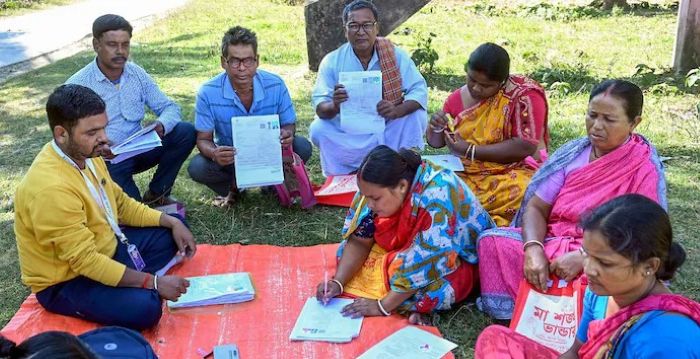
When a clerical error becomes a democratic question
A missing vowel. A misplaced maatra. A surname entered differently by a data-entry operator years ago. On paper, such errors may have meant little. In a database, however, they can acquire an entirely different significance — becoming a discrepancy, an anomaly and, potentially, a reason to question whether a citizen belongs on the electoral roll.
That is where the growing use of technology in electoral-roll revision deserves closer scrutiny. The Special Intensive Revision (SIR) of electoral rolls has been presented as an exercise in cleaning up electoral databases, removing duplication and ensuring that only eligible citizens remain enrolled. Those are legitimate objectives. No democracy benefits from inaccurate electoral rolls.
But there is a question that cannot be left to software alone: when does a discrepancy stop being a clerical problem and become a question about a citizen's right to vote?
The distinction matters because databases deal in exact matches, while human identities rarely do.
The discrepancy trap
India's electoral system has accumulated decades of paper records, digitisation, migration, changes of residence, variations in spelling and transliteration, and data entered at different points by different people. Indian names, in particular, move between scripts and languages. A name written in Devanagari may acquire several plausible Roman spellings. A vowel may disappear. A consonant may change. A maatra may be misplaced. A father's name may appear in one record as a first name and elsewhere as a middle name.
The Election Commission itself acknowledges the problem. Its current SIR search facility advises citizens that spellings may vary between older and current records and specifically suggests trying different variations — giving Maneesh and Manish as an example.
That admission points to something fundamental: a database discrepancy is not necessarily an identity discrepancy.
Yet as electoral administration becomes increasingly dependent on digital matching, the danger is that an old clerical inconsistency can acquire the authority of a new technological finding. What was once merely a spelling mistake can begin to look like a data anomaly. And once an anomaly enters an official workflow, the citizen may find himself explaining a problem that he did not create.
This is the real discrepancy trap.
The illusion of a perfectly clean roll
There is nothing inherently wrong with using technology to improve electoral rolls. Indeed, it would be absurd to argue otherwise in a country of India's scale.
The Election Commission's ERONET system is designed as a unified platform for electoral registration and form processing. It supports multiple languages and scripts and uses artificial intelligence to identify Photo Similar Entries and Demographic Similar Entries. Its stated purpose is to help officials identify possible duplication and maintain healthier electoral rolls.
The problem, therefore, is not technology versus democracy.
It is technology without sufficient context.
A machine is very good at telling us that two pieces of information are different. Democracy requires us to establish whether that difference is meaningful.
The distinction becomes especially important in an SIR. In Bihar's 2025 exercise, for example, the electoral roll stood at nearly 7.89 crore electors when the revision began. About 65 lakh names were absent from the draft roll published on 1 August, although the final roll, published after claims, objections and scrutiny, contained nearly 7.42 crore electors.
The numbers alone do not establish wrongful exclusion. Many names can legitimately disappear from an electoral roll because of death, migration, duplication or ineligibility. But numbers of this magnitude explain why the quality of the verification mechanism matters as much as the technology used to identify discrepancies.
A clean database is not necessarily a just database.
When automation mistakes difference for doubt
Consider something as ordinary as Krishan and Kirshan.
A basic string comparison sees two different sequences of characters. A more sophisticated system can recognise phonetic similarity, linguistic patterns and contextual relationships. But even that should not be the end of the inquiry.
Suppose both entries have the same house number. The same polling station. The same relatives. The same age range. The same locality. Perhaps the person has appeared consistently in electoral records for decades.
Individually, each piece of information may be imperfect. Together, they can provide a remarkably strong indication that the two records refer to the same human being.
This is where contextual intelligence matters.
The most important question for electoral technology should not be, “Does this record exactly match another record?” It should be, “Is there enough evidence to conclude that these records represent different people?”
That is a very different philosophy.
It moves the system from suspicion by discrepancy to verification through context.
And that distinction is not merely technical. It is constitutional.
The human being behind the database
There is another danger in excessive faith in digital systems. The citizen gradually disappears behind the record.
The Election Commission's procedures do provide human safeguards. Its own explanation of the SIR process makes clear that where eligibility is doubtful, the elector is to receive notice, have an opportunity to respond and face a reasoned determination. The Supreme Court, in its May 2026 judgment on the Bihar SIR, upheld the exercise and specifically noted that non-inclusion in the draft roll was provisional, with finality arising only after scrutiny, notice, inquiry and hearing.
That is important. It also means the argument should not be that the machine has already replaced the human being.
The more serious concern is whether the human safeguards are sufficiently accessible, comprehensible and effective when a citizen encounters a technological discrepancy.
After all, an appeal mechanism on paper is of little comfort to an elderly citizen who cannot navigate an online portal, a migrant worker whose records span different places, or a person whose name has been spelt differently across decades of official paperwork.
Form 8 is officially the route for correcting entries in the electoral roll, and the Election Commission continues to provide it for correction of particulars and related changes.
But a democratic system should ask a further question: how easily can an ordinary citizen actually correct an error once the database itself has become the source of suspicion?
The digital interface may be efficient for the administrator while remaining bewildering for the citizen.
That is the paradox of digital governance.
The Supreme Court's important reminder
The Supreme Court's intervention during the Bihar SIR also illustrates why human judgement cannot disappear from such processes.
The Court directed that excluded electors should be identified with reasons and required mechanisms to assist citizens and political parties in pursuing claims and objections. It also directed the Election Commission to accept Aadhaar as an additional document of identity for the limited purpose of the SIR, while making clear that Aadhaar is not proof of citizenship.
The Court ultimately upheld the Bihar SIR in May 2026, finding that the exercise had a legitimate purpose, was proportionate and contained procedural safeguards.
That judgement makes the argument more nuanced, not less urgent.
The lesson is not that electoral-roll revision is illegitimate. Nor is it that technology should be abandoned.
The lesson is that verification must remain human even when detection becomes technological.
A machine can identify a possible problem. It should not quietly become the judge of the person behind it.
From sharper scissors to wider lenses
India is going to use more technology in public administration, not less. Artificial intelligence will increasingly help governments process enormous databases, identify patterns and detect anomalies. There is no turning back from that transformation.
But the design philosophy matters.
AI should be used to find reasons for further verification, not reasons for automatic exclusion. A discrepancy should trigger a question, not constitute an answer. The system should be capable of recognising linguistic variation, phonetic similarity, family relationships, geographical continuity and historical consistency before raising the level of suspicion.
Most importantly, citizens must have an accessible human route to challenge the machine.
The real test of intelligent governance is not whether a computer can find ten thousand discrepancies overnight. It is whether the system can distinguish between ten thousand genuine problems and ten thousand ordinary manifestations of human imperfection.
A democracy cannot afford to confuse the two.
Technology should therefore be a bridge to civil liberties, not an automated gatekeeper that treats human variation as a system error. The purpose of an electoral roll is not to create a perfectly formatted database. It is to recognise the people who constitute the electorate.
That difference may appear small on a computer screen.
In a democracy, it is everything.
Author's Note
As someone who has consistently argued for the potential of AI to elevate human perspective and help solve difficult structural problems, its reductive use in public systems is deeply disheartening. The danger does not lie in machines becoming too intelligent. Sometimes it lies in institutions becoming too willing to accept the machine's limited understanding of human complexity.
True technological progress is not about building sharper scissors to trim datasets. It is about developing wider lenses through which human lives can be understood.
A spelling mistake should remain a spelling mistake until evidence proves otherwise. A discrepancy should remain a question until a human being has had a fair opportunity to answer it.
When technology begins deciding who belongs, democracy must insist on asking who is being left out.
<><><>
(Author: kgsharma1@gmail.com; The writer is a retired officer of the Indian Information Service and a freelance writer. Also worked as an international media consultant with UNICEF Nigeria and contributes regularly to various publications.)







Related Items
Trump promises $5,000 payout to US adults if Republicans win election
Trump hails AfD's record win in German state election
Prez Murmu urges Teachers to embrace technology for better learning