Uday Kumar Varma
In a podcast titled Whose Truth? Whose History?, Sanskrit scholar Nityanand Mishra makes an emphatic case against watching the new cinematic adaptation of the Ramayana. His objection is not to the use of creative imagination in interpreting an ancient epic, but to what he considers a serious failure of research and an unacceptable departure from the scriptural understanding of its principal characters. He is particularly disturbed by the portrayal of Ravana, whom he believes the film has sought to elevate at the expense of Rama. He also questions the film’s depiction of Sita’s response to her abduction and dialogue that appears to suggest that Ravana was not entirely evil. For Mishra, these are not minor cinematic liberties; they alter the moral character of a narrative that is sacred to millions. His refusal to watch the film is an expression of that conviction.
His criticism raises a larger question that deserves consideration beyond the merits or shortcomings of any individual film: how does one translate a sacred epic into contemporary cinema without compromising the very essence that makes it sacred?
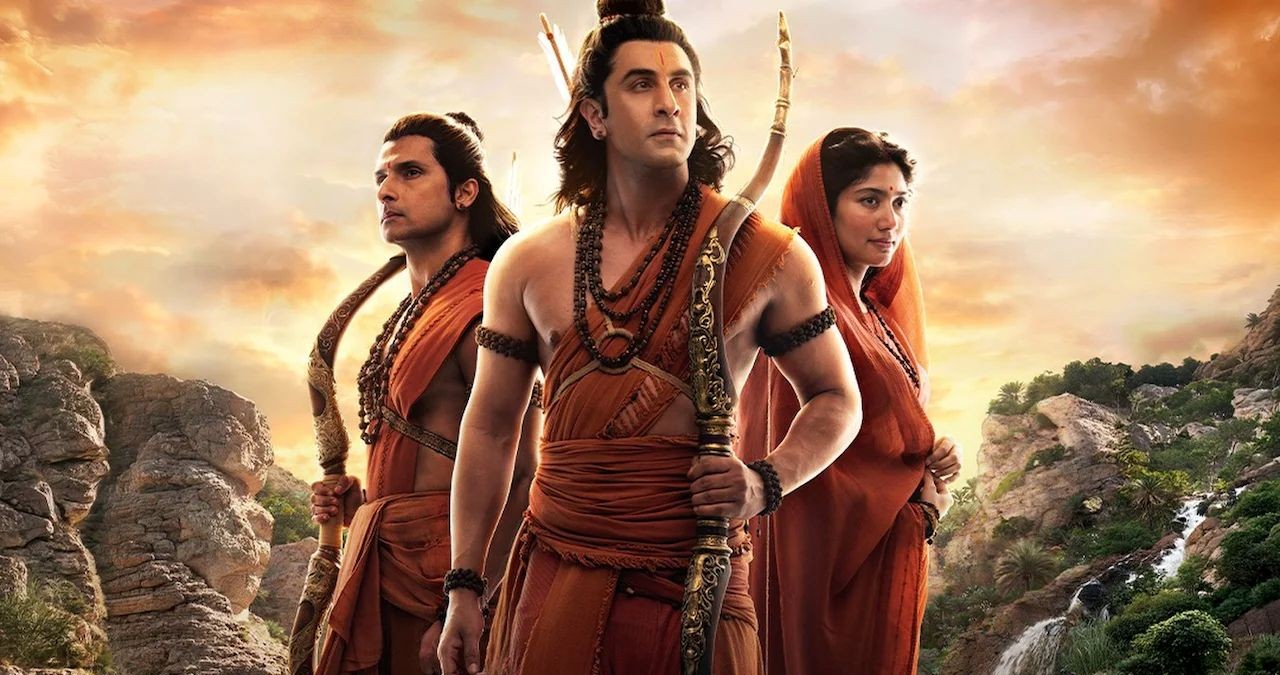
Ramayana: Rise of a Legend, directed by Nitesh Tiwari, is arguably the most ambitious cinematic undertaking in the history of Indian cinema. With an unprecedented budget, an international production and distribution network, and music by A.R. Rahman and Hans Zimmer, the makers have clearly set their sights beyond the Indian market. The first instalment, released in November 2026, is only the beginning; the second is expected around Deepavali 2028. The ambition is to give an Indian epic a global cinematic presence, perhaps even create a franchise comparable to the great entertainment universes of Hollywood.
Yet the Ramayana is no ordinary literary property waiting to be adapted. It is a living tradition, deeply embedded in the religious, cultural and emotional consciousness of millions. Valmiki’s Sanskrit epic, Tulsidas’s Ramcharitmanas, Kamban’s Tamil retelling and countless regional and folk versions have given it different expressions. It has travelled beyond India into the cultural traditions of Thailand, Indonesia and Cambodia. Its characters are therefore not strangers to be introduced to an audience; they arrive with inherited meanings, beliefs and expectations.
This makes the filmmaker’s task particularly demanding. Creative freedom is indispensable, but it cannot be entirely divorced from an understanding of the source. The question is not whether every adaptation must reproduce one prescribed version, but whether it preserves the essential moral and spiritual character of the epic.
The controversy surrounding Ravana illustrates this dilemma. His scholarship, devotion to Shiva, military prowess and formidable personality are part of the larger tradition. But these attributes cannot be considered in isolation from the arrogance, abduction of Sita and abuse of power that define his moral transgression. Mishra’s objection is more fundamental. He questions the film’s classification and characterisation of Ravana, arguing that presenting him as a morally respectable or essentially benevolent figure finds no justification in the scriptural tradition. His criticism of the suggestion that Ravana was not entirely bad, attributed to Sita in the film, is particularly pointed. Whether one agrees with every aspect of his interpretation or not, the underlying concern merits serious engagement.
There is a difference between making an antagonist compelling and making him morally equivalent to the protagonist. Indeed, the magnitude of Rama’s achievement derives partly from the formidable adversary he confronts. But the moral centre of the narrative cannot become blurred in the pursuit of dramatic effect.
The portrayal of Rama presents an equally difficult challenge. Revered as Maryada Purushottam, he represents righteousness, restraint and adherence to dharma, even when personal sacrifice is demanded. His greatness is not simply that he defeats Ravana, but that he confronts adversity without abandoning his moral obligations. Popular cinema often seeks heroes with visible imperfections, emotional conflicts and dramatic transformations. Rama’s moral composure may be less immediately amenable to such conventions. Yet the answer cannot be to diminish the ideal in order to make the hero more conventionally entertaining. The Ramayana offers abundant human drama through Dasharatha’s anguish, Bharata’s renunciation, Sita’s courage, Lakshmana’s loyalty and Hanuman’s devotion. The challenge is to bring these dimensions alive without losing their moral depth.
The debate is not confined to religious and scriptural criticism. Film critics, too, have questioned the balance of characterisation and the dominance of spectacle over storytelling. The Indian Express has drawn attention to Ravana’s more elaborately developed screen presence, while international reviews have differed in their assessment of the film’s visual achievement and narrative shortcomings. The Economist, in particular, has questioned whether the film’s emphasis on spectacle, at the expense of character development and storytelling, will enable it to travel successfully beyond India. The filmmakers, on the other hand, have defended their ambition to present a more expansive and internationally accessible interpretation.
The commercial dimension adds another layer to this debate. In a recent article in The Times of India, Neeraj Kaushal, Professor of Social Policy at Columbia University, argues that the overseas market for Indian films continues to depend substantially on the diaspora. For a film to become a genuine global commercial success, it must attract audiences in the West and China who have little or no cultural connection with India. This is a formidable challenge, even for a production of such scale. The Indian diaspora may provide an initial audience, but it cannot by itself sustain a global entertainment franchise.
There is nothing objectionable about this ambition. The Ramayana’s themes of duty, sacrifice, loyalty, the abuse of power and the conflict between good and evil have a universal resonance. But making the story accessible to the world should not mean making it conform to the expectations of Hollywood. Its cultural distinctiveness is not an impediment to its international appeal; it may well be its greatest asset.
Ultimately, the film must be judged on more than its box-office performance. Commercial success, cinematic accomplishment and cultural significance are three different measures, and they need not necessarily coincide. A spectacular production may attract millions without deepening their understanding of the epic. Conversely, a film that stimulates curiosity about the Ramayana, its characters and its moral universe may leave a cultural legacy extending well beyond its theatrical run.
It may be premature to pronounce a final verdict when the second instalment is yet to come. But one consideration should remain central. The Ramayana has survived not because one version has established an exclusive claim over it, but because successive generations and cultures have found new meanings in its characters and its moral universe. Its journey across centuries has been one of continuous renewal, without losing its essential identity.
The challenge before its newest cinematic interpreters is therefore not merely to take the Ramayana to the world, but to ensure that, in the process, the world encounters the Ramayana itself—not simply a spectacular production carrying its name. That would be a far more enduring achievement than any box-office record or cinematic franchise.
(Uday Kumar Varma is an IAS officer. Retired as Secretary, Ministry of Information & Broadcasting)