 Newsinc24 Team
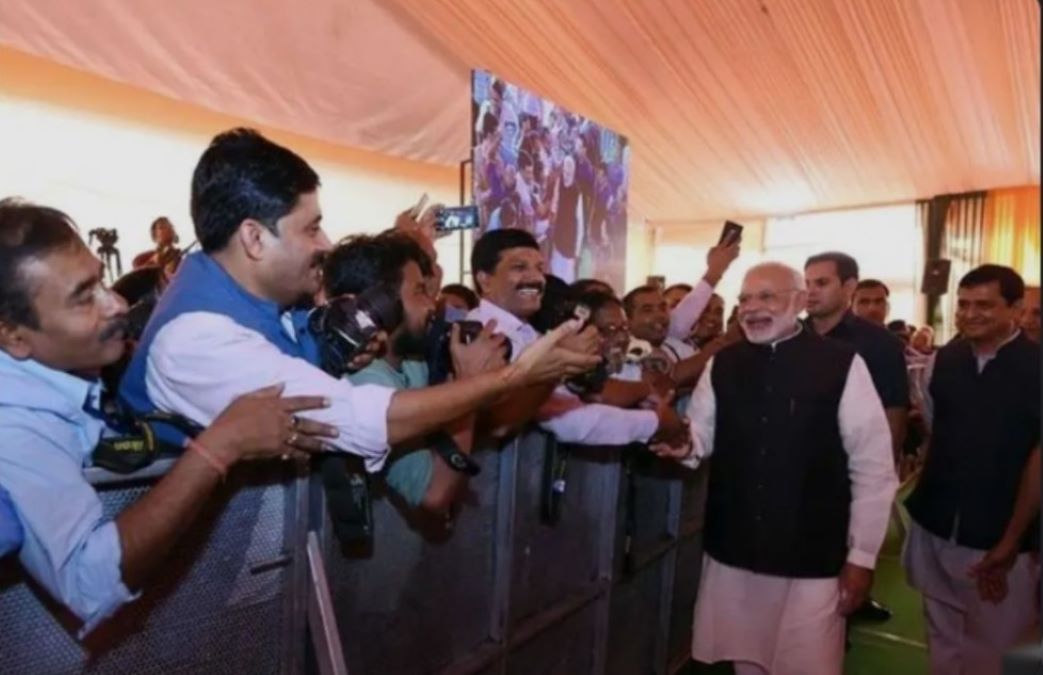
Prime Minister Narendra Modi on Thursday recalled his long association with the media fraternity, sharing anecdotes from his early days as a BJP functionary and highlighting the transformation in media and communication over the past 25 years while addressing journalists at the party headquarters’ Deepawali Milan Samaroh in New Delhi.
The event was hosted by BJP National President Nitin Nabin at the party’s central office in the national capital. Union Home Minister Amit Shah, Defence Minister Rajnath Singh and Union Minister for Health and Family Welfare JP Nadda were also present on the occasion.
#WATCH | BJP National President Nitin Nabin hosts Deepawali Milan in the presence of Prime Minister Narendra Modi at the BJP central office in New Delhi Union Home Minister Amit Shah, Defence Minister Rajnath Singh and Union Minister of Health and Family Welfare JP Nadda also present on the occasion (Source: DD)
— ANI (@ANI) November 12, 2026
Recalling his early interactions with journalists in the 1990s, Modi said he had shared a close relationship with the media long before becoming Chief Minister of Gujarat. He said that during his organisational responsibilities in the BJP, he would arrange chairs and welcome journalists at the party’s Diwali Milan gatherings.Highlighting the evolution of media communication, the Prime Minister said he had witnessed the transition from press releases and fax machines to Instagram reels and digital platforms. He recalled that during two major nationwide organisational tours in the early 1990s, finding a fax machine to send press releases was often a challenge.
Modi also shared an interesting anecdote from 2001, recalling how a group of journalists had suddenly arrived at his room at 11 Ashoka Road in Delhi and jokingly demanded sweets from him.He said the journalists told him to distribute sweets because he had been appointed Chief Minister of Gujarat, even before he himself had received the information. Recalling the incident, he said the journalists had already learnt about his elevation and came to congratulate him.
The Prime Minister further recalled that several journalists travelled to Gujarat at their own expense to attend his swearing-in ceremony in 2001, reflecting the personal bonds he shared with members of the media fraternity.Speaking about the changes witnessed over the past 25 years, Modi said the country, the world, politics and the media landscape had undergone significant transformations. While several aspects of news coverage had become easier, others had become more challenging.
Delhi: At the Deepawali Milan Samaroh at the BJP headquarters, Prime Minister Narendra Modi says, "When I took oath in 2001, many journalist friends came to the ceremony at their own expense and made their own arrangements. They came not for reporting, but out of affection and personal warmth. When I met them after the oath-taking ceremony, I asked, 'You could have told me. I would have made arrangements for you.' But they said, 'No, no, we just came on our own.'.." (Source: BJP)
— IANS (@ians_india) November 12, 2026
He pointed out that earlier, outside broadcast (OB) vans were essential for television news coverage, whereas mobile phones had now become OB vans in themselves. Drawing a comparison with the changing nature of public discourse, he remarked that while cricket experts were once found on every street corner discussing Sachin Tendulkar's game, political experts could now be found everywhere.
Modi also acknowledged the demanding nature of journalism, particularly during festivals, when media professionals often remain occupied with breaking news instead of spending time with their families.Expressing gratitude to the journalists for attending the gathering, he remarked that he was thankful they had taken time out for what he described as a "non-breaking news" event.
Delhi: At the Deepawali Milan Samaroh at the BJP headquarters, Prime Minister Narendra Modi says, "Another very important aspect of the news industry is deadlines. Your entire life revolves around deadlines. Whether it is the time to print a newspaper or broadcast a story, everything has a deadline. Without deadlines, everyone, from the desk to the field, would have the same attitude: 'There is still time, it will get done. We will manage it, as we have always done.'.." (Source: BJP)
— IANS (@ians_india) November 12, 2026
Reflecting on his own journey, the Prime Minister said his responsibilities had evolved over the years, much like those of a journalist who moves from reporting to becoming an editor. He added that the previous month marked 25 years of his tenure as the head of a government, referring to his journey since becoming Gujarat Chief Minister in October 2001.The interaction also provided an opportunity for the Prime Minister to revisit his longstanding association with journalists and acknowledge the changes in the relationship between political leaders and the media over the years.
Related Posts
Amish Shah vows to tackle Anti-India hate, roll back tariffs in US Cong
India's net direct tax collections rise 118 per cent
Moody's raises India's growth forecast to seven per cent