 Newsinc24 Team
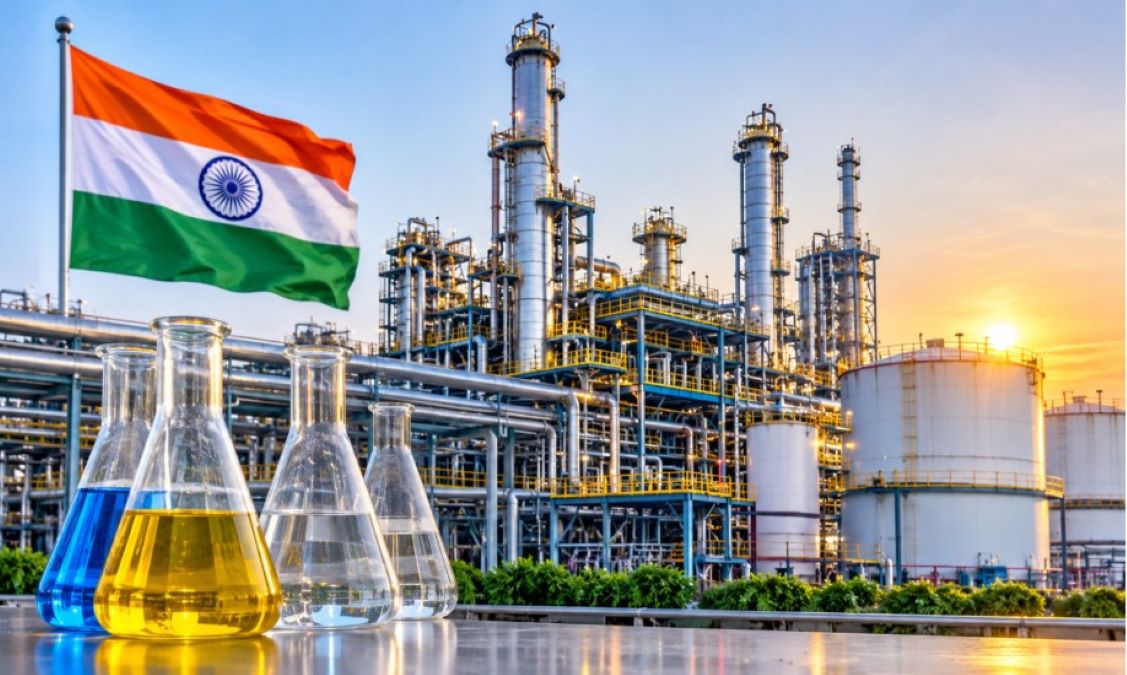
India’s chemicals and petrochemicals sector is witnessing significant expansion, driven by rising investments, manufacturing capacity, dedicated industrial parks and research initiatives, as the country seeks to strengthen its position in global markets.Valued at around $220 billion, the sector is projected to reach $300 billion by 2030 and $1 trillion by 2040. India is the world’s sixth-largest chemical producer and the fourth-largest in Asia. It is also the second-largest manufacturer and exporter of dyes and the third-largest exporter of agrochemicals, according to government agency.The industry comprises around 13,000 large-scale units and 4.45 lakh MSMEs, catering to key sectors such as pharmaceuticals, textiles, automobiles, construction and electronics.
Production of major chemicals and petrochemicals increased from 45.64 million tonnes in 2015-16 to 58.62 million tonnes in 2024-25. FDI inflows into the sector reached Rs 1.04 lakh crore during 2014-2026, more than double the Rs 45,240 crore recorded between 2004 and 2014. India allows 100 per cent FDI through the automatic route in most chemical sectors.Three Petroleum, Chemicals and Petrochemicals Investment Regions (PCPIRs) at Dahej in Gujarat, Visakhapatnam-Kakinada in Andhra Pradesh and Paradeep in Odisha have collectively attracted Rs 3.4 lakh crore in investments, generated 3.7 lakh jobs and facilitated over 2,200 manufacturing units.The BHAVYA Rasayan Scheme, approved in July 2026, aims to establish three dedicated chemical parks with a total outlay of Rs 3,030 crore. The parks will provide common infrastructure, waste management facilities and essential utilities to attract investments and strengthen domestic production.
The government is also promoting downstream manufacturing through the Plastic Parks Scheme. Ten parks have been approved, of which four have achieved complete infrastructure development.The Rs 1 lakh crore Research, Development and Innovation (RDI) Scheme, launched in November 2025, aims to encourage private-sector investment in advanced technologies. Advanced Chemicals, Petrochemicals and Material Technologies were added as eligible areas in October 2026.Meanwhile, the Central Institute of Petrochemicals Engineering and Technology (CIPET) has expanded its network to 51 centres and trained nearly 6.72 lakh professionals. Additionally, 18 Centres of Excellence have filed 85 patents, published over 600 research papers and developed 105 technologies and products.
The government is strengthening quality standards and industrial safety through regulatory measures. As of August 2026, 37 Quality Control Orders were in force to ensure compliance with prescribed product standards.A nationwide training programme under the Viksit Bharat\@2047 Action Plan aims to improve safety in 2,393 Major Accident Hazardous units. By August 2026, 21 programmes had covered 1,376 industrial units and trained 2,441 personnel.The 14th edition of India Chem 2026 was held in Mumbai from October 22 to 24 under the theme 'Advantage Bharat: An Emerging Global Chemicals Hub'. The event attracted over 5,000 visitors and brought together industry leaders through investment forums, CEO discussions and sector-specific roundtables.With manufacturing expansion, industrial infrastructure, research and investment gaining momentum, India is seeking to build a globally competitive chemicals and petrochemicals industry. These initiatives aim to strengthen domestic production, promote value addition and expand India's participation in global supply chains.


Related Posts
India surpasses US, Japan combined steel output, ranks 2nd globally
Brewing India's global rise heritage roots, premium coffees, expanding markets
Govt relaxes passport, visa norms for select foreigners residing in India