 Uday Kumar Varma
Deepa Shyam's first solo exhibition brings the Pardhan-Gond tradition into a fresh and compelling visual conversation.
I spent over an hour at Bikaner House in New Delhi recently, looking at the paintings in Garra, the first solo exhibition of Deepa Shyam. There was much to hold one's attention. The eye moved from one composition to another, following a profusion of colours, patterns and forms, sometimes pausing over a familiar motif, sometimes discovering unexpected relationships between elements that initially appeared quite disconnected. There was an exuberance to the paintings, a pleasing interplay of colours and a certain rhythm that made looking at them an engaging experience. One left with a lingering impression of colour, movement and feeling.
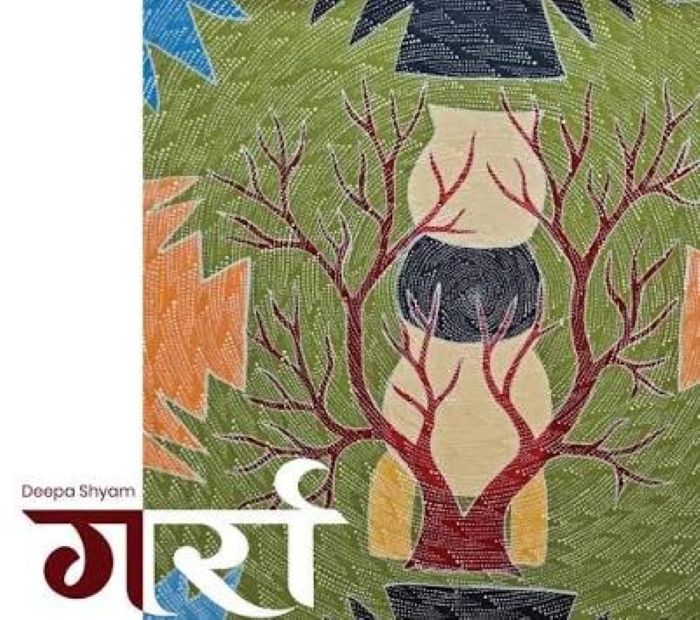
The title Garra is itself an invitation to enter this world. The word suggests a whirl, a powerful swirling movement that can occur in water or in the air. A whirlpool draws everything towards its centre; a whirlwind gathers and scatters things in its path. It can be fascinating, even beautiful, but it can also be destructive. The exhibition's English rendering, Circular Scatter, captures something of this paradox. The idea of the whirl seems to run through the collection, sometimes forming the dominant element in a painting, at other times remaining a less conspicuous presence in the movement and arrangement of its forms. It is as though the paintings are caught in a continuous process of gathering, dispersal and renewal.
Deepa is the wife of the celebrated Pardhan-Gond artist and Padma Shri awardee Bhajju Shyam. His formidable body of work has helped bring Gond painting to national and international attention. It would be natural to look for his influence in her paintings, and perhaps some of the shared visual vocabulary is inevitable. But Garra deserves to be approached in its own right. This is Deepa's first solo exhibition and, as I was informed, the first solo exhibition by a tribal woman painter at Bikaner House. It is an occasion worth recognising, not merely for the distinction it confers on the artist but also for the space it creates for a woman's independent artistic expression within a tradition that has acquired considerable contemporary recognition.
To appreciate her work, it helps to understand something of the Pardhan-Gond tradition. The Pardhans are a community within the larger Gond Adivasi community of central India, particularly Madhya Pradesh. Traditionally, they served as musicians, storytellers and custodians of community memory, preserving through song and oral narratives the stories of their people, their deities and their relationship with nature. Their visual traditions were equally embedded in everyday life. The floors and walls of their homes were decorated with digna and other designs, particularly during festivals and auspicious occasions. These were not paintings intended for galleries or collectors. They were expressions of faith, belonging and an intimate relationship with the world around them.
The visual language of Gond painting is distinctive. Trees, birds, animals and human figures are rendered in bright colours, their surfaces filled with intricate arrangements of dots, dashes, fine lines and repetitive patterns. The motifs are often drawn from nature, mythology and folklore. A tree is not simply a tree, nor an animal merely an object of representation. Forms carry stories and associations. Repetition creates rhythm, patterns lend movement, and colours give life. The resulting compositions often seem to inhabit a world where the boundaries between the natural and the spiritual, the animate and the inanimate, are less sharply drawn than in our everyday understanding.
An important chapter in the journey of this art into the contemporary world began at Bharat Bhavan in Bhopal, the multidisciplinary arts centre established by the Madhya Pradesh government. The celebrated modernist painter J. Swaminathan, entrusted with developing its art collection, took a keen interest in the visual traditions of indigenous communities. Influenced by the modernist search for abstraction and freedom from literal representation, he recognised in their art an imaginative power that went beyond the depiction of the visible world. It was here, in the early 1980s, that Jangarh Singh Shyam's extraordinary talent came to wider notice. His individual expression helped establish what came to be known as Jangarh Kalam, opening new possibilities for Pardhan-Gond painting.
Swaminathan was particularly struck by what he described as the 'colour geometry' of these compositions and their capacity to create an inner, almost meditative space. The transition from the mud walls and floors of village homes to paper and canvas did not necessarily mean abandoning the older visual language. Rather, it gave artists the opportunity to explore it in new ways. What had been an inherited community tradition began to acquire individual artistic identities and a place in contemporary Indian art.
Deepa's paintings seem to carry this inheritance with considerable ease. One of their most appealing features is the treatment of colour. There are hues traditionally associated with Gond painting, but the palette here is considerably more expansive. Colours mingle and merge, sometimes in unexpected combinations, producing a fusion that is both lively and harmonious. The effect is not merely decorative. It contributes to the movement within the compositions, drawing the eye across the canvas and giving the forms an animated presence. The familiar motifs of digna—doors, flags and animals, including deer—also find their way into these paintings. They remind us of the domestic and cultural world from which this art emerged, even as they acquire a fresh life in the artist's imagination.
There is something particularly satisfying about seeing a traditional art form remain alive through individual experimentation. Its vitality lies not in preserving every inherited convention unchanged, but in allowing artists to discover new possibilities within it. Deepa Shyam's Garra is an engaging instance of this continuing journey. She has drawn upon a rich visual inheritance, but has also brought to it her own imagination, her sensibility and a distinctive delight in colour and pattern.
One does not necessarily leave an exhibition such as this wanting to decode every motif or arrive at a critical judgement about each painting. Sometimes the pleasure lies simply in looking, allowing the eye and the imagination to wander. That is what Garra offered me: a sustained and rather delightful encounter with colour, movement and forms that gather, scatter and come together again. Like the whirl that gives the exhibition its name, the paintings continue to move in the mind even after one has left the gallery.
(Uday Kumar Varma is an IAS officer. Retired as Secretary, Ministry of Information & Broadcasting)



Related Posts
BJP to go solo in 2027 Punjab polls, says Amit Shah
Renowned filmmaker Shyam Benegal passes away at 90
PDP to contest Lok Sabha elections solo in J&K: Mehbooba Mufti