 Krishan Gopal Sharma
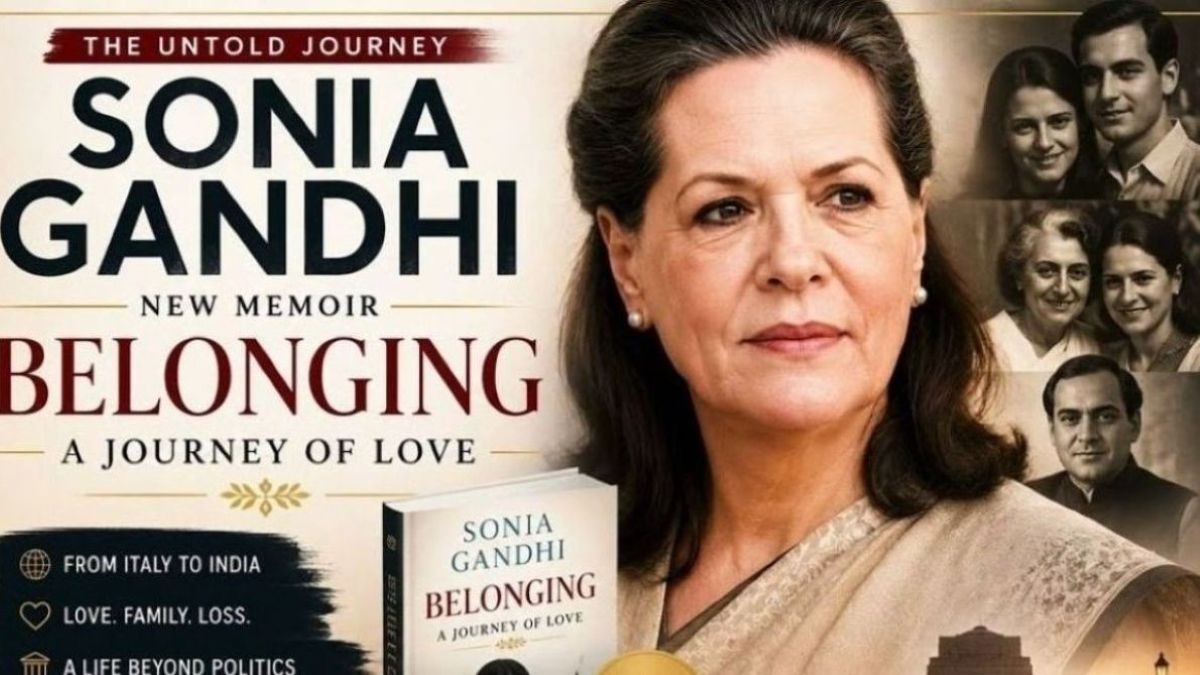
Belonging: A Journey of Love by Sonia Gandhi. New Delhi: HarperCollins India, 2026. 544 pp.
History books record the rise and fall of governments; memoirs often reveal what they leave behind: the private anxieties, losses and struggles of those who inhabit that history. For decades India has viewed Sonia Gandhi through the prism of political controversy and speculation. Belonging: A Journey of Love offers a chance to look past that familiar image. It is neither a comprehensive account of power nor a defence of a legacy, but a personal attempt to reclaim a woman whose private identity has long been overshadowed by her public role.
Some public lives are so intertwined with political history that the individual gradually disappears. Gandhi has lived much of her adult life in that predicament. Her foreign origins, her marriage into the Nehru-Gandhi family, her reluctance to enter politics, her leadership of the Congress and her refusal of the prime ministership in 2004 have been debated persistently, yet the woman behind them has remained guarded. This is not the political autobiography many readers expected. Political history enters it mostly through the doors of a family home, and its central concern is less how power was acquired than how a woman came to live within a history she had neither planned nor initially desired.
A memoir is not obliged to be a complete historical record; it is an account of how its author remembers and interprets a life. The reader, however, is entitled to ask what is remembered, how it is presented and what remains outside the frame. On that count, Belonging is both revealing and selective.
Sonia Gandhi begins far from the corridors of power: a childhood in post-war Italy, student years in Cambridge, and the meeting with Rajiv Gandhi. Their romance is presented not as the start of a political journey but as a personal choice that took her into an unfamiliar country and an extraordinary family.
Her entry into the Nehru-Gandhi household is among the book's most engaging parts. She had to negotiate unfamiliar customs, an imposing inheritance and a home where public affairs and private life were rarely separate. Indira Gandhi emerges not only as the formidable prime minister of political accounts but as a mother-in-law whose temper could unsettle those around her. These domestic recollections lend the narrative a welcome informality.
The emotional centre of the memoir, however, lies in its losses. Among the most affecting revelations is the couple's first child, a premature boy born in January 1969 who lived only a few hours. Gandhi recalls the brief joy, the shock and the grief that followed. Such memories have remained largely outside public knowledge. They matter not because they alter the chronology of events, but because they restore an ordinary human dimension to a family so often discussed as a political institution.
The recollections of fear are equally telling. After Operation Blue Star in 1984, the discovery of grenades at the family's residence offers a chilling glimpse of the insecurity in which they lived. The assassinations of Indira Gandhi in October 1984 and Rajiv Gandhi in May 1991 were not, in this account, isolated tragedies confined to official statements and funeral ceremonies. They were preceded and followed by apprehension, and by the knowledge that violence could enter the most private spaces. Political histories record dates and consequences for the state; a family remembers an absence.
The decision to decline the prime ministership in 2004 is naturally the most anticipated passage. It has been read variously as renunciation, calculation, or an attempt to exercise influence without holding the highest constitutional office. Gandhi offers a personal explanation. Under pressure from alliance leaders she briefly appeared to yield, uttering an almost inaudible theek hai. Rahul and Priyanka intervened, reminding her of the fate of their father and grandmother, and she returned to her original position and chose Manmohan Singh.
The episode illuminates the anxieties behind the decision, but it leaves a larger institutional question unanswered: how should we understand the relationship between the authority of the Congress president and the constitutional responsibility of the prime minister? The arrangement that emerged under Manmohan Singh cannot be judged solely by the personal circumstances of its creation. It also calls for scrutiny in terms of accountability and the functioning of parliamentary democracy.
Her treatment of the Emergency of 1975 shows the limits of family-centred recollection. She acknowledges it as a mistake and suggests that restraining Sanjay Gandhi might have prevented much of the damage. That admission is important, but the Emergency was not merely a difficult episode for one household. It was a serious assault on constitutional freedoms, institutions, opposition and individual rights, and its costs were borne by millions. Acknowledgement is welcome; historical responsibility demands a fuller reckoning.
The rupture with Maneka Gandhi is among the book's most uncomfortable sections. Sonia describes the deterioration of relations, Maneka's departure from the family home and the dispute over access to the young Varun, including her claim that she was accused of trying to kidnap him after delivering birthday gifts at his nursery school. This is plainly one side of a deeply personal dispute, and Maneka's perspective is not given equal space. Still, the bitterness preserved in the telling shows how family ties, political loyalties and public reputation became entangled.
The political chapters offer an insider's view of Congress leadership, coalition-building and the UPA governments, and Gandhi explains her confidence in Manmohan Singh by his grasp of governance and his credibility with allies. But readers expecting a searching retrospective on UPA-II will be disappointed. This is the memoir's most consequential limitation as a political account. The corruption controversies, ministerial rivalries, governance deficits and inflation that eroded public confidence receive little attention, though they shaped the environment in which the Congress suffered its historic defeat in 2014. The personal narrative is considerably more forthcoming than the political reckoning.
Gandhi's criticism of the RSS and the present establishment, including her remarks on the treatment of Rahul Gandhi and the changing character of political engagement, reflects her current concerns. Readers may agree or disagree, but whether political courtesy, institutional restraint and democratic conventions have weakened is worth considering apart from the partisan positions of those who raise it. The health of democratic institutions cannot be reduced to the fortunes of one party.
A question of identity runs through the book. Gandhi's foreign origins have repeatedly been invoked in Indian politics, sometimes in legitimate debate about leadership and national identity, but often as a tool of personal disparagement. Her account of finding a home in India gives the question an intimate context. Belonging is not simply a matter of birthplace or citizenship; it is also about relationships, shared experience, obligation and the passage of time. The title acquires its fullest meaning here.
The writing is restrained, intimate and unhurried, letting memory and emotion surface without embellishment. The prose is accessible and largely conversational, and its strength lies less in literary flourish than in the quiet weight of what is recalled.
One should resist both easy admiration and easy dismissal. To call the book mere image management overlooks the courage of revisiting private grief and making it public. To treat it as a definitive account of the history it touches would be equally misplaced. Emotional credibility and historical completeness are not the same thing. A memoir is a selective recollection of what its author finds meaningful; it need not answer every political question to justify its existence. We are free to question its silences, but should respect its purpose and read it as a personal journey rather than a political chronicle.
It does not settle the debate over Sonia Gandhi's legacy, and it does not try to. Its achievement is to remind us that behind political identities are human lives, and that living through history is not the same as shaping or controlling it. The public figure will remain a subject of debate. Belonging asks us to look beyond that debate, if only briefly, and encounter the private individual who has lived behind it.
(kgsharma1@gmail.com; The writer is a retired officer of the Indian Information Service and a former Editor-in-Charge of India's national broadcasters. He has also worked as an international media consultant with UNICEF Nigeria and contributes regularly to various publications.)


Related Posts
Shiv Sena protest against Sonia's book over remark on Savarkar
Odisha cabinet gives nod to Rs 4,708-crore power project
Gujarat CM inaugurates Ahmedabad International Book Festival 2026