 Uday Kumar Varma
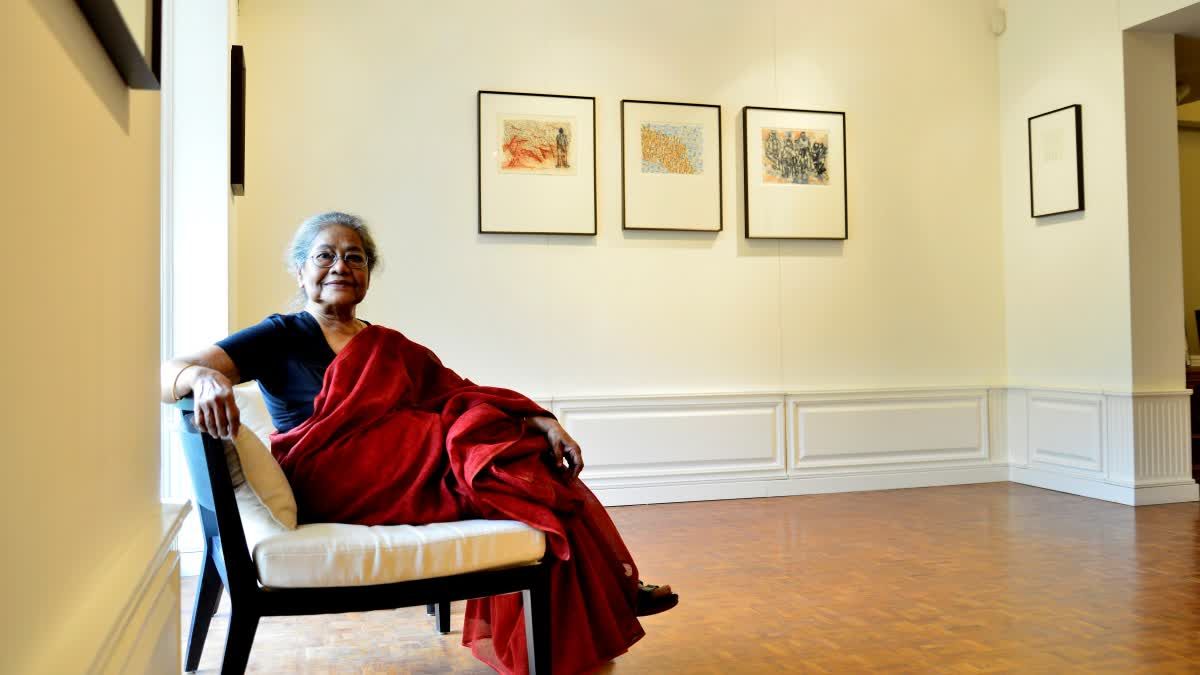
Arpita Singh, one of India's most eminent and celebrated women artists, passed away on Wednesday at the age of 89. A recipient of the Padma Bhushan and a Fellow of the Lalit Kala Akademi, she leaves behind a body of work that is as distinctive as it is intriguing. Her paintings fetched extraordinary prices, earned international recognition and found admirers across generations. Yet, to understand Arpita Singh, one must look beyond the accolades and auction records. For she was an artist who created a world of her own, drawing upon the experiences of life, its uncertainties, its absurdities and its quiet moments of tenderness.
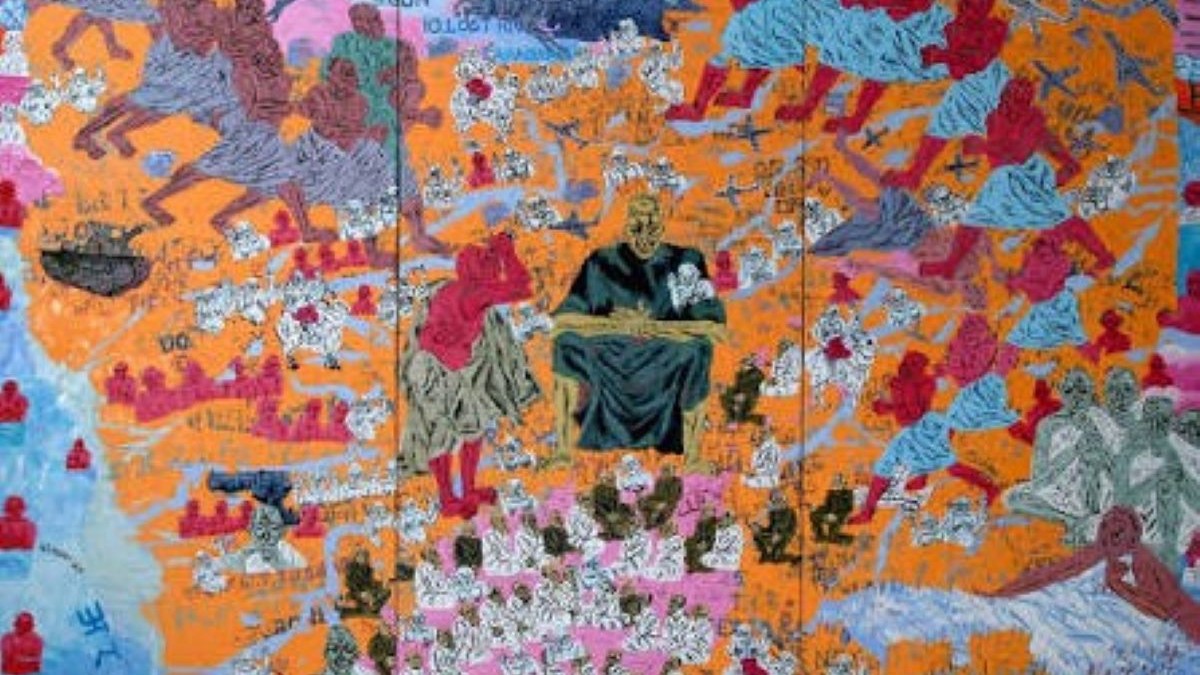
Her canvases were seldom conventional. They were populated by people, animals, flowers, household objects, fragments of maps, handwritten words and images that seemed to have arrived from different worlds. At first sight, they could appear crowded, even bewildering. But look a little longer and one begins to sense an underlying narrative. There were stories within stories, though the artist did not always feel obliged to tell them in a linear fashion. Her paintings were at once intimate and expansive, playful and unsettling.
Born in Bengal in 1937, Arpita moved to Delhi with her family before Independence. Her father died when she was young. She studied at the School of Art, Delhi Polytechnic, completing her diploma in fine arts in 1959. It was there that she met Paramjit Singh, also an artist, whom she married in 1962. Their life together was rooted in art, and their daughter Anjum Singh would herself grow into an accomplished painter.
Her early professional years were spent at the Government of India's Weavers' Service Centre, where she worked with traditional artists and craftspeople. The experience left its mark. The patterns of embroidery, the rhythms of textiles and the visual vocabulary of Indian folk traditions found their way, in transformed forms, into her paintings. It is interesting that an artist trained in modern art should have drawn so much inspiration from the creativity of ordinary craftspeople.
 Her artistic evolution was not, however, a straightforward journey. At one point, dissatisfied with her own work, she withdrew from figurative painting and spent nearly six years practising little more than dots and lines. It was an exercise in discipline and self-discovery, an attempt to return to the very elements of drawing. This period of apparent withdrawal eventually helped her discover the freedom and fluidity that became characteristic of her art.
By the 1980s, her paintings had acquired a distinctive visual language. Women, in particular, became recurring presences. They appeared in domestic settings and public spaces, sometimes as ordinary individuals and sometimes in unexpected, almost mythical forms. They were not idealised figures. They embodied the anxieties, vulnerabilities, resilience and contradictions of women as she encountered them in everyday life. Singh once observed that she painted real women, not the glamorous women of films and television.
What made her work particularly fascinating was her ability to bring together apparently unrelated images. A flower might appear beside an aeroplane; a household object might share space with a military figure; a map or a handwritten word might suddenly acquire an unsettling significance. Her canvases resembled a carnival of images, arranged in ways that were playful but often subversive. There was no prescribed route through these compositions. Each viewer could discover a different story, or perhaps several, within the same painting.
Her work reflected an engagement with the world around her: political violence, the vulnerability of ordinary people, the changing place of women and the uncertainties of everyday existence. Yet she rarely resorted to direct commentary. Her paintings did not instruct the viewer what to think. They allowed the personal and the political, the familiar and the fantastic, to coexist. One might describe her artistic approach as an expedition without a predetermined destination.
There was, inevitably, a personal dimension to this journey. Her husband, Paramjit Singh, remained her lifelong companion in art and life. Their daughter Anjum's death from cancer in 2020, at the age of 53, was a devastating loss. Arpita Singh continued to work thereafter, retaining her curiosity and engagement with the world. It would be tempting to read personal grief into her paintings, but her art was too expansive to be explained by any single experience.
Recognition came in India and abroad. In 2010, her sixteen-panel work Wish Dream (2000–01) fetched approximately Rs 9.56 crore at a Saffronart auction, then a record price for an Indian woman artist. Her work subsequently travelled to important international exhibitions, including a major presentation at London's Serpentine Gallery in 2025. But the auction record, impressive as it was, tells only a small part of her story. Her real achievement lay in creating an artistic vocabulary that was unmistakably her own.
What is perhaps most admirable is that recognition never seemed to diminish her willingness to explore. She continued to paint and experiment well into her eighties. She did not appear particularly interested in explaining every image or providing definitive interpretations of her work. There is a statement attributed to her which perhaps offers the best insight into this approach: "There should be a difference between what the viewer sees and what the artist paints." It is a simple observation, but one that reveals much about her understanding of art. A painting, in her view, need not be confined to what its creator intended. It must leave room for the viewer's imagination, memories and individual sensibilities. Perhaps that is why her canvases retain so much mystery.
And that is what makes her passing so poignant. The world she created does not offer easy answers, nor does it ask to be understood at once. It invites us to return, to look again, and to discover something we may have missed the first time. Her figures, colours and curious juxtapositions will continue to inhabit our imagination, long after the artist herself has departed.
In the end, Arpita Singh leaves us with something more enduring than acclaim or auction records: the memory of an artist who looked at the world without conventional boundaries and painted it with an imagination entirely her own. We may never fully decipher all that she put on her canvases. Perhaps we need not. For, in the space between what she painted and what we see lies the enduring magic of her art. Some artists leave behind paintings; a few leave behind entire worlds. Arpita Singh has left us one such world.
(Uday Kumar Varma is an IAS officer. Retired as Secretary, Ministry of Information & Broadcasting)

Related Posts
Deepawali celebrated across world, global leaders extend wishes
Rajnath Singh celebrates Diwali with army personnel in Sikkim
Defence Minister Rajnath Singh meets IAF personnel at Bagdogra