 Newsinc24 Team
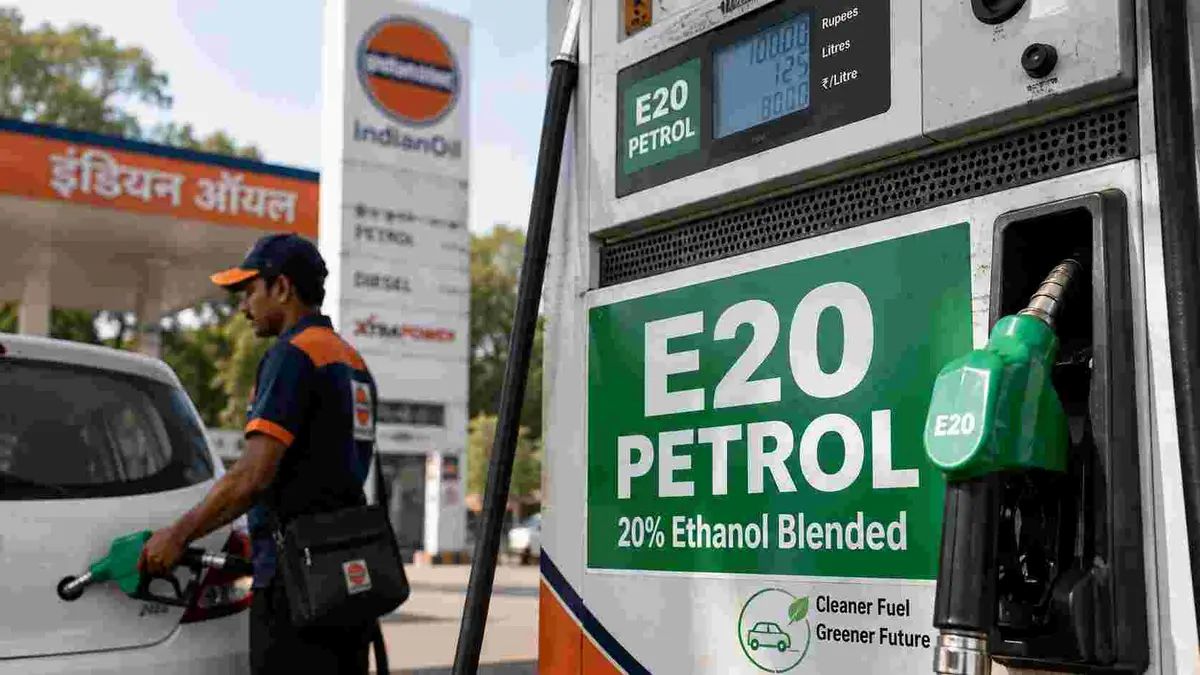
The three public sector Oil Marketing Companies – Indian Oil Corporation Limited, Bharat Petroleum Corporation Limited and Hindustan Petroleum Corporation Limited – have clarified that the E20 petrol supplied by them across the country complies with the Bureau of Indian Standards specifications for ethanol-blended motor gasoline. The clarification follows a press release issued by the Karnataka Government’s Department of Food, Civil Supplies, Consumer Affairs and Legal Metrology, which claimed that petrol sold at certain retail outlets in the state contained between 26 and 31 per cent ethanol.
The Oil Marketing Companies said that tests conducted on 893 samples collected from 27 States and Union Territories, including 56 samples from Karnataka, found that all the samples met the prescribed specifications.All samples were found to contain ethanol within the prescribed range of 19–21 percent. Of these, 56 samples collected from different locations in Karnataka and covering all three OMCs recorded ethanol content between 19 percent and 20 percent, with an average of 19.30 percent.
The companies raised concerns over the October sampling exercise, stating that samples were reportedly collected without the participation of OMC representatives. They said they had not received the corresponding retention samples, complete outlet-wise details or laboratory reports despite seeking these through the State Level Coordinator. The procedure also requires jointly signed sample labels and communication of test results within the prescribed timeframe.
The OMCs further questioned the technical methodology cited in the laboratory certificates accompanying the Karnataka government's findings. They said the certificates referred to ethanol percentage measured through Gas Chromatography but did not specify the applicable standard test method, prescribed dilution procedure or reference material used for correction.
The companies said the absence of essential technical details made it difficult to independently validate the reported ethanol levels of 26–31 percent. The OMCs also flagged discrepancies in the reported density readings, which ranged from 0.742 to 0.749 g/cc. This was lower than the 0.752–0.760 g/cc recorded in their E20 samples tested under the QCC-1 and QCC-2 surveys.
Addressing concerns over vehicle performance and consumer costs, the companies said more than 30 crore two-wheelers and four crore four-wheelers have been running on E20 fuel for over three years. They said there had been no widespread reports of vehicle breakdowns attributable to E20 fuel quality.
Seeking resolution of the issue, IOCL, BPCL and HPCL have requested the Karnataka government to share complete sampling documentation, outlet-wise laboratory reports and details of the testing methodology. They have also sought access to counterpart samples for independent testing at an authorised laboratory using the prescribed referee method in the presence of state government and OMC representatives. The three companies said they were willing to participate in joint sampling and testing in accordance with the applicable regulations and guidelines, adding that any deviation established through the prescribed procedure would be dealt with accordingly.
Related Posts
NDA wins 3 Karnataka MLC seats, leads on 4th
Karnataka ministers stopped at Mysuru Dasara venue, CM orders probe
Karnataka HC strikes down enhanced SC & ST quota provisions