 Ira Singh
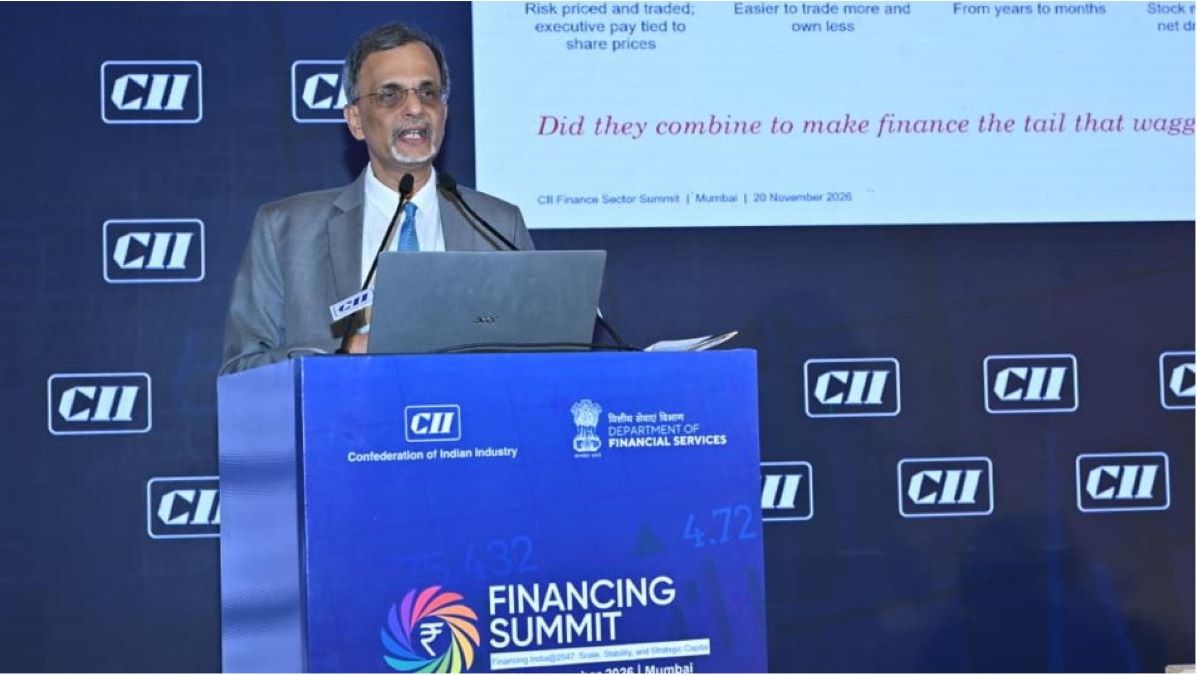
Chief Economic Adviser (CEA) V. Anantha Nageswaran on Friday said India’s capital markets must “serve” the real economy rather than “rule” it, stressing that excessive financialisation and technology-driven speculation could divert markets from their primary purpose of channelling household savings into productive investments.
Addressing the Confederation of Indian Industry’s (CII) Financing Summit in Mumbai, themed Capital Markets 2.0: Technology, Innovation, and Global Competitivenes, Nageswaran stressed the need for financial markets to support businesses that manufacture goods, develop infrastructure and generate employment.He urged that excessive financialisation at an early stage of economic development could undermine India's long-term growth ambitions. “Too much finance, too early in the development cycle, will pull that ladder back,” he said.
Highlighting the structure of India's financial markets, the CEA noted that equity market capitalisation stood at around 130 per cent of GDP, while the corporate bond market accounted for approximately 16 per cent.“What we have not yet built is a financial system designed to finance the making of real things over 20-25 years,” he said.
Nageswaran emphasised that capital markets should provide long-term funding for sectors such as agriculture, manufacturing and infrastructure. He said a financial system focused primarily on asset-light businesses and quick returns would fail to adequately support investments in cold chains, warehouses and food processing facilities in rural India, as well as small manufacturers in Tiruppur and Ludhiana.The CEA also expressed concern over speculative trading in India's equity derivatives market, which is among the world's largest in terms of the number of contracts traded.
Citing Securities and Exchange Board of India (SEBI) studies, he said around 93 per cent of individual equity derivatives traders incurred losses during the three years up to March 2024, with their combined losses reaching Rs 1.8 lakh crore.He further noted that more than three-quarters of individual traders had declared annual incomes below Rs 5 lakh in 2023-24. Additionally, over 75 per cent of traders who suffered losses for two consecutive years continued trading in the third year.
“Derivatives were invented to move risk from those who cannot bear it to those who can. In our market, a good deal of it has moved from those who understand it to those who do not understand it,” Nageswaran said.Questioning whether technological advancements had strengthened the fundamental purpose of capital markets, he acknowledged improvements such as next-day settlement, easier access to public issues and reduced intermediary fraud.
However, he raised concerns that technology had also made speculative trading easier for retail investors, taking markets further away from their core function.“My own answer, unfortunately, is that on balance, technology has taken markets further away from their core function. They have become faster and safer in their mechanics while drifting away from their purpose,” he said.Calling for a broader assessment of capital market performance, Nageswaran suggested that success should be measured by the ability to mobilise long-term investments rather than trading turnover.He also called for greater participation by pension funds, insurance companies and provident funds in financing long-gestation projects across agriculture, manufacturing and infrastructure.
Further, he urged brokers and distributors to strengthen product suitability checks, disclose trading outcomes and take greater responsibility for financial products promoted through social media.“Will finance once again serve the real economy, or will it continue to rule the real economy?” Nageswaran asked, adding that the answer would determine the stability of India's financial markets and the sustainability of its economic growth.
(Business Correspondent)


Related Posts
India’s infrastructure output rises 10.9% in October on strong demand
Trump urges Fed to cut rates, praises India's low interest rates
India, UAE to expand cooperation in education, skills & research